Which problem are you solving?
There are only three real reasons to look past a wood stove, and they lead to different products.
“I do not want to handle cordwood.” Splitting, stacking, seasoning and carrying is the part most people quit over, and it is the part a pellet stove removes completely: bagged fuel, poured into a hopper, fed automatically. A pellet stove is the direct answer and it is why it is the top pick here.
“I do not have a chimney, or cannot build one.” This is the expensive constraint. A wood stove needs Class A insulated chimney pipe to the roof line, and on a house without one that install is frequently more than the stove. A pellet stove vents through a small horizontal wall pipe instead. An electric panel vents nothing at all. A kerosene convection heater is unvented, which is why ventilation becomes your responsibility instead.
“I want to reload less often.” Coal, and a hopper feed. Anthracite burns longer per load than cordwood, and an automatic circulator is built for overnight. Our wood stove vs coal stove comparison covers the fuel properly.
What each alternative actually costs you
A pellet stove needs electricity.The auger, the combustion blower and the controller all run on mains power, so a power cut stops the heat — which is precisely the scenario many people buy a wood stove for. If outage resilience is the point, a pellet stove is the wrong answer and a plain cordwood stove is the right one.
A pellet insert needs an existing fireplace. The ComfortBilt HP22i publishes 2,800 square feet and a 47 lb hopper and is designed to slide into a masonry opening, which makes it the best option on this page for a house that already has a fireplace doing nothing. It is also the most expensive thing here by a wide margin. Wood stove vs fireplace insert compares the formats.
A hardwired electric panel needs 240 V.The Dr. Infrared DR-975 publishes 7,500 W on 240 V with a remote. Nothing burns, nothing vents, there is no fuel to store and no chimney to sweep — and the running cost is whatever your utility charges, which in most of the US is more per unit of heat than wood, pellets or coal. It is the honest answer for a garage, a shop or an addition rather than for a whole house, and it is a wiring job. Best electric garage heaters covers the install.
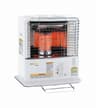
A kerosene heater needs ventilation and attention. It is unvented by design, which is what makes it cheap and portable, and it means the combustion products go into the room with you. The CPSC records more than 200 accidental non-fire carbon monoxide deaths a year in the US associated with consumer products and recommends CO alarms on every level of a home and outside sleeping areas. Crack a window, fit an alarm, and do not run one in a closed bedroom. Propane vs kerosene compares the two unvented fuels.
How we ranked these five
- Does it replace stove heat, or just make heat? A pellet stove and a coal circulator are stove-shaped appliances that heat a room by radiation and convection. An electric panel and a kerosene heater make heat without replacing the object, and they rank accordingly.
- What it needs that a wood stove does not. Mains power, a 240 V circuit, an existing fireplace, a local coal supplier, an open window.
- Published output, in the maker’s own units. BTU, watts or heated square feet, exactly as each listing states it, with Not published where a listing is silent.
- Install reality.Two of these are appliances a professional connects. One is an electrician’s job. One you take out of the box and fill.
- Price last. The cheapest option here is the budget pick, not the winner.
No cost-per-hour or cost-per-season figure appears anywhere on this page. Running cost depends on local pellet, coal, kerosene and electricity prices, which vary by region and by month, and we will not publish a number we cannot source. The shape of the answer is stable and worth stating: wood is cheapest if you cut it, pellets and coal are predictable and bagged, and electricity is the most expensive per unit of heat in most of the country. How we pick sets out what we do instead.
When the alternative is the wrong idea
You want heat in a power cut. Only a cordwood stove and a non-electric design do that. Everything with an auger, a blower or a controller stops when the lights go out.
You have free or cheap wood.If you have a woodlot, a saw and somewhere to stack, nothing on this page competes with a cordwood stove on running cost — the whole argument for these alternatives is convenience, and convenience is what you are paying for. Best wood burning stoves is the page to read instead.
Your real problem is the install cost.Then compare total installed cost rather than appliance price: Class A chimney pipe, a hearth pad, clearances, a permit and a professional connection can approach the cost of the stove itself, and that arithmetic is what makes a pellet stove’s small wall vent so persuasive. Best wood stoves under $2,000 works through the install side.
Four households, four answers
- No chimney, mains power, wants a visible fire. The small pellet stove.
- Has a chimney, hates getting up to reload. The coal circulator.
- Has an unused masonry fireplace. The pellet insert.
- Needs heat in a garage or shop, nothing burning.The 240 V electric panel — or the kerosene heater if there is no circuit to spare and the space ventilates.