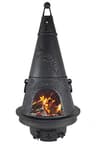
Buy metal unless you specifically want what clay does. Metal heats in minutes, takes a bigger fire, survives a knock and will never crack from a temperature shock. Clay gives softer radiant heat that outlasts the flames and looks the way a chiminea is supposed to look — and it asks you to cure it, raise it, cover it and never let cold water touch it hot.
The decision is really about how the two fail. Metal rusts: slowly, visibly, from the inside out, over years, and a cover plus emptying the ash pushes that a long way out. Clay cracks: suddenly, permanently, usually from one mistake, and often in the first fortnight. Neither is a bad product. One forgives, the other does not.
The comparison, point by point
| | Clay | Metal (steel / cast iron) | Cast aluminum |
|---|
| Time to useful heat | Slow — the mass has to warm | Fast | Fast |
| Heat character | Gentle, holds after the fire dies | Harder while burning, stops with the fire | As steel |
| Fire size it tolerates | Small only | Moderate to large | Moderate to large |
| Main failure mode | Cracking from thermal shock | Rust, inside first | Essentially none |
| Needs curing | Yes — non-negotiable | No | No |
| Sand or lava rock base | Required | Recommended | Recommended |
| Rain while hot | Can crack it | Harmless | Harmless |
| Freeze risk | Real — absorbed water splits it | Low | None |
| Weight and moving it | Heavy and brittle — two people | Manageable | Lightest of the three |
| Winter storage | Indoors ideally | Outdoors, covered | Outdoors |
| Typical price band | Budget | Budget to mid | Premium |
| Realistic lifespan | Years if treated well; one night if not | Several seasons, longer with care | Decades |
What clay is actually good at
Thermal mass. A clay wall takes a while to warm up and then keeps radiating after the fire has burnt down to coals, which produces a softer, more even warmth than thin steel does. People who prefer clay are describing this, and they are right about it. The traditional Mexican form also simply looks the part in a way painted steel does not, and clay costs less than cast aluminum.
The conditions attached are real, though, and all four matter:
- Cure it. Two to three inches of sand, gravel or lava rock in the base, then three or four progressively larger small fires with full cooling between them. This drives moisture out of the clay gradually.
- Keep wood off the bare floor.The base layer is permanent, not a curing step — burning directly on clay is a reliable way to crack the floor out.
- Small fires only. A clay chiminea is not a fire pit with a chimney. Flames licking out of the top are too much fire for the material.
- Cover it, and keep it off the ground. Water absorbed into clay is what freezing splits apart, and standing water at the base is the usual route in. A rain lid over the flue matters as much as a body cover.
What metal is actually good at
Tolerance. You can light a big fire in a cold steel chiminea on a damp evening, get rained on, knock it with a chair, forget to cover it, and it will still be there next spring looking slightly worse. For a patio that gets real use and occasional carelessness, that is worth more than clay’s heat quality.
It also heats fast, which changes how you use it: a steel chiminea is worth lighting for an hour, where a clay one is only just warming up by then. And metal units commonly ship with a cover, a poker or a built-in log rack, which clay rarely does.
The rust management is straightforward: empty the ash rather than letting it sit, because ash holds moisture against the steel; keep a cover on it; and accept that the inside of the firebox will discolour and scale. If none of that appeals, cast aluminum sidesteps it entirely for more money — that is the entire case for the premium pick above.
Which to buy, by situation
A deck or a small courtyard:metal. It is lighter, it will not shatter if it is knocked, and a smaller fire still produces heat quickly. The deck rules are the same as for any fire — see can you put a fire pit on a deck — and best small chimineas covers the compact units.
A freezing climate: metal, or cast aluminum. Clay in a hard-freeze region needs indoor winter storage to be a sensible purchase.
A sheltered patio, a mild climate, and patience: clay is a genuinely nice object and the heat is better than metal at the same price. Cure it properly and keep the lid on.
Buy once, never replace: cast aluminum. It does not rust, it does not crack, it is the lightest of the three and it is the most expensive by some margin.
Smoke is the actual problem you are solving:either material works, because the chimney is doing that job, not the wall. But dry wood matters far more than material — an enclosed firebox burning 30 percent wood smokes badly and coats the flue. Seasoning is the fix, and how to make a fire pit less smoky covers the rest.
Running either one well
Both want the same things: a base layer of sand or lava rock, small dry hardwood splits rather than long logs, a stand so the body is off the paving, and the ash out before it sits through a wet week. The EPA’s target of under 20 percent moisture content applies here more strictly than it does to an open pit, because an enclosed firebox with a flue is where creosote actually accumulates.
Siting follows the same published guidance as any outdoor fire: clear at least a 10-foot diameter around it, stay at least 15 feet from vegetation and low-hanging branches, and keep vertical clearance at least three times the flame height — which, for a chiminea, means nothing overhanging the flue. The EPA’s never-burn list applies too: no coated, painted or pressure-treated wood, no plywood or particle board, no driftwood, no trash.
If you have not settled the shape question yet — enclosed chimney against open bowl — start with chiminea vs fire pit, then come back here to choose the material.