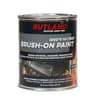
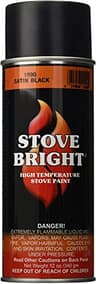
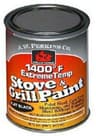
The five paints, side by side
Only what the listings publish. Where a maker is silent on finish, dry time or volume, the table says so.
| | Rating | Application | Volume | Color and finish |
|---|
| Rutland 1200 brush-on | 1,200°F | Brush | 16 fl oz | Black, flat |
| Rutland 81V | 1,400°F | Brush | 16 fl oz | Black, finish not published |
| AW Perkins | 1,400°F | Brush | 1 pint | Black, finish not published |
| Stove Bright satin black | 1,200°F | Aerosol | Not published | Satin black |
| Stove Bright New Bronze | 1,200°F | Aerosol | 12 oz | Bronze, rust resistant |
Note that the two 1400 degree options are both brush-on and both cost more than the 1200 degree brush-on. There is no cheap route to the higher rating, and for a stove body there is no need for one.
Brush or spray: the actual decision
It is not about finish quality. It is about whether the stove is in the room or out on a drop sheet.
Brush, if the stove stays installed. This is most repaints. The stove is connected to a flue, it weighs a great deal, and disconnecting it to spray is a bigger job than the painting. A brush lets you work around the glass, the rope gasket, the air controls and the handle without masking any of them, and lets you do one faded panel rather than the whole appliance. Expect brush marks if you flood it; thin coats, well worked out, do not show.
Spray, if it is coming out.New stove being refinished before install, a stove you are stripping back completely, a length of pipe, a fire screen, a set of legs. An aerosol gets into places a brush cannot and leaves no texture. Mask the glass and gasket properly — paint on a door gasket is a real problem, because the gasket has to compress and seal.
One thing neither type does: paint a stove’s glass, or paint over a gasket, or coat the inside of a firebox. Firebox interiors see direct flame and are refractory or cast surfaces that are meant to be bare.
How to do it so it lasts
- Cold stove, every time.Not warm, not “cooled down since this morning.” Properly cold.
- Wire-brush back to bare metal. A cup brush in a drill for the big flat areas, a hand brush for the castings, then a scraper on anything flaking. This is 80 percent of the work and 100 percent of whether it lasts. Loose rust under fresh paint lifts the paint with it inside a season.
- Vacuum, then degrease, then let it dry. Brush dust sitting on the surface becomes texture in the finish. Any oil, polish or wax residue stops the paint keying.
- Mask what must not be painted. Door glass, rope gaskets, the air control slides, the name plate if you want to keep it legible, and the hearth pad underneath. With a brush that is a few minutes; with a spray it is most of the setup.
- Two thin coats beat one thick one. High-temperature coatings are thin by design. Flooding a corner gives you a run that will never fully cure.
- Cure it with fire, outside or with the windows open. This is the step people are not told about. High-temp stove paint air-dries but only fully cures when it is heated, and the first one or two fires after painting will smell strongly and may smoke a little as the binders burn off. Follow the can’s own instructions, ventilate the room properly, and plan the first cure fire for a day you can have windows open rather than the first cold snap.
Paint, polish and cement are three different products
People searching for stove paint often want one of the other two, so it is worth separating them.
Stove paint is a high-temperature coating for the exterior of the body, the pipe and the legs. That is what this page ranks. Stove polishis a wax or paste buffed onto cast iron for a satin sheen — it is a maintenance product, not a refinish, and it will not cover rust. Stove cement and gasket cement are for sealing joints and bedding door rope, and no amount of paint substitutes for either.
If the reason you are painting is that the stove is rusting through rather than looking tired, paint is the wrong answer entirely. A firebox with rust holes, a cracked casting or a warped door is a safety question, not a cosmetic one. Our safest wood stoves page covers what to check, and best budget wood stoves covers what replacing it actually costs.
Matching an older bronze stove
A lot of 1980s and 1990s stoves and inserts left the factory in brown or bronze enamel, and touching those up in black makes the repair obvious rather than invisible. The Stove Bright New Bronze is the reason that problem is solvable, and its listing states rust resistance alongside the 1200 degree rating.
Set your expectations about shade, though. “Bronze” is not a standard, and a 30-year-old factory finish has faded. Spray the back panel or an area behind the stove first, let it cure, and look at it in daylight before you commit to the front. If it is close but not exact, repainting the whole visible surface in the new bronze looks far better than a patch that nearly matches.
Last practical note: paint is also the cheapest way to make a second-hand stove presentable, and a refinished older stove with a sound firebox is one of the better value buys in wood heat. Pair it with a correct sizing check and an honest look at the flue, and put the money you saved into dry wood and a stove fan.