Coal & Char

Propane vs Kerosene Heater

Propane is cleaner, instant and portable. Kerosene runs far longer per fill and stores better. The deciding question is how many hours you need, not which fuel is better.

By Stephen V.Last updated How we pick

How this is funded:we earn a commission if you buy through our links, at no extra cost to you. It never changes which pit or heater we recommend, and we’ll tell you when we’d skip one. Full disclosure.

Buy propane if you want heat in thirty seconds, in a space you can ventilate, for a few hours at a time. Buy kerosene if you need a full day of heat per fill, or heat that works when the power is out. That is the whole decision. Both are unvented combustion appliances, both need fresh air and carbon monoxide alarms, and neither is safe to run while you sleep — so the comparison is about convenience and run time, not about one fuel being fundamentally better.

What propane genuinely wins on is cleanliness and simplicity. Press the igniter and it lights. There is no wick to trim, no soot, no fuel odor at start-up, and the fuel keeps indefinitely in a sealed cylinder — so a propane heater bought for emergencies will work in three years without anyone having maintained it. Cylinders are available at any hardware store, and the small radiant units are genuinely portable.

What kerosene genuinely wins on is hours per fill, and output per dollar spent on the appliance. A convection kerosene heater’s filled tank runs for most of a day, and the Dyna-Glo here publishes 23,800 BTU and a 1,000 square foot capacity for less than many propane units of half that output. For an ice-fishing shack, a workshop, a greenhouse in a cold snap or a house with no power, that combination is hard to beat.

The comparison, point by point

 PropaneKerosene
LightingInstant, push-button igniterWick needs a minute to establish
Hours per fillA few on a 1 lb cylinder; long on a 20 lb tankMost of a day on a filled tank
OdorEssentially noneYes, at start-up and shut-down
Fuel storage lifeIndefinite, sealed cylinderDegrades; buy fresh each season
Where fuel is storedOutdoors, upright, never indoorsSealed can, cool and out of sun
RefuelingSwap a cylinder, outdoorsPour by hand, outdoors, heater cold
MaintenanceNone beyond hose and connection checksWick trimming and replacement
Leak behaviorGas, heavier than air, pools lowLiquid — spills rather than leaks
Needs electricityNoNo
Needs ventilationYesYes

Run time is the real difference, and it has a twist

The honest version of “propane runs out faster” depends entirely on which cylinder you use. A 9,000 BTU radiant heater on a 1-pound disposable cylinder is a few hours of heat and the most expensive heat on this page per BTU. The same class of heater plumbed to a 20-pound tank with a hose runs for a very long time and costs far less per hour.

That is why the Big Buddy is here: it publishes 18,000 BTU and accepts either two 1-pound cylinders or a 20-pound tank with a hose, which is the configuration that makes propane competitive with kerosene on duration. The hose is not included, and buying it is the difference between a weekend heater and an all-season one. We go through the arithmetic on how long propane heaters last.

Fuel storage: the practical difference nobody mentions

Propane stores forever but has to live outside. A sealed cylinder does not degrade, which makes propane the better emergency fuel on paper. The constraint is where it goes: outdoors, upright, out of the sun, and never in a garage, shed, basement or vehicle, because propane is heavier than air and a slow leak collects at floor level rather than dispersing.

Kerosene can live in the garage but does not keep. A sealed can of kerosene in a cool dark place is a much easier storage problem than a propane cylinder. The trade is that the fuel degrades, and old or contaminated kerosene is the usual cause of a smelly, sooty, badly burning wick heater. Buy fresh fuel each season, use the correct grade for the appliance, and never put gasoline or any other fuel in a kerosene heater.

Safety: same requirement, different hazards

Both are unvented combustion appliances. Both consume room oxygen and produce carbon monoxide, and the CPSC’s standing advice is battery-operated CO alarms, or alarms with battery backup, on every level of a home and outside sleeping areas. Neither should run while anyone is asleep, and an “indoor-rated” label means the appliance was built for occupied spaces, not that ventilation has stopped mattering.

Propane’s specific hazard is the gas. Loose fittings and perished hoses leak, and the leak pools low. Soapy-water test the joints before the first use of the season, replace a hose that has gone hard rather than taping it, and swap cylinders outdoors.

Kerosene’s specific hazard is the liquid and the wick. Never refuel a kerosene heater while it is lit or still hot, never move a lit one, refuel outdoors, and do not overfill — kerosene expands as it warms. A tip-over switch is the feature to look for, and a hot wick heater in a room with children or pets needs a clear perimeter.

For the enclosed-space version of this question, including which propane units are genuinely rated for indoor use, is a propane heater safe indoors goes through it feature by feature.

So which should you buy?

Propane, if:you want grab-and-go heat for a few hours; you will not maintain an appliance between seasons; odor would be unacceptable; or the heater has to be small and carryable. A tent, a blind, a stand at a kids’ match, a chilly garage for an afternoon — propane every time, and portable propane heaters ranks that field.

Kerosene, if: you need most of a day of heat without touching the appliance; you want maximum output per dollar spent on the heater; or the use case is a power cut, where a cordless wick heater keeps running when nothing else in the house does.

And if the space has power,ask whether you need combustion at all. An electric heater has no fuel to store, no CO, no ventilation requirement and no refueling, and for a garage with a spare circuit it is usually the better answer than either fuel here — electric garage heaters covers that, and propane garage heaters covers the combustion route with the ventilation detail it deserves.

What we'd buy on each side

Two of each, because the decision splits by how long you need the heat rather than by fuel preference. The propane pair is for grab-and-go use in a space you can ventilate; the kerosene pair is for long unattended runs and for having heat when the power is off.

Quick picks

Ranked on published specs, beginner-friendliness and value. Select a row to jump to the full write-up. We haven’t cooked on every one of these — here is exactly what we do instead.

#ProductBest forPrice
1
Mr. Heater 9,000 BTU Portable Buddy Radiant Propane Heater

Mr. Heater 9,000 BTU Portable Buddy Radiant Propane Heater

The Portable Buddy is the one radiant propane heater almost everyone in cold-weather outdoor hobbies already owns, and it runs on a 1 lb cylinder rather than a 20 lb tank — which is what makes it portable in the real sense. Nine thousand BTU is small next to a patio heater but enormous inside a tent, an ice shanty or a blind. Mr. Heater builds in a tip-over switch and an oxygen depletion sensor. Use a carbon monoxide alarm with it anyway, every time.

Best propane for a small space
$89.99 · View on Amazon

Price as of October 27, 2026. #ad How we’re funded

2
Dyna-Glo WK95C6B Indoor Kerosene Convection Heater (23,800 BTU, 1,000 sq ft)

Dyna-Glo WK95C6B Indoor Kerosene Convection Heater (23,800 BTU, 1,000 sq ft)

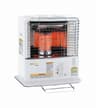
The kerosene heater that makes the fuel argument concrete: the listing states 23,800 BTU and a 1,000 square foot heating capacity, and it does that from a tank you fill rather than a cylinder you swap. That is kerosene's real advantage — no trip to exchange a tank, and a fuel that stores for a long time without a pressure vessel. The costs are the smell on lighting and extinguishing, a wick that is a consumable, and the same absolute requirement for ventilation and a CO alarm that propane carries.

Best kerosene for a long run
3
Mr. Heater 18,000 BTU Big Buddy Heater

Mr. Heater 18,000 BTU Big Buddy Heater

Double the Portable Buddy's output and the ability to run two 1 lb cylinders at once, which turns a two-hour heater into an all-evening one. It is the right size for a garage, a workshop, a large tent or a covered porch — still not an open patio. The same caveats apply and apply harder at 18,000 BTU: combustion heater, enclosed space, carbon monoxide alarm, every single time.

Best propane for a long evening
4
Sengoku HeatMate Portable Kerosene Heater (10,000 BTU, Cordless)

Sengoku HeatMate Portable Kerosene Heater (10,000 BTU, Cordless)

The small, cordless kerosene heater — 10,000 BTU per the listing, and no mains power required, which is the pairing that makes it an emergency-heat choice rather than a shop-heating one. It is the direct comparison against a 9,000 BTU propane Buddy heater: similar output, a fuel that stores for years in a can rather than a cylinder, and a wick instead of a regulator. Same rules as every combustion heater: ventilate the space and fit a carbon monoxide alarm.

Best kerosene for a power cut
$189.95 · View on Amazon

Price as of October 27, 2026. #ad How we’re funded

#1Best propane for a small space

Mr. Heater 9,000 BTU Portable Buddy Radiant Propane Heater

The Portable Buddy is the one radiant propane heater almost everyone in cold-weather outdoor hobbies already owns, and it runs on a 1 lb cylinder rather than a 20 lb tank — which is what makes it portable in the real sense. Nine thousand BTU is small next to a patio heater but enormous inside a tent, an ice shanty or a blind. Mr. Heater builds in a tip-over switch and an oxygen depletion sensor. Use a carbon monoxide alarm with it anyway, every time.

What’s good

  • Runs on a 1 lb cylinder — genuinely carryable
  • Tip-over shutoff and oxygen depletion sensor built in
  • 9,000 BTU is a lot of heat in a small enclosed space
  • The long-standing default in cold-weather outdoor hobbies

Trade-offs

  • Far too small to warm an open patio
  • 1 lb cylinders are expensive per hour of heat
  • Still a combustion heater: use a CO alarm, always
  • Not rated for use in every enclosed space — read the manual
TypePortable radiant propane heater
Heat output9,000 BTU (per the listing)
Fuel1 lb propane cylinder
SafetyTip-over switch and oxygen depletion sensor, per the maker
SeriesMidnight Series

Specs read from the product listing, on October 7, 2026. “Not published” means the maker doesn’t state that figure there.

#2Best kerosene for a long run

Dyna-Glo WK95C6B Indoor Kerosene Convection Heater (23,800 BTU, 1,000 sq ft)

The kerosene heater that makes the fuel argument concrete: the listing states 23,800 BTU and a 1,000 square foot heating capacity, and it does that from a tank you fill rather than a cylinder you swap. That is kerosene's real advantage — no trip to exchange a tank, and a fuel that stores for a long time without a pressure vessel. The costs are the smell on lighting and extinguishing, a wick that is a consumable, and the same absolute requirement for ventilation and a CO alarm that propane carries.

What’s good

  • 23,800 BTU and a stated 1,000 sq ft capacity
  • Fill a tank instead of exchanging a cylinder
  • Kerosene stores long-term without a pressure vessel
  • Convection pattern warms the whole room, not one direction

Trade-offs

  • Noticeable odor on lighting and extinguishing
  • Wick is a consumable that needs replacing
  • Needs ventilation and a CO alarm, like any combustion heater
  • Fuel is messier to handle than propane
TypeIndoor kerosene convection heater
Output23,800 BTU (per the listing)
Heating capacity1,000 sq ft (per the listing)
FuelKerosene (filled tank)
Heat patternConvection

Specs read from the product listing, on October 13, 2026. “Not published” means the maker doesn’t state that figure there.

#3Best propane for a long evening

Mr. Heater 18,000 BTU Big Buddy Heater

Double the Portable Buddy's output and the ability to run two 1 lb cylinders at once, which turns a two-hour heater into an all-evening one. It is the right size for a garage, a workshop, a large tent or a covered porch — still not an open patio. The same caveats apply and apply harder at 18,000 BTU: combustion heater, enclosed space, carbon monoxide alarm, every single time.

What’s good

  • 18,000 BTU covers a garage or a large tent properly
  • Runs two 1 lb cylinders, or a 20 lb tank with the right hose
  • Variable output rather than one fixed setting
  • Same proven Mr. Heater safety features

Trade-offs

  • Still a combustion heater — a CO alarm is mandatory, not optional
  • Hose and filter for a 20 lb tank are extra
  • Heavy and bulky next to the Portable Buddy
  • Not a substitute for a patio heater in open air
TypePortable radiant propane heater
Heat output18,000 BTU (per the listing)
FuelTwo 1 lb cylinders, or 20 lb tank with a hose (hose not included)
ModelBig Buddy

Specs read from the product listing, on October 7, 2026. “Not published” means the maker doesn’t state that figure there.

#4Best kerosene for a power cut

Sengoku HeatMate Portable Kerosene Heater (10,000 BTU, Cordless)

The small, cordless kerosene heater — 10,000 BTU per the listing, and no mains power required, which is the pairing that makes it an emergency-heat choice rather than a shop-heating one. It is the direct comparison against a 9,000 BTU propane Buddy heater: similar output, a fuel that stores for years in a can rather than a cylinder, and a wick instead of a regulator. Same rules as every combustion heater: ventilate the space and fit a carbon monoxide alarm.

What’s good

  • 10,000 BTU with no mains power needed, per the listing
  • Kerosene stores for a long time in a plain can
  • Directly comparable output to a 9,000 BTU propane heater
  • Small enough to store out of the way

Trade-offs

  • 10,000 BTU will not heat a garage or shop
  • Kerosene odor on lighting and extinguishing
  • Wick is a consumable
  • Needs ventilation and a CO alarm
TypePortable radiant kerosene heater
Output10,000 BTU (per the listing)
PowerCordless — no mains needed (per the listing)
FuelKerosene (filled tank)
Heating areaNot published

Specs read from the product listing, on October 13, 2026. “Not published” means the maker doesn’t state that figure there.

A note on fire safety. Clearances and extinguishing steps on this page follow Smokey Bear’s campfire-safety guidance. Your local burn rules, HOA and the manual that came with your unit all override anything here. We’re enthusiasts sharing what we’ve researched, not fire officers — when in doubt, follow your local fire authority.

Frequently asked questions

Is a propane or kerosene heater better?

Propane for short, portable, clean-burning use — it lights instantly, the fuel stores indefinitely in a sealed cylinder and there is no odor or wick maintenance. Kerosene for long runs and emergency heat, because a filled tank gives many more hours per fill than a 1-pound propane cylinder and the heater keeps working with no electricity. Decide on hours needed, not on fuel.

Which is cheaper to run, propane or kerosene?

It depends far more on how you buy the fuel than on the fuel itself. Propane bought in 1-pound disposable cylinders is by far the most expensive heat on this page; propane from an exchanged or refilled 20-pound tank is much cheaper. Kerosene bought by the can sits between the two. Compare the price per BTU you will actually pay in your area rather than the headline fuel price.

Does a kerosene heater smell?

Yes, mostly at start-up and shut-down rather than while running, and that is inherent to a wick heater rather than a defect. Running one in a correctly ventilated space with clean fresh fuel and a trimmed wick minimizes it. Propane has essentially no odor beyond the added odorant, which is why it is the better choice anywhere the smell would be unacceptable.

How long does a kerosene heater run on one tank?

Many hours — typically most of a day on a convection heater's filled tank, which is the category's main advantage. A 1-pound propane cylinder on a 9,000 BTU radiant heater is measured in a few hours, and a 20-pound tank with a hose extends a propane heater considerably. Check your own model's published run time, since tank size and output both move it.

Can you use a kerosene heater indoors?

Some are specified as indoor kerosene heaters and some are not, and the label and manual are what decide it — the Dyna-Glo here is listed as an indoor convection heater. Either way it is unvented combustion in an occupied room: provide fresh air, fit carbon monoxide alarms as the CPSC recommends, never run one while asleep, and refuel outdoors once the heater is cool.

Which is safer, propane or kerosene?

Neither is inherently safer; their risks differ. Propane is a pressurized gas that is heavier than air, so a leak pools at floor level — hence outdoor cylinder storage and leak-testing joints with soapy water. Kerosene is a liquid that will not leak as a gas but can be spilled, is refueled by hand, and involves a hot wick heater that must never be moved or refueled while lit.

Do propane and kerosene heaters need ventilation?

Both, always. Any unvented combustion appliance consumes room oxygen and produces carbon monoxide, so an occupied space needs a deliberate fresh-air supply and CO alarms — the CPSC recommends them on every level of a home and outside sleeping areas. Neither fuel changes that requirement, and no alarm makes it safe to run either one while asleep.

Sources

  • CPSC — Carbon Monoxide Information Center — The US Consumer Product Safety Commission on carbon monoxide: “More than 200 people in the United States die every year from accidental non-fire related CO poisoning associated with consumer products,” and its standing recommendation to “Install battery-operated CO alarms or CO alarms with battery backup on every level of the home and outside sleeping areas” (accessed October 7, 2026)
  • FTC Consumer Advice — Online Shopping — FTC guidance for buying online: “before you buy something online, shop around and check out sellers and products,” note the exact manufacturer or model number when comparison shopping, and pay by credit card so a bad order can be disputed (accessed October 7, 2026)
  • EPA Burn Wise — The EPA's residential wood-burning program: guidance on appliance choice, fuel quality and reducing smoke from wood heaters and outdoor fires (accessed October 7, 2026)

Keep reading