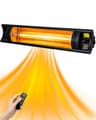
Why covered matters more than wattage
Infrared heat travels in a line until it hits something. On a covered porch, that something is you, the chairs, the floor and the ceiling — all of which re-radiate, and the roof keeps the warmed air from simply rising away. Remove the roof and the same heater is throwing most of its output at the sky.
So the first question is not how many watts but how enclosed the space is:
- A porch with a roof and two or three walls: 1,500 watts will make a real difference to two or three people sitting under it.
- A roof only, open on all sides: 1,500 watts warms whoever is directly beneath it. Mount it lower and closer than you think.
- No roof: electric infrared is the wrong tool. Propane, and the propane vs electric comparison explains why in numbers.
IP ratings: the one spec to insist on
An IP rating describes protection against solids and water. IP55 — published by two of the heaters here — means protected against dust and against water jets from any direction, which is the sensible minimum for anything permanently mounted outdoors. A heater with no published IP figure is not necessarily unsafe under full cover, but it is an unknown, and we have flagged it as not published rather than assuming.
Mount any of them to the manufacturer’s stated height and clearance, on a structure that will hold the weight, and on a circuit that can take 12.5 amps with whatever else is on it. A 1,500 watt heater on the same circuit as a fridge and a freezer is how breakers get discovered.
Running cost, honestly
A 1,500 watt heater uses 1.5 kWh an hour. At typical US residential rates that is in the region of 20 to 25 cents an hour, and a 3,000 watt unit twice that. Propane is cheaper per BTU in most places, but you are buying far more BTU than a porch needs and carrying cylinders to do it.
Where electric genuinely wins is everything other than the energy bill: no tank to refill, no combustion, no carbon monoxide, no ventilation requirement, no wind blowing the flame out, and an on-switch rather than an ignition sequence. On a porch used for an hour most evenings, those things matter more than the cents.
Porch, patio or garage?
Three similar-looking purchases with different answers:
- A covered porch: a mounted 1,500 watt infrared bar. This page.
- An open patio: a propane patio heater at 46,000 BTU and up, or a tall electric unit if a cylinder is out of the question.
- A garage or workshop: an electric garage heater, which is a different animal — 240 volts, hardwired, and sized to heat air in an enclosed space rather than warm people in an open one.
And if what the porch actually wants is somewhere to gather rather than a few degrees, a small propane fire pit does something an overhead heater cannot — though it needs the clearance an overhead heater does not.
Choosing for a roof, a gust or a whole winter
Best patio heater for a covered porch approaches the same space from the clearance side: why a seven-foot propane heater often cannot meet its own published clearance under an eight-foot ceiling, why radiant heat beats convective heat in wind, and what changes when the heater has to run every evening from November to March.