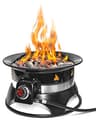
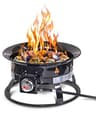
Short answer: yes, outdoors, in the open, with a connection you have actually checked. A propane fire pit removes most of what makes an open fire dangerous. There are no flying embers to land on a deck or a dry lawn, no sparks, no smoke, and no bed of coals that stays hot for hours after you have gone inside. You close a valve and the fire is genuinely out. For a family with children, on a timber deck, in a region with fire restrictions, a propane pit is the safer product and it is not a close call.
What changes is where the risk sits. It moves from the fire to the fuel. A wood fire has no pressurized cylinder, no hose and no regulator. A propane pit has all three, and propane is heavier than air, so a leak collects at ground level instead of dispersing upward. That single property explains almost every rule below: why you test the joints with soapy water, why spare cylinders live outdoors, why you light from the side with the lid open, and why a garage — which also stores gasoline vapor at floor level — is the worst room in the house for one.
The six risks, in the order they actually cause problems
This is the list to work through, roughly in descending order of how often each one bites. None of it is complicated and none of it needs a professional.
- 1. The connection. A loose fitting after a cylinder swap, or a hose that has spent three winters outside and gone hard. This is the most common real fault in the category and the easiest to catch: soapy water on the joints, cylinder valve open, pit off. Bubbles mean a leak. Never test with a flame, and replace a cracked hose rather than patching it.
- 2. Enclosure. A screened porch, a three-walled nook, a pop-up gazebo with the sides down, a tent, a garage. Propane burns oxygen and produces carbon monoxide; outdoors that disperses, and in a restricted space it does not. These are outdoor appliances and the manual means it literally.
- 3. What is overhead. A patio roof, soffit, pergola beam or low branch is combustible material above a flame. Your manual publishes a clearance to combustibles; measure rather than eyeball it. We go through this in detail on fire pits for covered patios.
- 4. Hot surfaces, not just flames. The rim and top of a fire table get hot enough to burn, and a child reaching for a dropped toy does not distinguish between the flame and the steel beside it. Keep a clear perimeter and treat the whole unit as hot until it has cooled.
- 5. Lighting it badly.Gas that has pooled under a closed lid or behind a glass wind guard, then met a lighter, is the classic flare-up. Open the lid, use the unit’s own igniter, stand to the side, and if it does not catch in a few seconds shut the gas off and let it clear before you try again.
- 6. Wet media. Lava rock and fire glass hold water, and trapped moisture turns to steam under the flame and can pop a stone out of the bowl. Use a cover, let the media dry before a first burn after rain, and replace lava rock that has started to crumble.
The fix, in six minutes
Before the first fire of the season: soapy-water test every joint, look at the hose for cracks and hard spots, check the burner ports are clear of spider webs and debris, and make sure the media is dry. That is the whole annual service for most pits.
Every time: level ground, clear perimeter, lid or wind guard open before you light, igniter rather than a match, stand to the side, run it turned down. Every time you finish: close the cylinder valve as well as the burner knob, so no gas is left sitting in the hose, and let the unit cool before you cover it.
Storage is where people get careless. Spare cylinders go outdoors, upright, out of the sun, and never in a garage, shed, basement or vehicle. A cylinder in a cupboard is the one genuinely serious mistake in this whole category, and it is also the easiest to avoid.
Where a propane pit is clearly the safer choice
On a deck. No embers dropping between boards and no ash to spill. A protective mat under the unit handles the radiant heat, and our gas fire pits for patios page covers surface protection.
Under a fire restriction.Many jurisdictions allow a valve-controlled gas appliance when open wood fires are banned, precisely because it produces no embers and goes out instantly. Check your own local rules, but this is the normal distinction, and it is the main reason campers buy propane — portable camping fire pits is written around it.
With children, or where someone needs to leave quickly.A wood fire takes real work to extinguish properly — Smokey Bear’s method is drown, stir, drown, then feel the ashes with the back of your hand. A gas pit takes a quarter turn of a valve. If that difference matters in your household, it is the strongest single argument in propane’s favor.
Where it is not the safer choice
Anywhere enclosed, and anywhere you cannot keep the cylinder away from the flame and out of the living space. A screened porch is the case people get wrong most often: it feels outdoors, but with screens on three or four sides the ventilation an outdoor appliance assumes is not there. In that space, an electric heater removes the question entirely — no combustion, no carbon monoxide, no cylinder to store — and electric porch heaters is the page for it.
One more honest limit: a propane pit is not a substitute for supervision. The reason it is safer is that its failure modes are predictable and its off switch is instant. Both of those only help someone who is in the garden paying attention.