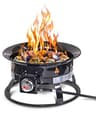
Why nothing that burns wood is on this list
Two reasons, and both are about the roof rather than the fire. The first is embers. A wood fire throws sparks upward, and a smokeless pit with its secondary burn throws them with more energy, not less. Under an open sky they burn out. Under a tongue-and-groove ceiling they land on it.
The second is accumulation. Wood smoke deposits soot and creosote on whatever is above it, and a patio ceiling has no flue and no sweep. The visible result is a stained roof deck within a season; the invisible one is combustible residue collecting on combustible material directly over an open fire. Gas burns clean enough that neither applies, which is the whole reason this page is on the gas hub.
If your covered area is an open-slat pergola or a canopy rather than a solid roof, the calculation changes and a wood fire can come back into play — fire pits under pergolas and gazebos works through slat spacing, canopy fabric and where the heat actually goes. And if what you want under a solid roof is a chimneyed appliance that vents its own smoke, outdoor fireplaces for covered patios covers that properly, including why a decorative chimney is not a flue.
The picks ranked by flame height
Under a roof this is the ranking that matters, so here it is explicitly. Figures are what each listing publishes.
| | Type | Published output | Flame sits |
|---|
| Endless Summer 30 low-profile | Low-profile gas fire table | Not published | Coffee-table height |
| Ciays 28-inch table | Square propane fire table, lid | 50,000 BTU | Table height |
| Endless Summer 30 resin | Round gas fire table | Not published | Table height |
| Camplux FP19MB | 19-inch portable bowl | Not published | Ground level |
| Outland 19-inch bowl | Portable bowl | 58,000 BTU | Ground level |
| Ciays 28-inch tabletop | Tabletop pit, glass wind guard | 50,000 BTU | On top of a table |
Note the tension in that table. A ground-level bowl keeps the flame furthest from the ceiling, which is good — but the 58,000 BTU Outland produces the tallest flame of anything here when run flat out, which is bad. The low-profile Endless Summer sits lowest overall and publishes no BTU figure, which is frustrating on a page about clearance. The Ciays table wins because it publishes its output, states a certification, adjusts down, and closes.
Five checks before you light anything under a roof
- Measure the ceiling, then read the manual. The clearance number in the manual is the specification. Your tape measure is the test. If the manual says not to use the unit under an overhead structure, that is the answer and no workaround makes it a different answer.
- Run it turned down. Flame height is adjustable on every gas pit here. A 50,000 BTU burner at half is still real heat and a much shorter flame. Under a roof, a turned-down pit is not a compromise, it is the correct operating setting.
- Check where the tank lives. A 20-pound cylinder inside a table cabinet is normal and designed for; a cylinder sitting beside a pit on an enclosed porch is a second hazard in the same space. Swap and store cylinders outside, and test connections with soapy water rather than a flame.
- Fit a CO alarm if any side is enclosed. Screens, blinds, drop-down panels or a three-walled nook all restrict the ventilation an outdoor appliance assumes.
- Mind the floor as well as the roof. A covered patio is often decking, outdoor rug or composite. A fire-resistant mat under the unit protects it, and the gas pits here have no ash to spill either way.
Who should buy which
A roofed patio with open sides, dining seating: the Ciays 28-inch table. Certification stated, adjustable output, closes to a flat surface. A roofed patio with lounge chairs: the low-profile Endless Summer, because the flame sits lowest and the surface is at the right height for a drink beside a sofa. A small balcony or a tight porch corner:the Camplux 19-inch, which is the smallest footprint here — and our balcony fire pit page covers the lease clauses that often decide it.
A fully screened porch:read the manual’s wording about enclosed spaces first, and if it rules the unit out, do not argue with it. The resin-mantel Endless Summer is the pick among these if your porch is screened on one or two sides only and genuinely ventilated, because it looks like furniture rather than equipment and its output is modest. Otherwise go electric: electric porch heaters have no combustion, no cylinder and no clearance-to-flame problem, and a mounted panel takes no floor space at all.
A pit that lives outside and comes under cover occasionally: the Outland 19-inch. 58,000 BTU is more flame than a low ceiling wants, but it has a carry kit and a cover, so the honest use is out on the open patio most nights and tucked under the roof when it rains — turned down.