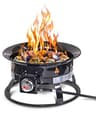
What each pick publishes
| | Type | Published output | Certification | Notes |
|---|
| Ciays 28-inch table | Square propane fire table | 50,000 BTU | CSA-listed | Lid included |
| Endless Summer 30 low-profile | Low gas fire table | Not published | Not published | Coffee-table height |
| Outland 19-inch | Portable propane bowl | 58,000 BTU | Not published | Cover and carry kit |
| Camplux FP19MB | Portable propane bowl | Not published | Not published | 19-inch diameter |
| DocSafe 48-inch round mat | Deck protection mat | Not applicable | Not published | 4-layer construction |
| DocSafe 40-inch square mat | Deck protection mat | Not applicable | Not published | 4-layer, straight edges |
Neither mat publishes a temperature rating, which is the figure we would most like to see on a product whose job is heat protection. Treat that as the category norm, size the mat generously, and do not read a missing rating as a reason to skip the mat entirely.
Sizing the mat, and placing the pit
- Go wider than the pit, not equal to it. Radiant heat spreads outward from the base, so a mat the same diameter as the bowl leaves the ring of decking just outside it unprotected. The 48-inch round under a 19 to 28-inch pit is the right proportion; the 40-inch square suits a square table with straight edges.
- Match the shape. A round mat under a square table leaves four exposed corners exactly where the hot cabinet sits. This is the whole reason both a round and a square mat are on this page.
- Keep clearance to the house and the railing.Follow your unit’s published clearance to combustibles. Siding, soffit, a wooden railing and a privacy screen all count, and a deck tends to put all of them within a few feet.
- Level matters more on a deck. Boards cup and crown with age, and a fire table rocking on an uneven board is a hazard with a propane cylinder inside it. Check it loaded, not empty.
- Nothing overhead.If the deck is roofed or has a pergola over it, that is a different and stricter problem — fire pits for covered patios and fire pits under pergolas deal with clearance to a ceiling and to open slats respectively.
Where the propane cylinder goes
On a deck this is a real design question rather than a detail. A fire table with a cabinet is designed to hold a 20-pound cylinder, with vents that must stay clear — propane is heavier than air, so a slow leak collects in the cavity rather than dispersing upward. A portable bowl has its cylinder sitting beside it on the deck, which is acceptable but means a cylinder, a hose run and a trip hazard in a space people walk through.
Either way: swap and store cylinders off the deck, keep spares outdoors and upright, and soapy-water test the connection before the first fire of the season. Our propane fire pit safety guide has the full sequence, and propane fire pits with a hidden tank covers the units that solve the cylinder problem most tidily.
Three deck-specific choices
A dining deck with chairs and a table: the Ciays 28-inch. Table height suits dining chairs, the lid gives you the surface back, and the stated certification is worth having on a structure attached to your house.
A lounge deck with low seating: the low-profile Endless Summer 30-inch. The flame sits at coffee-table height, which is the right level for sofas and loungers, and a low unit is less visually dominant on a small deck. Its listing publishes no BTU figure, which is a fair criticism.
A deck the pit does not live on permanently:the Outland 19-inch or the Camplux. Both are portable bowls with small footprints, and the Outland includes a cover and carry kit, so the honest pattern is out on the deck for the evening and stored afterwards. The Outland’s published 58,000 BTU is the most output here, so run it turned down on a deck and keep the clearances honest.
For the heat-first version of this ranking see best propane fire pit for heat, and for the patio equivalent of this page, including surface protection on stone and composite, gas fire pits for patios.
Before you buy: check with whoever owns the deck
Two quick checks that are easy to skip and expensive to discover late. If you rent, or live under an HOA or a condo board, open-flame appliances on a balcony or deck are frequently restricted by the lease or the bylaws — and the restriction often distinguishes between wood and a valve-controlled gas appliance, which is another point in gas’s favor. Our balcony fire pit page is written from the lease outward if that is your situation.
And tell your insurer if you are adding a permanent gas appliance to a deck attached to the house. Then follow the general outdoor-fire rules regardless of fuel: clear ground around the site, at least 15 feet from tents, vegetation and low-hanging branches, and vertical clearance of at least three times the flame height.