How small is small enough?
Work from the space, not the product. On a patio, you want roughly two to three feet of clear space between the pit’s edge and the front of a chair — close enough to feel the heat, far enough to be comfortable. That gap is what decides the pit:
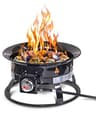
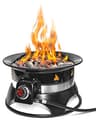
- 19 to 21 inches: works on a patio of about 8 by 8 feet with three or four chairs around it. The sweet spot, and where all three bowls here sit.
- 28 to 30 inches, tabletop: uses no floor space at all because it sits on a table you already own. The right answer on a balcony.
- Over 30 inches: not a small fire pit. If you have the room, the full propane fire pit roundup covers it.
Our fire pit sizing guide works the seating-circle arithmetic properly, and fire pits for small patios covers the wood-burning side of the same problem.
BTU on a small pit: why the big number is not the point
Two of these bowls publish 58,000 BTU, which sounds enormous next to a patio heater’s 46,000. The difference is direction. A patio heater radiates heat outward and downward at the people around it; a fire pit sends most of its heat straight up. A fire pit is primarily a thing to sit around, and only secondarily a heater — if your actual problem is being cold on a small patio, a porch heater will do more for less.
What BTU does buy on a small pit is flame height and presence. A low-output tabletop unit gives a pretty flame; 50,000 BTU and up gives a fire you can see from the other side of the garden. Both are legitimate; they are just not the same purchase.
Where does the propane tank go?
This is the question small-patio buyers forget, and it is the one that causes returns.
- Bowl-style pits (Outland, Camplux) run from a 20 lb cylinder on a hose, which has to sit beside the pit. Some owners use a tank cover or a small side table to hide it; either way it occupies about a foot of floor.
- Tabletop units mostly run from a 1 lb canister, or from a 20 lb tank with an adapter hose. The 1 lb canister is tidier and much more expensive per hour.
- Tables with enclosed bases — see our fire pit tables — hide the tank inside the structure, which is the neatest solution if the footprint allows it.
Wherever it ends up, the cylinder stays upright, outdoors and ventilated, and spares are not stored inside. Check the connection with soapy water, never a flame.
Small propane pits and decks
A gas pit is substantially better on a deck than a wood one, for the obvious reason: no embers, no sparks, no ash. It is not automatically safe, though. The pit needs to be raised on its own legs or feet, with a heat-resistant mat under it, and composite decking scorches at lower temperatures than timber — check the decking manufacturer’s guidance as well as the pit’s.
Clearance still applies. Smokey Bear’s guidance of keeping vertical clearance at least three times the flame height is a sensible rule under a pergola, an awning or a balcony above. A 19-inch pit on a small patio under a low awning is the one combination to think twice about, and fire pit safety has the rest.