How we judged these
“Portable” is the most abused word in this category. A 30-inch steel bowl with handles is technically portable and nobody has ever carried one anywhere twice. So we ranked on four things, in this order.
1. Packed size and weight, as published.Not “lightweight” from the marketing copy — an actual figure on the listing. Two of the pits here publish a weight in their own title (7 lbs and 3 lbs). Most do not, and where a listing is silent our spec table says “Not published” rather than estimating. That silence is itself worth knowing when you are deciding what will fit in a car already holding a tent.
2. Whether it still makes a real fire.Below about 18 inches you stop heating a circle of people and start heating whoever is leaning over it. That is a legitimate thing to buy — a solo camp, a balcony, a table — but it has to be a decision rather than a surprise. We say plainly which of these warms a group and which warms one person.
3. Whether you can legally light it where you are going. This is the specification nobody thinks about until they arrive. Plenty of campgrounds, RV parks and drought-season county rules ban open wood fires while permitting a certified propane appliance, because a gas burner throws no embers. That is the entire case for the propane pick on this page, and it is a strong one.
4. What is actually in the box. A carry bag, a cover, a heat shield: on a portable pit these are not accessories, they are the difference between a pit that travels and a sooty object you have nowhere to put. We name what each listing includes and, just as importantly, what it says it does not.
Collapsible, rigid, or propane?
Collapsible mesh pits— the Fireside Outdoor pair here — fold flat on a frame and burn on a stainless mesh floor. Air enters from underneath across the whole base, so they light fast, burn hot and leave almost no ash. The trade is that heat and embers both go down through the mesh, so on grass, decking or anything you care about you need a heat shield underneath. The 24-inch listing states outright that the heat shield is not included, which is honest of it and a real line in your budget. Both Fireside Outdoor pits also sit inside the sub-$100 band, so they appear in best fire pits under $100 alongside the cheap open bowls they compete with on price rather than on portability.
Rigid portable pits— the HGD and the GasOne — are small versions of ordinary fire bowls. They do not pack down, so they take up their full volume in the car, but there is no mesh to wear out, nothing radiates downward, and a double-wall one like the HGD gives you the smokeless burn that makes a small fire bearable when everyone is sitting close to it.
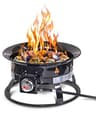
Portable propane— the Outland bowl — is a different proposition again. There is no wood to carry, no ash, no embers and no smoke, and it is on and off with a knob. It is also the only option on this page that works during a wood-fire ban. The costs are real: a 20 lb tank is a separate purchase and a heavy, awkward thing to transport, and a propane flame delivers less radiant warmth than a wood fire of the same diameter because much of the energy goes straight up. Our full ranking of those is in best propane fire pits.
Sizing a portable pit to what you are doing
A portable pit is nearly always smaller than the one you would buy for a patio, so the sizing arithmetic matters more, not less. As a rough guide: 12 inches warms one person leaning over it. 19 to 20 inches is the smallest size that genuinely warms three or four chairs pulled in close. 24 inches starts to behave like a proper garden fire and is about the largest thing anyone packs. The full method, including clearances and wood consumption, is in what size fire pit do I need.
One consequence of going small that catches people out: a small firebox means short burns and constant feeding. A 12-inch pit wants attention every few minutes. A 20-inch pit will hold a fire for a reasonable stretch on split wood. If the evening is meant to be relaxing rather than a project, bias upward within whatever you can physically carry.
Fuel, when you are not at home
Away from your own woodpile, fuel becomes the hard part. The EPA’s guidance is that wood burns best below 20 percent moisture content, and campground firewood sold from a cage in the rain is routinely nowhere near that. It is also the reason a smokeless pit can seem to stop working the moment you take it camping: the secondary burn that keeps a double-wall pit clean only lights up once the firebox is properly hot, and wet wood never gets it there.
Two practical answers. Carry a box of fatwood— it lights from a match in wind and damp, with no chemical smell to sit in all evening. And for genuinely tight situations, pre-packed wood pellet fuel is bone dry by definition, which removes the variable entirely at a cost per hour you would never accept at home. Both are in our accessories picks.
Also worth knowing: many states and parks ask you to buy firewood locally rather than bring it, because moving wood between regions is a well-established route for spreading tree pests. It happens to be the cheaper option too. More on choosing fuel in best wood to burn in a fire pit.
Safety away from home
A portable pit gets used in places you have not assessed, which is exactly when clearance rules matter most. Smokey Bear’s published guidance is to clear at least a 10-foot diameter around the fire site, stay at least 15 feet from tents, vegetation and low-hanging branches, and keep vertical clearance of at least three times the height of the flames. The 15-foot figure is the one that bites at a campsite, where the instinct is to put the fire close to the tent.
Put it out properly before you leave or sleep: drown, stir, drown, feel. Pour water on until the hissing stops, stir the water right through the embers with a shovel, keep adding water until all the material is cool, then hover the back of your hand over the ashes. Dirt or sand alone insulates embers rather than killing them — that is how an apparently dead fire restarts hours later. The full method and the rest of the clearance figures are in fire pit safety.
Two things specific to this category. A collapsible mesh pit drops embers through its floor, so what is underneath it matters as much as what is beside it — heat shield on anything flammable, and never on a wooden deck without one. And never run a fuel-burning pit or heater inside a tent, awning or camper: the CPSC reports more than 200 accidental non-fire carbon monoxide deaths a year in the United States linked to consumer products. A fire pit is an outdoor object, full stop.
What we would skip
The sub-twenty-dollar folding mesh baskets that appear and disappear under a dozen brand names. They pack beautifully, and the ones we looked at publish no weight, no material grade and no dimensions anybody could act on — and a mesh basket with no frame rigidity is a fire that collapses into a heap halfway through the evening. The GasOne 23-inch on this page costs roughly twice as much, publishes its diameter and material, and is a pit rather than a gamble.
Also skip buying a “portable” pit above about 24 inches. Handles on a 30-inch bowl are a marketing feature. If the pit is going to live on a patio, buy a proper one from our wood-burning roundup or the smokeless roundup and get more fire for the money, because you are not paying for portability you will never use.
Two adjacent pages. If portability matters because you rent and have a balcony rather than a yard, best fire pits for apartment balconies starts from the building's rules instead of the product. And if a smokeless pit is on the shortlist, the TIKI fire pit review covers the main Solo Stove alternative.