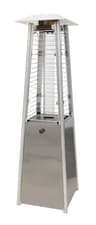
What you are actually buying
A pyramid heater — also sold as a flame tower or a glass-tube heater — puts the burner at the bottom of a tall quartz or glass tube and lets the flame run up inside it. Two consequences follow, and they explain every review of every unit in the category.
It is a visual product first.The tube is there so you can see the flame. That is a legitimate reason to buy one — it does the job of a fire pit and a heater in a single object, which is exactly the appeal on a small patio where there is no room for both. Our patio heater vs fire pit comparison is the honest version of that trade.
It heats in a column, not a dome.A mushroom heater has a reflector at the top that pushes heat down and out in a circle. A pyramid sends much of its heat straight up the tube, which is why the published BTU on a pyramid tends to be high while the felt warmth at a given distance is not obviously better than a smaller mushroom. Nobody publishes a comparable number for that, so we will not invent one — but it is the reason to think of the flame as half the product.
The three sizes, and who each is for
Full height (roughly 7 feet). The EAST OAK is the only one here, publishing 48,000 BTU with the tank in the base. This is the version that warms a seating group, and it is the only pyramid we would describe as a patio heater without qualification. It needs a flat, sheltered-from-wind spot and a 20 lb cylinder you buy separately.
Tabletop with a published output.The Hiland publishes 10,000 BTU on a 1 lb camping cylinder. Enough for the people at the table, not the people behind them. Its model number is published on the listing (HLDS032-GTTSS), which matters when you need a replacement glass tube in two years — the tube is the part that breaks.
Tabletop without one. The Tangkula publishes a 34-inch height and a finish and not much else. It is the cheapest route to the look. Where a listing does not publish output or safety features we treat that as a finding rather than filling the gap, and it is worth weighing before buying.
If a table is where this is going, cross-shop outside the shape too — best tabletop patio heaters includes electric infrared units that produce heat without a cylinder on the table.
How we ranked these
- Published output first. Two of the three heaters publish a BTU figure; the third does not, and that put it last among the heaters.
- Stated materials. Stainless steel and glass on two listings. On an object that lives outdoors and has a breakable tube, the material story is the durability story.
- Fuel format. A 20 lb tank in the base for the full-height unit; 1 lb cylinders for the tabletops. The cylinder decides the run time and the hassle, and neither listing publishes a run time.
- What it needs that is not included. No pyramid here includes a tank, and none includes a cover.
No heat measurement sits behind any of this, because we have taken none. How we pick is explicit about that.
The glass tube is the weak point — cover it
This is the maintenance fact that decides whether a pyramid heater is a three-season purchase or a five-year one. The tube is glass or quartz, it sits at the top of a tall object that catches wind, and it is the single most commonly replaced part in the category.
A cover does two jobs: it keeps water out of the burner assembly and it stops the tube taking a hit from something blown across a patio. The Stanbroil listing publishes a 90-inch height and waterproof construction, which fits a full-height unit — measure your heater before ordering, because pyramid covers are sized to a taller, narrower shape than mushroom covers. The wider field, including the mushroom shapes, is in best patio heater covers.
Where a pyramid heater must not go
All three heaters here burn propane, and the tall flame tube makes the clearance question more acute than it is for a tabletop radiant unit.
- Not under a low roof, pergola or awning.The heat goes up the tube and out of the top. Vertical clearance is not optional on this shape, and a covered patio changes the answer entirely — patio heaters for covered porches covers the mounted electric units that exist for exactly that case.
- Not in an enclosed or screened space.Propane consumes oxygen and produces carbon monoxide. The CPSC records more than 200 accidental non-fire CO deaths a year in the US associated with consumer products and recommends CO alarms on every level of a home and outside sleeping areas. A zipped gazebo is indoors as far as combustion is concerned — carbon monoxide and outdoor heaters is the full version.
- Not on soft or uneven ground. A seven-foot heater with a tank in the base is top-heavy by design. Flat and firm, or not at all.
When to buy a different shape instead
You want maximum heat for the money. A mushroom heater or a tank-top burner delivers more published BTU per dollar, because you are not paying for a glass tube. Best propane patio heaters ranks those, and best patio heaters under $100 is the floor of the category.
You are heating a covered space.Buy electric. A mounted infrared panel puts heat down from above with no combustion at all — see best electric patio heaters.
You are not sure what size you need. What size patio heater do I need works through output against area, and why an open patio changes the sum.
The enclosed-flame shape is also the one we would put on a wooden or composite deck, for reasons that have nothing to do with how it looks: best outdoor heaters for a deck ranks heaters on what sits at floor level, on base stability and on wind rather than on output alone.