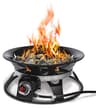
Choose wood if you have open ground, cheap seasoned wood and you want the fire to be the point of the evening. Choose propane if the pit lives on a deck or a small patio, if smoke would reach a neighbor, if a burn ban applies, or if you want a fire you can have for forty minutes and then switch off. The two are not really competing on quality of fire — wood wins that and it is not close. They compete on whether your site, your rules and your patience allow a wood fire at all.
Propane buys convenience and permission. Ten seconds to a flame, a dial to set it, no smoke, no sparks, no ash, no coat that smells of campfire, and it is allowed in a long list of places where an open wood fire is not. It also goes out instantly, which matters more than people expect when it starts raining or the evening ends early.
Wood buys the actual fire, and the cheapest heat there is. Coals, collapse, the smell, the heat pulse when a log catches, and the ability to build a bigger fire than any portable gas pit can produce. If you split and season your own wood it costs a fraction of propane per hour. If you buy bundles at a gas station it costs considerably more — worth knowing before you pick wood for the economics.
The comparison, point by point
| | Propane | Wood |
|---|
| Time to a flame | Seconds | 15–20 minutes to useful heat |
| Rated output | 50,000–58,000 BTU on the listings | Not rated — higher ceiling |
| Adjustable | Yes, on a knob | Only by what you put on it |
| Switches off | Instantly | No — must be extinguished |
| Smoke | None | Yes, unless double-wall and dry wood |
| Embers and sparks | None | Yes — a screen matters near timber |
| Ash to deal with | None | Every few fires |
| Fuel cost per evening | Moderate — cylinder refills | Lowest if self-seasoned; highest if bundled |
| Fuel storage | A cylinder, outdoors and upright | A rack and six months of patience |
| Allowed under a burn ban | Commonly yes | Commonly no |
| Deck and small patio friendly | Yes, with a mat and clearance | Possible, with more conditions |
| Smells like a fire | No | Yes — the entire argument |
| Cooks over it | No | Not what this site is about either way |
| Things that can fail | Regulator, igniter, hose | Nothing — it is a steel bowl |
What propane actually costs to run
A 20-pound cylinder holds roughly 430,000 BTU of usable energy. A 50,000 BTU pit run flat out therefore empties one in about eight to nine hours; a 58,000 BTU bowl rather faster. Most people run a pit well below maximum, which stretches that considerably — but the practical pattern is a refill every handful of evenings through the season.
Two things follow. First, buy a second cylinder with the pit. Running out mid-evening is the most common complaint about propane and a spare removes it permanently. Second, if the pit is staying in one place forever and there is gas at the house, a plumbed natural gas pit never runs out and costs less per hour — that decision is on natural gas vs propane.
What wood actually costs to run
This is where the comparison is usually argued badly. Wood is the cheapest heat in this category ifyou buy a cord green, split it, stack it off the ground, cover the top only and wait — the EPA’s guidance is to season at least six months to get below the 20 percent moisture content wood burns best at. Done that way, an evening costs very little.
Buy the same wood in shrink-wrapped bundles at a gas station and it becomes the most expensive fuel on this page, with the added insult that bundled wood is frequently not dry. Wet wood is the direct cause of most “my smokeless pit still smokes” complaints: a double-wall pit needs a hot fire to burn its own smoke, and 30 percent wood never gets there. How to season firewood is the page that makes the cheap version real, and best wood to burn in a fire pit covers species.
Where you are putting it decides more than you think
On a deck or composite decking: propane is the easier yes. No embers and no ash removes most of what makes a deck fire risky, though you still need a mat and real clearance. The full picture is on can you put a fire pit on a deck and best fire pits for decks.
On a small patio with neighbors close:propane, almost always. Smoke is the thing that generates complaints, and a gas flame produces none. If you want wood anyway, a double-wall pit on dry wood is the version worth attempting — see fire pits for small patios.
In an open yard: free choice, and wood is the better fire. Diameter is what buys warmth here; a 36-inch bowl throws a far bigger circle of heat than any portable gas pit.
Camping, RVs and fire bans:propane, for a reason that has nothing to do with preference — it is frequently the only fire permitted. See portable camping fire pits.
Under anything overhead:neither, without checking the manual. A roof, a balcony or a dense pergola changes the problem entirely — fire pits under pergolas and gazebos covers it. Both fuels produce carbon monoxide, and the CPSC recommends CO alarms on every level of a home and outside sleeping areas for exactly the part-enclosed cases.
Safety, briefly, because they fail differently
Wood:clearance and embers. Smokey Bear’s published guidance is to clear at least a 10-foot diameter around the site, stay at least 15 feet from tents, vegetation and low-hanging branches, and keep vertical clearance at least three times the flame height. The fire is not finished when it looks finished — drown, stir, drown, feel, per how to put out a fire pit.
Propane:the cylinder and the connection. Propane is heavier than air, so a leak pools at ground level — in the bowl, in a table cabinet, in a window well — rather than rising and dispersing. Leak-test connections with soapy water, light with the lid off, and do not keep clicking an igniter at a burner that has been flowing gas. More on are propane fire pits safe.
So, which should you buy?
Propane, if: the pit goes on a deck or a tight patio; neighbors are close; you are in a rental, an HOA or a fire-ban area; you travel or camp with it; you want a fire on a weeknight without an hour of commitment; or nobody in the house wants to deal with ash.
Wood, if: you have open ground and real clearance; you can get wood cheaply and will season it; people sit down and stay; and the smell, the coals and the sound are the reason you are buying a fire pit at all.
And if you genuinely cannot decide,buy the wood pit and buy it double-walled. It is the better fire, it burns cleaner than an open bowl, it has nothing to fail, and it costs least to feed. Propane is the right answer to a constraint — a deck, a rule, a neighbor, a fire ban — rather than the better fire.