Coal & Char

How to Start a Gas Fire Pit

Lid open, valve on, wait, click, set the flame. Written for a first fire, including the three reasons it clicks and does not light.

By Stephen V.Last updated How we pick

How this is funded:we earn a commission if you buy through our links, at no extra cost to you. It never changes which pit or heater we recommend, and we’ll tell you when we’d skip one. Full disclosure.

The sequence is: lid open, cylinder valve open slowly, wait half a minute, knob to high, press the igniter from the side, then turn it down. That is the whole job, and the two steps people skip are the two that cause the trouble — opening the lid before any gas flows, and opening the cylinder valve slowly rather than cranking it.

If you only remember one thing from this page, remember the regulator. The regulator on a 20-pound propane cylinder contains an excess-flow device that is designed to cut the gas down to a trickle if it detects a sudden rush — the sort of rush a leaking hose would produce, and also the sort a fast turn of the valve produces. Once it has tripped, the pit will click and click and never light, and nothing is actually broken. Close the burner knob, close the cylinder valve, wait a minute, then open the cylinder valve slowly and all the way. This one mechanism is behind more “faulty” fire pits than every other cause combined.

Before the first fire of the season

Five minutes, once a year, and it prevents almost every problem on this page.

  • Look at the hose. Cracks, hard spots, stiffness, cuts or rodent damage mean replace it, not tape it. A hose that has spent three winters in the weather is a consumable.
  • Soapy-water test the joints. Cylinder valve open, burner off, soapy water brushed on every connection. Bubbles mean a leak. Tighten by hand and retest. Never use a flame to find a gas leak.
  • Clear the burner ports. Spiders genuinely like burner tubes, and a blocked port next to the electrode is the difference between lighting and clicking. A soft brush is all it takes.
  • Make sure the media is dry. Lava rock and fire glass hold water, and trapped moisture turns to steam under a flame and can pop a stone out of the bowl. Let it dry before a first burn after rain.
  • Check the igniter. Many have a replaceable battery behind the knob, usually an AA or a button cell. A faint or absent click is normally a flat battery or a corroded electrode, not a dead pit.

Troubleshooting, by symptom

It clicks but will not light. The spark is there and the gas is not. Work in this order: reset the regulator by closing and slowly reopening the cylinder valve; check the cylinder is not empty by weight rather than by guess; clear the burner ports nearest the electrode.

No click at all. Battery, then electrode. Replace the battery first because it is free to try, and look for white corrosion or a bent electrode in the burner pan. On a built-in pit, a complete spark ignition assembly is a replaceable part rather than a reason to rebuild the feature.

It lights, then goes out after a few seconds. Usually the regulator in its limited-flow state, or a nearly empty cylinder that cannot keep up once the burner demands full flow. On a cold night, a cylinder that has chilled down produces less vapor and can do the same thing, which is physics rather than a fault.

The flame is yellow, lazy or sooty. Not enough air, or something blocking the burner. Common causes are fire glass or lava rock heaped over the burner instead of arranged around it, blocked ports, or the wrong regulator. A correctly burning propane flame is blue at its base.

It smells of gas and will not light.Stop. Shut the cylinder valve, step back and let the area clear completely before doing anything else, then leak-test before another attempt. Propane is heavier than air and collects in the bowl and at ground level, so “it will blow away” is not a safe assumption.

Natural gas pits light the same way, with one difference

There is no cylinder valve and no regulator to trip, so the sequence shortens to: lid open, gas valve on at the wall or the key valve, knob to high, igniter, turn it down. What natural gas adds is that the supply never runs out mid-evening, and what it takes away is portability — the pit lives where the plumber put the line. If you are still choosing between the two fuels, natural gas vs propane fire pit runs that decision properly, including the BTU and install differences.

Two habits for the end of the evening

Close the cylinder valve, not just the knob. The burner knob stops the flame; the cylinder valve stops gas sitting in the hose until next time. Doing both is the cheapest safety measure available.

Let it cool before you cover it.A cover trapped over a hot bowl melts, and a damp cover put straight onto warm steel holds moisture against the metal — which is how a pit that was fine in October is rusty in March. Our fire pit covers page covers what a waterproof rating actually means, and are propane fire pits safe has the full storage rules for spare cylinders.
If lighting it is the problem, these three solve it

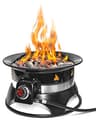
Most lighting trouble is sequence rather than hardware, and the six steps above fix it for free. These three are for the cases where the hardware is the problem: a pit with a proper auto-ignition instead of a match, a first fire table that closes when you are done, and the replacement spark ignition for a built-in pit whose original one has stopped sparking.

Quick picks

Ranked on published specs, beginner-friendliness and value. Select a row to jump to the full write-up. We haven’t cooked on every one of these — here is exactly what we do instead.

#ProductBest forPrice
1
Outland Living Firebowl 870 Premium 19" Auto-Ignition

Outland Living Firebowl 870 Premium 19" Auto-Ignition

The 870 adds auto-ignition to Outland's standard 19-inch bowl, which sounds like a small thing until you have crouched over a fire pit in the wind with a lighter. Push and turn, it lights. Everything else — the bowl, the output, the CSA listing people actually need for campgrounds — is the familiar Outland package. It is worth the modest premium over the base model if the pit will be used often, and not worth it if it comes out twice a year.

Easiest to light — auto-ignition
$199.99 · View on Amazon

Price as of October 27, 2026. #ad How we’re funded

2
Ciays 28-Inch CSA-Listed Propane Fire Pit Table (50,000 BTU)

Ciays 28-Inch CSA-Listed Propane Fire Pit Table (50,000 BTU)

The cheapest fire pit table here that states a CSA listing on the listing itself, which is the thing worth paying for in this category — a 50,000 BTU burner hidden inside furniture is exactly where certification matters. Twenty-eight inches square with a lid means it works as an ordinary patio table when the burner is off, which is the real appeal of a fire table over a fire bowl. Build quality is what you would expect at this price: fine, not heirloom.

Best first fire table
$149.89 · View on Amazon

Price as of October 27, 2026. #ad How we’re funded

3
Stanbroil Fire Pit Gas Burner Spark Ignition Kit

Stanbroil Fire Pit Gas Burner Spark Ignition Kit

The cheapest honest route into a built-in gas pit: burner and spark ignition only, with the pan, the surround and the gas run all down to you. It is the right buy when you are converting a stone pit that already exists, and the wrong buy if you were hoping a kit meant everything in one box.

When the igniter has died
$89.99 · View on Amazon

Price as of October 27, 2026. #ad How we’re funded

#1Easiest to light — auto-ignition

Outland Living Firebowl 870 Premium 19" Auto-Ignition

The 870 adds auto-ignition to Outland's standard 19-inch bowl, which sounds like a small thing until you have crouched over a fire pit in the wind with a lighter. Push and turn, it lights. Everything else — the bowl, the output, the CSA listing people actually need for campgrounds — is the familiar Outland package. It is worth the modest premium over the base model if the pit will be used often, and not worth it if it comes out twice a year.

What’s good

  • Auto-ignition — no lighter, no crouching in the wind
  • The well-proven Outland 19-inch bowl underneath
  • Smokeless by nature: it is gas
  • Still portable and still campground-friendly

Trade-offs

  • Ignition module is one more thing that can fail
  • Costs more than the manual-light version of the same pit
  • Tank not included
  • Lava rock included quantity is not published
TypePortable propane fire bowl, auto-ignition
Diameter19" (per the listing)
IgnitionAuto-ignition, per the listing
FuelPropane — 20 lb tank not included
Heat outputNot published on this listing

Specs read from the product listing, on October 7, 2026. “Not published” means the maker doesn’t state that figure there.

#2Best first fire table

Ciays 28-Inch CSA-Listed Propane Fire Pit Table (50,000 BTU)

The cheapest fire pit table here that states a CSA listing on the listing itself, which is the thing worth paying for in this category — a 50,000 BTU burner hidden inside furniture is exactly where certification matters. Twenty-eight inches square with a lid means it works as an ordinary patio table when the burner is off, which is the real appeal of a fire table over a fire bowl. Build quality is what you would expect at this price: fine, not heirloom.

What’s good

  • CSA listing stated on the listing — unusual at this price
  • 50,000 BTU is plenty for a 28-inch table
  • Lid turns it back into a usable patio table
  • Tank hides inside the base on this design

Trade-offs

  • Thin steel and a painted finish — cover it
  • 28 inches is small if you want food and drinks round the flame
  • Fire glass or lava rock quantity included is not published
  • Assembly is required and the instructions are basic
TypeSquare propane fire pit table
Size28" (per the listing)
Heat output50,000 BTU (per the listing)
CertificationCSA-listed, per the listing
Lid includedYes, per the listing

Specs read from the product listing, on October 7, 2026. “Not published” means the maker doesn’t state that figure there.

#3When the igniter has died

Stanbroil Fire Pit Gas Burner Spark Ignition Kit

The cheapest honest route into a built-in gas pit: burner and spark ignition only, with the pan, the surround and the gas run all down to you. It is the right buy when you are converting a stone pit that already exists, and the wrong buy if you were hoping a kit meant everything in one box.

What’s good

  • Lowest-cost way to add a gas burner and ignition
  • Stainless construction, per the listing
  • Suits a surround that already exists
  • Known hearth-parts brand

Trade-offs

  • Burner and ignition only — no pan, no media
  • Needs a qualified gas connection
  • Burner diameter not published as a figure
  • Not a kit in the complete-boxed sense
TypeGas burner + spark ignition kit
IncludesBurner and spark ignition (per the listing)
MaterialStainless steel (per the listing)
PanNot included
Burner sizeNot published

Specs read from the product listing, on October 13, 2026. “Not published” means the maker doesn’t state that figure there.

A note on fire safety. Clearances and extinguishing steps on this page follow Smokey Bear’s campfire-safety guidance. Your local burn rules, HOA and the manual that came with your unit all override anything here. We’re enthusiasts sharing what we’ve researched, not fire officers — when in doubt, follow your local fire authority.

Frequently asked questions

How do you start a gas fire pit?

Open the lid or wind guard first, confirm the hose and regulator are sound, open the propane cylinder valve slowly and all the way, wait about 30 seconds, then push the control knob in, turn it to high and press the igniter while standing to the side. Once it lights, turn the flame down to the height you want. If it does not catch, shut the burner off and wait two to three minutes before trying again.

Why won't my gas fire pit light?

Four causes cover almost all of it. The cylinder valve was opened too fast and tripped the excess-flow device in the regulator — close everything, wait a minute and reopen the valve slowly. The cylinder is empty or nearly empty. The igniter has no spark, usually a dead battery or a corroded electrode. Or the burner ports are blocked by debris, spider webs or damp fire glass. Work through them in that order.

Why does my gas fire pit click but not light?

A click means the igniter is sparking, so the gas is not arriving at the spark. Either the regulator is in its limited-flow state from opening the cylinder valve too quickly, the cylinder is low, or the port nearest the electrode is blocked. Shut the burner off, close and reopen the cylinder valve slowly, wait 30 seconds and try again. If it still only clicks, clear the ports around the electrode.

Can you light a gas fire pit with a match?

Only if the manual says so, and then only in the order it specifies — usually flame at the burner first, gas second. Many pits are designed for their own igniter and leaning over a burner with a lighter while gas flows is exactly how a pocket of gas ignites in your face. If the igniter has failed, replace it rather than making a habit of matches.

How long should I wait between attempts to light a fire pit?

Two to three minutes, with the burner knob off. That is long enough for unburned propane, which is heavier than air and pools in the bowl, to clear. Repeated clicking with the gas on is the single most common way people turn a stubborn pit into a flare-up.

Why is my fire pit flame yellow and sooty?

A yellow, lazy or sooty flame means the burner is not getting the air it needs, or something is restricting it: blocked ports, fire glass piled over the burner, a damaged air shutter, or the wrong regulator for the appliance. Fix it rather than living with it — a correctly burning propane flame is mostly blue at the base, and a sooty one stains everything above it and burns less efficiently.

Do you turn off the cylinder valve or just the burner knob?

Both, and the cylinder valve last. Turning the burner knob off stops the flame; closing the cylinder valve means no gas is left sitting in the hose overnight. It takes two seconds and it is the single habit that most reduces the chance of a leak going unnoticed.

Sources

  • CPSC — Carbon Monoxide Information Center — The US Consumer Product Safety Commission on carbon monoxide: “More than 200 people in the United States die every year from accidental non-fire related CO poisoning associated with consumer products,” and its standing recommendation to “Install battery-operated CO alarms or CO alarms with battery backup on every level of the home and outside sleeping areas” (accessed October 7, 2026)
  • Smokey Bear — Campfire Safety — The official “Drown, Stir, Drown, Feel” method for extinguishing an outdoor fire — “Pour lots of water on the fire until the hissing sound stops, drowning all the embers,” stir the water into the embers with a shovel, keep adding water until all material is cool, then “Hover the back of your hand over the ashes to feel that the embers are cool.” The same page gives the siting rules: clear “at least a 10-foot diameter around the site,” “stay at least 15 feet from tents, vegetation, and low-hanging branches,” and “ensure you have vertical clearance at least 3 times the height of the flames” (accessed October 7, 2026)
  • FTC Consumer Advice — Online Shopping — FTC guidance for buying online: “before you buy something online, shop around and check out sellers and products,” note the exact manufacturer or model number when comparison shopping, and pay by credit card so a bad order can be disputed (accessed October 7, 2026)

Keep reading