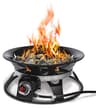
Choose natural gas if a gas line already runs near the patio and the pit is never moving. Choose propane for everything else. That is the verdict, and it is unusually clean for a fuel comparison, because the two options are not really competing on performance. They are competing on whether you are willing to pay a licensed gas fitter before you get your first fire.
Natural gas buys you one thing that propane cannot: it never runs out. No cylinder, no swap, no twenty-pound tank to hide inside a table cabinet, no guessing how much is left, no trip to the exchange cage on the one evening everyone is over. It is also cheaper per hour of burn, because piped utility gas costs less per unit of energy than cylinder propane. If you use a fire pit most evenings through a long season, that difference compounds.
Propane buys you the ability to have a fire this weekend, anywhere. Zero install cost, no permit, no trench across the lawn, no plumber. Put it where you like, move it when the wind changes, take it camping, take it with you when you move house. For most people that flexibility is worth more than the per-hour saving, which is why propane outsells natural gas enormously in this category.
The comparison, point by point
| | Natural gas | Propane |
|---|
| Cost to start | Licensed line, permit, inspection | Cylinder and a regulator |
| Cost per hour | Lower | Higher |
| Runs out mid-evening | Never | Yes — keep a spare |
| Portable | No, fixed to the line | Yes, anywhere in the garden |
| Energy per cubic foot | Lower — needs a larger orifice | Higher — smaller orifice |
| Output on a freezing night | Unaffected | Drops as the cylinder chills |
| Where the tank goes | Nowhere — nothing to store | Cabinet, or beside the pit |
| Leak behavior | Lighter than air, rises | Heavier than air, pools low |
| Typical product form | Drop-in burner pan, built-in | Finished bowl or table |
| Moves with you | No | Yes |
The orifice difference, and why it matters to you
Propane carries more energy per cubic foot than natural gas and is delivered at a different pressure. The practical consequence is that the same flame requires a different gas orifice for each fuel, and that is why you cannot simply attach a natural gas line to a propane pit.
Get it wrong in one direction and you get a weak, starved flame — natural gas through a propane orifice, which is disappointing but not dangerous. Get it wrong in the other and you over-fire the burner, which is the direction that matters. This is why a conversion is only legitimate when the maker supplies a kit for that model and a qualified fitter does the work. It is also why a listing that states both fuels from the outset, as the Stanbroil 48 x 14 pan does, is a cleaner starting point than a conversion.
The install, realistically
Natural gas is a construction project.A new line to the patio is licensed work in most places, generally needs a permit and an inspection, and has to be sized for the total load of every appliance on it — a fire pit added to a line already feeding a furnace and a water heater may need the line upsized. Then the pit itself is a built-in: a stainless drop-in pan set into a masonry, block or framed surround, with an access panel for the valve. Budget for the surround as well as the pan, because the pan is the cheap part.
Propane is unboxing.Attach the regulator, connect a cylinder, leak-test with soapy water, light it. If you want the built-in look on propane, the same drop-in pans work — you just need somewhere ventilated in the surround for the cylinder, which is a real design constraint rather than an afterthought. Our propane fire pits with a hidden tank page covers the units that have solved it, and best fire pit kits covers the drop-in route in general.
Safety differs in one specific, useful way
Both fuels are safe when installed and used correctly, and both produce carbon monoxide, which is why neither belongs in an enclosed space. The CPSC recommends CO alarms on every level of a home and outside sleeping areas.
The difference worth knowing is leak behavior. Natural gas is lighter than air and rises, so a leak outdoors disperses upward. Propane is heavier than air and pools at ground level — in the fire pit bowl, in a surround cavity, in a window well, at the floor of a garage. That single property is why propane cylinders are stored outdoors and upright, why you light a propane pit with the lid open, and why repeated clicking at an unlit burner is a bad idea. We cover all of it on are propane fire pits safe.
So, which should you buy?
Natural gas, if: there is already a gas line at or near the patio; the pit is part of a permanent hardscape you are building anyway; you expect to use it very regularly; and running out of fuel mid-evening would genuinely annoy you. Confirm permitting and line capacity before you buy a burner pan.
Propane, if:there is no line, or getting one means trenching across a finished garden; you rent; you might move; you want the pit in different places; or you want a fire this weekend rather than after a permit. Buy a spare cylinder with it — that one accessory removes the main disadvantage of the fuel.
And if neither sounds right, the honest third answer is wood. It is the cheapest heat per dollar by a wide margin and needs no line and no cylinder, at the cost of smoke, ash and a fire you cannot switch off. Wood-burning fire pits covers that side, and best fire pit tables covers what the gas route gets you that wood never will: a flat, usable surface and a knob.