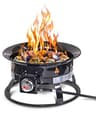
Why gas is the right default on a patio
We recommend wood fires on most of this site, so it is worth being clear why a patio is the case where gas usually wins.
No embers.A wood fire throws sparks, and on a patio those sparks land on your surface, your cushions and your decking. A gas flame produces none. This is the single biggest reason HOAs, condo boards and campgrounds that ban open wood fires allow certified propane appliances — and why a smokeless pit, which reduces smoke but still throws embers, does not satisfy those rules.
No ash. Ash plus rain makes a gray alkaline wash that runs across pavers and into the joints, and on pale concrete it leaves a mark you will be looking at next summer. There is no ash from a gas pit at all.
No staining material. Corten weathering steel is a wonderful material and it bleeds rust-colored runoff in its first rains. On a dark slate patio nobody notices; on pale concrete it is permanent. Stainless and painted steel do not do this.
Short sessions work.A gas pit lights with a knob and goes out instantly, so you can have a fire for forty minutes on a Tuesday. A wood fire needs lighting, establishing and then properly extinguishing — which realistically means it is a weekend thing.
Protecting the surface
Whatever you buy, two cheap things do most of the work.
A mat. A multi-layer fireproof mat under the pit stops heat transfer into the slab and catches anything that falls. This matters far more under a wood fire than a raised gas bowl, and it is essential on anything combustible. Our fire pits for decks page covers the decking case in full, and the same mats apply to pavers you care about.
A cover.A gas pit’s burner and its glass wind guard are the expensive parts, and water sitting in a burner pan over winter is what ruins them. Twenty dollars of fabric, as our cover picksset out — and buy the right shape, because a round cover on a square table leaves the corners exposed, which is where water pools.
One more, free: do not site the pit against the house wall. Heat marks render and siding, and you need clearance for airflow and for getting round it. Smokey Bear’s clearance guidance for open fires is a cleared 10-foot area, 15 feet from vegetation and low-hanging branches, and vertical clearance of at least three times the flame height. A certified gas pit relaxes the ember part of that, not the common sense.
Sizing a fire pit to a patio
The rule is to size to the seating circle, not the patio — but on a patio you also have to leave room to walk. A useful way to think about it:
- Courtyard or balcony: a tabletop unit. It takes no floor, and the floor is what you are short of.
- Small to average patio: a 19 to 21-inch bowl, or a 28-inch fire table that also works as a table. Anything larger dominates.
- Large patio: a 44-inch rectangular table, which seats six properly and reads as furniture rather than an appliance.
Our sizing guide works the seating circle out in detail. For gas specifically, remember that BTU is not warmth at your chair— a fire table puts the flame at table height behind a wind guard and sends most of its energy upward, so a 50,000 BTU table is a social object more than a heater. If what you actually want is to be warm on a patio in October, a patio heater does that far better for the money.
Where to put the tank
The detail that spoils more patios than anything else on this page. A propane bowl needs a 20 lb tank somewhere, and a tank sitting next to a nice fire bowl on a nice patio looks exactly like a tank sitting next to a nice fire bowl.
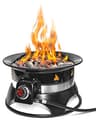
Fire pit tablesgenerally hide the tank in the base, which is a large part of what you are paying for. Portable bowls like the Outland come with a hose that runs to a tank you place yourself — behind a planter, under a side table, or in the corner. Decide where it goes before you buy, because “we will sort that out later” is how a tank ends up in the middle of the patio with a hose across the walkway.
Cylinder or gas line?
Every pit on this page runs on a 20-pound cylinder, which is why none of them needed a plumber. If the patio is being built or rebuilt anyway, a piped supply is worth pricing: natural gas vs propane fire pit compares the two on install cost, running cost, cold-weather output and what happens to portability when the fire is plumbed in.