Coal & Char

Fire Pits Under Pergolas and Gazebos

You have a structure over the patio and you want a fire under it. Here is the clearance rule that decides it, the fuel that makes it workable, and the units with the lowest flame.

By Stephen V.Last updated How we pick

How this is funded:we earn a commission if you buy through our links, at no extra cost to you. It never changes which pit or heater we recommend, and we’ll tell you when we’d skip one. Full disclosure.

The short answer: a propane fire pit with a low flame can work under an open-slat pergola if the height clears both the manufacturer’s figure and three times the flame height. A wood-burning fire pit under any covered structure is a bad idea, and an enclosed gazebo is a no. That is the whole decision, and the rest of this page is how to check it against your own patio.

The problem is specific and it has two halves. Heat rises in a column straight into whatever is above the fire, and timber, fabric and vinyl all have limits. Embers and smokeride that same column — which is why the fuel you choose changes the answer more than anything else you can do.

The fix, in plain steps

Work through these in order. If any one of them fails, the answer is no, and the alternative is at the bottom of this page.

  1. Measure the height. From the surface the pit will stand on to the lowestthing above it — and the lowest thing is usually not the beam. It is the canopy, the shade sail, the hanging basket, or the spare lumber someone put across the rafters.
  2. Get the maker’s overhead clearance figure.It is in the manual for the specific unit, and it is the number that governs. If a listing publishes no clearance figure, treat that unit as unsuitable for use under a structure — do not substitute a rule of thumb for a missing specification.
  3. Apply the flame-height check as well.Smokey Bear’s published guidance for outdoor fires is vertical clearance of at least three times the height of the flames. Both checks have to pass.
  4. Choose propane.No embers, no smoke, no ash, and a valve that stops the fire instantly. Under a structure that last property is worth more than it sounds — a wood fire cannot be turned off.
  5. Clear everything overhead and keep the sides open. Fabric canopy down, shade cloth down, baskets off, nothing stored on the rafters. Open sides let the heat plume and combustion products disperse instead of collecting under the roof.

Pergola, gazebo, pavilion: they are not the same problem

People use the words interchangeably and the structures behave completely differently.

StructureWhat is overheadVerdict with propane
Open-slat pergolaSpaced timber or aluminum beams, sky betweenUsually workable if the height clears
Pergola with a fabric canopyCombustible cloth, lower than the beamsOnly with the canopy retracted or removed
Louvered or vinyl-top pergolaSolid when closed, plastic in many casesOpen the louvers; check the maker's temperature limits
Gazebo, open-sidedSolid roof, air can move sidewaysPossible with generous height and nothing stored above
Gazebo, screened or enclosedSolid roof, restricted airflowNo — treat it as an indoor space
Pop-up canopy or party tentFabric, low, and it moves in windNo, with any fuel

The dividing line is airflow plus what the lowest surface is made of. An open-slat pergola over a patio is barely a roof. A screened gazebo is a small room, and putting a combustion appliance in a small room introduces the one hazard that is invisible: the CPSC reports more than 200 accidental non-fire carbon monoxide deaths a year in the US from consumer products. Propane burns cleanly, but it still consumes oxygen and produces carbon monoxide, and an enclosed space is exactly where that becomes dangerous. Outdoor-rated appliances are rated for outdoors because the air moves.

Why propane is the answer here

Four reasons, in order of how much they matter under a structure.

  • No embers.This is the big one. A wood fire lofts glowing fragments on rising air, and under a roof they have somewhere to land and lodge — in timber grain, in a fabric seam, in the leaf debris nobody cleared off the rafters.
  • No smoke, so no residue. Wood smoke deposits tar and soot on whatever is directly above the fire. Over seasons that stains the structure and adds a combustible film to it.
  • A valve. If the flame is reaching higher than you expected, or wind pushes it sideways, you turn it off and the fire stops. A wood fire has to burn down.
  • A lower, more predictable flame.A burner pan produces a flame height you can judge in advance and roughly reproduce every time. A wood fire’s flame height depends on how much wood is on it.

Among propane units, the low-profile fire tables are the best shape for this job: the burner sits in a wide shallow pan close to table height, the flame is correspondingly low and spread out, and the tank hides inside the body. The full range is on best fire pit tables and propane fire pits with a hidden tank. Avoid tall fire columns and pyramid-style units entirely — they are designed to send a flame upward.

If the height does not work

Do not force it. There are three honest alternatives, and two of them are better than a compromise.

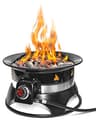
Move the fire out from under the structure.A portable propane bowl like the Outland in the picks weighs little and carries by its handle — use it on the open patio and sit under the pergola when it is not lit. This is the answer most people land on.

Heat the space instead of lighting a fire in it. An electric infrared heater mounted on a pergola beam is designed for exactly this situation: it produces no combustion products at all, it can be mounted above head height, and it is the only genuinely safe way to put warmth under a solid roof. Our electric patio heaters page covers the wall and ceiling-mount models, and porch heaters covers the same problem on a covered porch.

Reconsider the structure. If the fire is the point of the patio, an open-slat pergola with the canopy left off, or a louvered roof you can open, gets you shade in the afternoon and clearance in the evening. That is a cheaper change to make at the planning stage than after.

Whatever you choose, keep the means of putting the fire out within reach. For a propane unit that is the valve and the tank shut-off. For any wood fire — including one you have moved out into the open — Smokey Bear’s method is drown, stir, drown, feel: water until the hissing stops, stir the water into the embers, keep adding water until everything is cool, then hover the back of your hand over the ashes to check.

Under a solid roof instead of open slats

Everything above assumes a structure that air and heat can pass through. A solid patio roof is a different problem, and it is decided by your unit’s published clearance to combustibles against your actual ceiling height. Best fire pit for a covered patio ranks the gas pits by flame height for exactly that case, and explains why no wood or smokeless pit belongs under a roof deck.

What we'd actually buy

All four are propane, because propane is the fuel that makes this situation workable at all. They are ordered by how low and how controlled the flame is — which under a structure is the only ranking that matters.

Quick picks

Ranked on published specs, beginner-friendliness and value. Select a row to jump to the full write-up. We haven’t cooked on every one of these — here is exactly what we do instead.

#ProductBest forPrice
1
Endless Summer 30" Tabletop Steel Propane Gas Fire Table

Endless Summer 30" Tabletop Steel Propane Gas Fire Table

A low 30-inch gas table at close to fire-bowl money, and the sensible pick for a small patio or a balcony where a full-height fire table would dominate. It sits at coffee-table height, which is where a fire actually wants to be if people are in lounge chairs rather than dining chairs. Steel rather than resin or tile keeps the price down and the ledge hot, so treat the surround as decoration rather than a place to set a glass.

Lowest flame profile
$139.99 · View on Amazon

Price as of October 27, 2026. #ad How we’re funded

2
Ciays 28-Inch CSA-Listed Propane Fire Pit Table (50,000 BTU)

Ciays 28-Inch CSA-Listed Propane Fire Pit Table (50,000 BTU)

The cheapest fire pit table here that states a CSA listing on the listing itself, which is the thing worth paying for in this category — a 50,000 BTU burner hidden inside furniture is exactly where certification matters. Twenty-eight inches square with a lid means it works as an ordinary patio table when the burner is off, which is the real appeal of a fire table over a fire bowl. Build quality is what you would expect at this price: fine, not heirloom.

Best certified table
$149.89 · View on Amazon

Price as of October 27, 2026. #ad How we’re funded

3
Outland Living Firebowl 870 Premium 19" Auto-Ignition

Outland Living Firebowl 870 Premium 19" Auto-Ignition

The 870 adds auto-ignition to Outland's standard 19-inch bowl, which sounds like a small thing until you have crouched over a fire pit in the wind with a lighter. Push and turn, it lights. Everything else — the bowl, the output, the CSA listing people actually need for campgrounds — is the familiar Outland package. It is worth the modest premium over the base model if the pit will be used often, and not worth it if it comes out twice a year.

Best portable, instant off
$199.99 · View on Amazon

Price as of October 27, 2026. #ad How we’re funded

4
Camplux FP19MB Portable Propane Fire Pit (19")

Camplux FP19MB Portable Propane Fire Pit (19")

Camplux's 19-inch propane bowl is the obvious cross-shop against the Outland, built for the same RV-and-campsite job at a similar price. There is very little between them on paper; choose on whatever is in stock and cheaper on the day, with one tiebreaker — if a campground specifically asks to see a CSA listing, check the listing you are buying states it, because that is the detail that varies between cheap propane bowls.

Cheapest low bowl
$129.99 · View on Amazon

Price as of October 27, 2026. #ad How we’re funded

#1Lowest flame profile

Endless Summer 30" Tabletop Steel Propane Gas Fire Table

A low 30-inch gas table at close to fire-bowl money, and the sensible pick for a small patio or a balcony where a full-height fire table would dominate. It sits at coffee-table height, which is where a fire actually wants to be if people are in lounge chairs rather than dining chairs. Steel rather than resin or tile keeps the price down and the ledge hot, so treat the surround as decoration rather than a place to set a glass.

What’s good

  • Coffee-table height suits lounge chairs better than a dining-height table
  • 30 inches without the footprint of a full fire table
  • Among the cheapest branded gas tables available
  • Steel construction with very little to go wrong

Trade-offs

  • Steel surround gets hot — not a drinks ledge
  • BTU rating is not published on this listing
  • No lid stated
  • Low profile means more wind interference with the flame
TypeLow-profile propane gas fire table
Size30" (per the listing)
MaterialSteel
FuelPropane — 20 lb tank not included
Heat outputNot published on this listing

Specs read from the product listing, on October 7, 2026. “Not published” means the maker doesn’t state that figure there.

#2Best certified table

Ciays 28-Inch CSA-Listed Propane Fire Pit Table (50,000 BTU)

The cheapest fire pit table here that states a CSA listing on the listing itself, which is the thing worth paying for in this category — a 50,000 BTU burner hidden inside furniture is exactly where certification matters. Twenty-eight inches square with a lid means it works as an ordinary patio table when the burner is off, which is the real appeal of a fire table over a fire bowl. Build quality is what you would expect at this price: fine, not heirloom.

What’s good

  • CSA listing stated on the listing — unusual at this price
  • 50,000 BTU is plenty for a 28-inch table
  • Lid turns it back into a usable patio table
  • Tank hides inside the base on this design

Trade-offs

  • Thin steel and a painted finish — cover it
  • 28 inches is small if you want food and drinks round the flame
  • Fire glass or lava rock quantity included is not published
  • Assembly is required and the instructions are basic
TypeSquare propane fire pit table
Size28" (per the listing)
Heat output50,000 BTU (per the listing)
CertificationCSA-listed, per the listing
Lid includedYes, per the listing

Specs read from the product listing, on October 7, 2026. “Not published” means the maker doesn’t state that figure there.

#3Best portable, instant off

Outland Living Firebowl 870 Premium 19" Auto-Ignition

The 870 adds auto-ignition to Outland's standard 19-inch bowl, which sounds like a small thing until you have crouched over a fire pit in the wind with a lighter. Push and turn, it lights. Everything else — the bowl, the output, the CSA listing people actually need for campgrounds — is the familiar Outland package. It is worth the modest premium over the base model if the pit will be used often, and not worth it if it comes out twice a year.

What’s good

  • Auto-ignition — no lighter, no crouching in the wind
  • The well-proven Outland 19-inch bowl underneath
  • Smokeless by nature: it is gas
  • Still portable and still campground-friendly

Trade-offs

  • Ignition module is one more thing that can fail
  • Costs more than the manual-light version of the same pit
  • Tank not included
  • Lava rock included quantity is not published
TypePortable propane fire bowl, auto-ignition
Diameter19" (per the listing)
IgnitionAuto-ignition, per the listing
FuelPropane — 20 lb tank not included
Heat outputNot published on this listing

Specs read from the product listing, on October 7, 2026. “Not published” means the maker doesn’t state that figure there.

#4Cheapest low bowl

Camplux FP19MB Portable Propane Fire Pit (19")

Camplux's 19-inch propane bowl is the obvious cross-shop against the Outland, built for the same RV-and-campsite job at a similar price. There is very little between them on paper; choose on whatever is in stock and cheaper on the day, with one tiebreaker — if a campground specifically asks to see a CSA listing, check the listing you are buying states it, because that is the detail that varies between cheap propane bowls.

What’s good

  • Direct alternative to the Outland at a comparable price
  • 19-inch bowl is the easy size to stow in an RV bay
  • Gas means no ash, no sparks and instant shutdown
  • Light enough to carry one-handed when empty

Trade-offs

  • BTU rating is not published on this listing
  • Tank, regulator storage and lava rock top-ups are all on you
  • Smaller support network than Outland if a part fails
  • Check the listing for a CSA statement before relying on it at a campground
TypePortable propane fire bowl
Diameter19" (per the listing)
ModelFP19MB
FuelPropane — 20 lb tank not included
Heat outputNot published on this listing

Specs read from the product listing, on October 7, 2026. “Not published” means the maker doesn’t state that figure there.

A note on fire safety. Clearances and extinguishing steps on this page follow Smokey Bear’s campfire-safety guidance. Your local burn rules, HOA and the manual that came with your unit all override anything here. We’re enthusiasts sharing what we’ve researched, not fire officers — when in doubt, follow your local fire authority.

Frequently asked questions

Can you put a fire pit under a pergola?

Sometimes, and only with the right fuel and enough height. An open-slat timber pergola with nothing stored on it, a propane fire pit with a low flame, and clearance that satisfies both the manufacturer's published figure and the three-times-flame-height rule can be an acceptable combination. A wood-burning fire pit under any pergola is a bad idea, because wood throws embers upward and deposits smoke residue on the timber directly above the fire.

Can you use a propane fire pit under a gazebo?

A gazebo is harder than a pergola, because it usually has a solid roof and often closed or screened sides. Propane removes the ember and smoke problem, but a solid roof traps heat and combustion products, and enclosed sides stop air moving through. If the roof is solid you need the manufacturer's overhead clearance figure met with room to spare, the sides genuinely open, and nothing fabric or stored overhead. If the gazebo is enclosed, the answer is no — that is an indoor space as far as combustion is concerned.

How much clearance does a fire pit need underneath a structure?

Whatever the manufacturer's manual says for that specific unit — that figure governs and it varies widely. As a second sanity check, Smokey Bear's published guidance for outdoor fires is vertical clearance of at least three times the flame height. If the maker publishes no overhead clearance figure at all, treat the unit as not suitable for use under a structure rather than guessing.

Is a wood fire pit ever safe under a pergola?

Far less safe than propane, and we would not recommend it. Wood fires throw embers upward on rising air, and those embers can lodge in timber, fabric or debris above the fire. Wood smoke also leaves a residue on whatever is directly overhead. If you only have a wood pit and a pergola, use the pit well clear of the structure instead — or switch to a propane unit for the covered area.

What about a fabric or canvas pergola canopy?

Take it down before you light anything. A retractable canopy, shade sail or canvas top sits directly in the heat plume, it is combustible, and in many cases it is the lowest thing above the fire — which means it, not the beams, sets your clearance measurement. The same goes for bamboo screens, reed roll, shade cloth and hanging baskets.

Does a smokeless fire pit make it safe under a pergola?

No. Smokeless fire pits reduce visible smoke by burning combustion gases more completely; they still burn wood, still throw embers, and still run very hot. The smokeless design solves a comfort problem — smoke in your eyes — not a clearance or ember problem. Under a structure the fuel is the decision, and propane is the fuel that changes the answer.

Do I need to tell my HOA or check local rules?

Check, yes. Rules on open flame under covered structures and on raised decks vary by municipality, by fire district and by HOA, and seasonal burn bans frequently apply to wood but not to propane. A permanent gas installation may also need a permit and an inspection. It is a short phone call, and far cheaper than removing something you have already built.

Sources

  • Smokey Bear — Campfire Safety — The official “Drown, Stir, Drown, Feel” method for extinguishing an outdoor fire — “Pour lots of water on the fire until the hissing sound stops, drowning all the embers,” stir the water into the embers with a shovel, keep adding water until all material is cool, then “Hover the back of your hand over the ashes to feel that the embers are cool.” The same page gives the siting rules: clear “at least a 10-foot diameter around the site,” “stay at least 15 feet from tents, vegetation, and low-hanging branches,” and “ensure you have vertical clearance at least 3 times the height of the flames” (accessed October 7, 2026)
  • CPSC — Carbon Monoxide Information Center — The US Consumer Product Safety Commission on carbon monoxide: “More than 200 people in the United States die every year from accidental non-fire related CO poisoning associated with consumer products,” and its standing recommendation to “Install battery-operated CO alarms or CO alarms with battery backup on every level of the home and outside sleeping areas” (accessed October 7, 2026)
  • EPA Burn Wise — Best Wood Burning Practices — EPA on firewood: “Wood burns best at a moisture content of less than 20 percent,” and “Season wood for at least six months. Be sure to store wood outdoors, off the ground, with only the top covered -- covering the sides traps in moisture.” The same page lists what must never be burned, including household trash, “coated, painted, and pressure-treated wood,” plywood and particle board, driftwood, and “wet, rotted, diseased, or moldy wood” (accessed October 7, 2026)

Keep reading