Coal & Char

Best Patio Heater for a Covered Porch

A roof above you rules out the tall propane heaters and rules in the mounted ones. The same logic answers windy spots and all-winter use.

By Stephen V.Last updated How we pick

For a covered porch, buy the Dr. Infrared DR-239 and mount it. It puts 3,000 watts of radiant heat on a wall or ceiling bracket, carries a published IP55 weather rating so rain blowing in is not a problem, and takes up no floor at all. Under a roof that last point matters more than it sounds — a porch is usually the narrowest outdoor space you own, and a freestanding heater eats the walkway.

The reason the tall propane heaters are not the answer here is clearance. A mushroom or pyramid heater is roughly seven feet tall and puts a burner and reflector at the very top of itself, directly under your ceiling, and its manual specifies a minimum clearance above and around. On an eight or nine foot porch ceiling, many of them simply do not fit the specification. Add combustion in a space with at least one enclosed side and the case gets weaker still. Electric radiant mounts above head height, has no flame and no exhaust, and solves the geometry instead of fighting it.

The same answer covers the other two questions people ask here: wind, and winter. A gas patio heater warms largely by heating air, and wind takes that air away — it is the reason a 46,000 BTU heater can feel like nothing on a gusty evening, and gusts blow pilot flames out. Infrared radiant heat travels to what it hits rather than warming the air in between, so wind affects it far less. And across a whole winter, a mounted electric unit has no cylinders to swap, nothing to drag in and out, and no output drop when the temperature falls — which a chilled propane cylinder genuinely suffers from.

How this is funded:we earn a commission if you buy through our links, at no extra cost to you. It never changes which pit or heater we recommend, and we’ll tell you when we’d skip one. Full disclosure.

Quick picks

Ranked on published specs, beginner-friendliness and value. Select a row to jump to the full write-up. We haven’t cooked on every one of these — here is exactly what we do instead.

#ProductBest forPrice
1
Dr. Infrared Heater DR-239 3000W Wall/Ceiling Infrared Patio Heater

Dr. Infrared Heater DR-239 3000W Wall/Ceiling Infrared Patio Heater

The permanent-install answer: a 3,000 watt IP55-rated infrared bar that bolts to a wall or a pergola beam and heats the space under it on a switch. Mounted overhead it takes up no floor space, nothing can be knocked over, and there is no tank. That is close to ideal for a covered patio or a balcony. It needs a suitable circuit and a competent install, which is the real cost — the heater itself is not expensive for what it does.

Best overall for a covered porch
$293.20 · View on Amazon

$349.0016% off

Price as of October 27, 2026. #ad How we’re funded

2
hykolity 1500W Infrared Wall-Mount Patio Heater, 35.5" (IP55)

hykolity 1500W Infrared Wall-Mount Patio Heater, 35.5" (IP55)

A 1,500 watt infrared bar with an IP55 weather rating, a remote and a 24-hour timer — the specification a covered porch actually needs. IP55 is the figure to look for on anything mounted outdoors: it is the difference between a heater rated for rain-blown air and an indoor heater someone photographed on a patio.

Best 120 V wall mount
$105.99 · View on Amazon

$139.9924% off

Price as of October 27, 2026. #ad How we’re funded

3
Econat 1500W Infrared Wall or Ceiling Mount Patio Heater

Econat 1500W Infrared Wall or Ceiling Mount Patio Heater

The cheapest mounted infrared heater worth listing, with an adjustable thermostat and the option of wall or ceiling mounting. The listing does not publish a weather rating, which is why it sits below the hykolity here: for a fully covered porch it is fine, and for anywhere rain can reach it is the wrong buy.

Best budget mount
$84.55 · View on Amazon

$89.005% off

Price as of October 27, 2026. #ad How we’re funded

4
Dr. Infrared Heater Portable Infrared Indoor/Outdoor Space Heater

Dr. Infrared Heater Portable Infrared Indoor/Outdoor Space Heater

Electric infrared solves the two things people actually hate about propane heaters: refilling tanks and the hard limit on where you can run one. It plugs into a socket, it produces no combustion products at all, and it can be used in a garage or a covered porch where a gas heater should not be. The honest trade is reach — infrared warms what it is pointed at, so it heats a person on a chair beautifully and an open lawn not at all.

Best if you cannot mount anything
$109.98 · View on Amazon

$125.9913% off

Price as of October 27, 2026. #ad How we’re funded

5
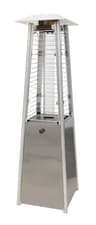
Hiland HLDS032-GTTSS Tabletop Pyramid Patio Heater (10,000 BTU)

Hiland HLDS032-GTTSS Tabletop Pyramid Patio Heater (10,000 BTU)

A tabletop version of the glass-tube pyramid, running on a 1 lb cylinder hidden in the base. Ten thousand BTU will take the edge off for two or three people sitting right at the table, and the visible flame does most of the work emotionally. It is the right answer for a bistro table, a balcony or a small deck where a six-foot heater would be absurd — and the wrong answer if you actually need to warm a group.

Best small gas option
$149.38 · View on Amazon

Price as of October 27, 2026. #ad How we’re funded

The picks in full

#1Best overall for a covered porch

Dr. Infrared Heater DR-239 3000W Wall/Ceiling Infrared Patio Heater

The permanent-install answer: a 3,000 watt IP55-rated infrared bar that bolts to a wall or a pergola beam and heats the space under it on a switch. Mounted overhead it takes up no floor space, nothing can be knocked over, and there is no tank. That is close to ideal for a covered patio or a balcony. It needs a suitable circuit and a competent install, which is the real cost — the heater itself is not expensive for what it does.

What’s good

  • 3,000 W mounted overhead — no floor space, nothing to knock over
  • IP55 weatherproof rating stated on the listing
  • No tank, no combustion, no refueling
  • Heats the area beneath it consistently

Trade-offs

  • Needs a suitable circuit and a proper electrical install
  • Fixed in place — it heats one spot forever
  • Listing states 208-240V, so check your supply before buying
  • Running cost is real at 3,000 W
TypeWall or ceiling mounted electric infrared heater
Power3,000 W (per the listing)
Weather ratingIP55 (per the listing)
ModelDR-239
MountingWall or ceiling, per the listing

Specs read from the product listing, on October 7, 2026. “Not published” means the maker doesn’t state that figure there.

#2Best 120 V wall mount

hykolity 1500W Infrared Wall-Mount Patio Heater, 35.5" (IP55)

A 1,500 watt infrared bar with an IP55 weather rating, a remote and a 24-hour timer — the specification a covered porch actually needs. IP55 is the figure to look for on anything mounted outdoors: it is the difference between a heater rated for rain-blown air and an indoor heater someone photographed on a patio.

What’s good

  • IP55 weather rating published on the listing
  • 1,500 W on an ordinary 120 V socket
  • Remote and 24-hour timer, per the listing
  • Mounts overhead, out of the way of furniture

Trade-offs

  • 1,500 W warms people, not air — it needs cover overhead
  • Needs a mounting point at the right height
  • Coverage area not published as a figure
  • Marketplace brand rather than a heat name
TypeWall-mount electric infrared heater
Output1,500 W (per the listing)
Weather ratingIP55 (per the listing)
Length35.5" (per the listing)
ControlsRemote, 24-hour timer (per the listing)

Specs read from the product listing, on October 13, 2026. “Not published” means the maker doesn’t state that figure there.

#3Best budget mount

Econat 1500W Infrared Wall or Ceiling Mount Patio Heater

The cheapest mounted infrared heater worth listing, with an adjustable thermostat and the option of wall or ceiling mounting. The listing does not publish a weather rating, which is why it sits below the hykolity here: for a fully covered porch it is fine, and for anywhere rain can reach it is the wrong buy.

What’s good

  • 1,500 W on a normal socket for well under $100
  • Adjustable thermostat, per the listing
  • Wall or ceiling mounting
  • Indoor and outdoor use stated on the listing

Trade-offs

  • No IP weather rating published
  • No remote stated on the listing
  • Coverage area not published
  • Marketplace brand with a short track record
TypeWall / ceiling mount electric infrared heater
Output1,500 W (per the listing)
ThermostatAdjustable (per the listing)
MountingWall or ceiling (per the listing)
Weather ratingNot published

Specs read from the product listing, on October 13, 2026. “Not published” means the maker doesn’t state that figure there.

#4Best if you cannot mount anything

Dr. Infrared Heater Portable Infrared Indoor/Outdoor Space Heater

Electric infrared solves the two things people actually hate about propane heaters: refilling tanks and the hard limit on where you can run one. It plugs into a socket, it produces no combustion products at all, and it can be used in a garage or a covered porch where a gas heater should not be. The honest trade is reach — infrared warms what it is pointed at, so it heats a person on a chair beautifully and an open lawn not at all.

What’s good

  • No tank to refill and no combustion products at all
  • Safe to use in a garage or covered porch where gas heaters are not
  • Warms people directly rather than heating the air around them
  • Cheap to buy and simple to run

Trade-offs

  • Needs a power outlet within reach
  • Heats only what it points at — useless for an open circle
  • Electric running cost is higher per hour than propane in most areas
  • Wattage and coverage area are not published on this listing
TypePortable electric infrared heater
FuelElectric — no tank, no combustion
UseIndoor and outdoor, per the listing
WattageNot published on this listing

Specs read from the product listing, on October 7, 2026. “Not published” means the maker doesn’t state that figure there.

#5Best small gas option

Hiland HLDS032-GTTSS Tabletop Pyramid Patio Heater (10,000 BTU)

A tabletop version of the glass-tube pyramid, running on a 1 lb cylinder hidden in the base. Ten thousand BTU will take the edge off for two or three people sitting right at the table, and the visible flame does most of the work emotionally. It is the right answer for a bistro table, a balcony or a small deck where a six-foot heater would be absurd — and the wrong answer if you actually need to warm a group.

What’s good

  • Visible flame column at tabletop scale
  • Runs on a 1 lb cylinder concealed in the base — no 20 lb tank
  • Stainless and glass rather than painted steel
  • Small enough to leave on a table between uses

Trade-offs

  • 10,000 BTU warms the people at the table and nobody else
  • 1 lb cylinders run out quickly and cost more per hour
  • Glass tube is fragile and exposed
  • Light enough to be blown over — do not leave it out in wind
TypeTabletop glass-tube propane patio heater
Heat output10,000 BTU (per the listing)
MaterialStainless steel with glass flame tube
Fuel1 lb propane cylinder
ModelHLDS032-GTTSS

Specs read from the product listing, on October 7, 2026. “Not published” means the maker doesn’t state that figure there.

Published specifications

Only the figures the listings state. Where a maker does not publish a weather rating or a wattage, the table says so — and on a porch, a missing IP rating is worth noticing.

 OutputMountingWeather ratingControls
Dr. Infrared DR-2393,000 WWall or ceilingIP55Not published
hykolity wall mount1,500 WWallIP55Remote, 24-hour timer
Econat 1500 W1,500 WWall or ceilingNot publishedAdjustable thermostat
Dr. Infrared DR-238Not publishedPortable, floorNot publishedNot published
Hiland tabletop pyramid10,000 BTUTabletopNot publishedNot published

Note the circuit difference, because it decides the shortlist. The 1,500 watt units run on an ordinary 120 volt outlet. The 3,000 watt DR-239 does not — check what the listing and manual specify for supply and have an electrician confirm your porch circuit before you buy it. Twice the wattage is roughly twice the felt heat, and it is only available to you if the supply is there.

Three porches, three answers

A roofed porch with a solid ceiling you can drill. Mount the DR-239 if your circuit supports it, the hykolity if it does not. Both publish IP55, both go above head height, and a mounted heater aimed down and slightly outward warms the seating without warming the ceiling. Mount height and angle matter more than wattage: too high and the radiant heat spreads too thin, too low and it is uncomfortable.

A rented porch, or a surface you will not drill.The portable Dr. Infrared DR-238 is the honest answer. It sits on the floor, plugs into a normal outlet, and the listing covers indoor and outdoor use — which is the useful part, because it moves to a garage or workshop out of season. It publishes no wattage, so expect it to be the modest option, and it does occupy floor space.

A porch where you want a visible flame.The Hiland tabletop pyramid is the only gas unit on this page, and it is here precisely because it is small: 10,000 BTU from a 1-pound cylinder, on a table, with a glass flame tube. That is a fraction of a full patio heater’s output and therefore a fraction of its clearance problem. Still read its manual for clearance, still ventilate, and still fit a CO alarm if any side of the porch is enclosed.

Where a screened porch changes the rules

Screens on three or four sides stop being “outdoors” in the sense a gas appliance’s manual means. The ventilation it assumes is not there, and a propane burner consumes oxygen and produces carbon monoxide. The CPSC’s standing advice is battery-operated CO alarms, or alarms with battery backup, on every level of a home and outside sleeping areas.

In a fully screened porch, electric is not merely the better option, it is the one that removes the question — no combustion, no exhaust, no cylinder stored anywhere. Our electric porch heaters page covers the field in more depth, and is a propane heater safe indoors sets out which propane units are rated for enclosed spaces and which are never safe in one.

Windy porches, specifically

Three practical points, because this is a distinct problem rather than a variation of the first one.

  • Radiant beats convective in wind, every time. Infrared heats the objects and people it strikes. A gas heater warms a column of air that a gust removes. If your porch is exposed on the windward side, this is the whole decision.
  • A gust puts out a pilot; it cannot put out an element. Relighting a gas heater three times an evening is the common complaint in exposed spots, and some units will not stay lit in sustained wind at all.
  • Nothing tall and top-heavy in the wind.A seven-foot propane heater with a 20-pound cylinder in its base is stable until it is not, and a tipped heater is a serious event. If you want a freestanding gas heater, the ones with a water-fillable base are meaningfully steadier — our propane patio heaters page covers which publish that feature.

Winter running costs, honestly

Electric radiant heat is not cheap to run. A 1,500 watt unit draws 1.5 kilowatt-hours per hour; a 3,000 watt unit draws twice that. Multiply by your own rate and by the hours you will actually use it, because that is the figure that matters rather than any headline. What electric gives you in return is zero setup cost per session, no cylinder swaps in January, and a thermostat or timer so it is not running while nobody is sitting there — the hykolity publishes a remote and a 24-hour timer, the Econat an adjustable thermostat, and both features pay for themselves in a long winter.

Propane is usually cheaper per hour of heat and more expensive in everything else: the cylinder, the swaps, the storage, the output drop on the coldest nights, and the clearance it needs. For a covered porch used most evenings through winter, mounted electric wins on total cost of ownership rather than on the per-hour number. If your situation is the reverse — an open patio, used occasionally, where the biggest possible output matters — then propane vs electric patio heaters runs that comparison properly, and best small patio heaters covers the compact end of both fuels.


Frequently asked questions

What is the best patio heater for a covered porch?

A mounted electric infrared heater, and the Dr. Infrared DR-239 is the pick — 3,000 W on a wall or ceiling bracket with a published IP55 weather rating, and no floor space used. Check your porch circuit before buying it, because 3,000 W is not a standard 120 V load; the 1,500 W hykolity and Econat mounts are the plug-in alternatives.

Can you use a propane patio heater on a covered porch?

Usually not the tall ones. A mushroom or pyramid heater stands around seven feet and puts its burner and reflector directly under your ceiling, and its manual specifies a minimum clearance above and around that an eight or nine foot porch ceiling often cannot meet. A small tabletop gas heater is a different proposition because its output and clearance needs are a fraction of the size — read its manual, ventilate, and fit a CO alarm if any side is enclosed.

What is the best patio heater for windy areas?

An electric infrared heater, mounted. Infrared heats the people and objects it strikes rather than the air in between, so a gust cannot carry the heat away — and it has no pilot flame for the wind to blow out. Gas patio heaters warm air by convection, which is exactly what wind removes, and relighting one repeatedly is the standard complaint in an exposed spot.

What is the best patio heater for winter?

For regular winter use on a covered porch, a mounted electric unit with a thermostat or timer. It has no cylinders to swap in freezing weather, no output drop when the temperature falls — which a chilled propane cylinder genuinely has — and nothing to drag in and out. Propane is cheaper per hour of heat and more expensive in everything else, so electric wins on total cost when you use it most evenings.

How high should you mount a patio heater?

Follow the bracket height the manual specifies, then aim it down and slightly outward over the seating rather than straight down. Too high and the radiant heat spreads thin before it reaches anyone; too low and it is uncomfortable to sit under. On a porch, mounting above head height is also what keeps the walkway clear, which is half the reason to mount rather than stand.

Is an electric patio heater expensive to run?

It is not cheap. A 1,500 W unit draws 1.5 kilowatt-hours per hour and a 3,000 W unit twice that, so multiply by your own electricity rate and by the hours you will really use it. A thermostat or timer is the feature that controls the bill, which is why the hykolity's remote and 24-hour timer and the Econat's thermostat are worth having over a bare on-off switch.

Sources

  • CPSC — Carbon Monoxide Information Center — The US Consumer Product Safety Commission on carbon monoxide: “More than 200 people in the United States die every year from accidental non-fire related CO poisoning associated with consumer products,” and its standing recommendation to “Install battery-operated CO alarms or CO alarms with battery backup on every level of the home and outside sleeping areas” (accessed October 7, 2026)
  • FTC Consumer Advice — Online Shopping — FTC guidance for buying online: “before you buy something online, shop around and check out sellers and products,” note the exact manufacturer or model number when comparison shopping, and pay by credit card so a bad order can be disputed (accessed October 7, 2026)
  • Smokey Bear — Campfire Safety — The official “Drown, Stir, Drown, Feel” method for extinguishing an outdoor fire — “Pour lots of water on the fire until the hissing sound stops, drowning all the embers,” stir the water into the embers with a shovel, keep adding water until all material is cool, then “Hover the back of your hand over the ashes to feel that the embers are cool.” The same page gives the siting rules: clear “at least a 10-foot diameter around the site,” “stay at least 15 feet from tents, vegetation, and low-hanging branches,” and “ensure you have vertical clearance at least 3 times the height of the flames” (accessed October 7, 2026)

Keep reading