Three kinds of small, and which one you have
“Small” means different things on different patios, and the right heater follows from which constraint binds.
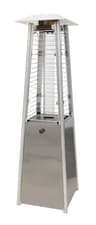
- No floor space, but there is a table. A tabletop propane tower like the Hiland. It occupies the middle of the table and nothing else, and the cylinder lives in the base. That category has its own ranking on best tabletop patio heaters, where five units are compared on published output and safety hardware.
- No floor space and no spare table. A wall- or ceiling-mounted electric infrared panel. It is the only category here that costs you no surface at all, and it is also the only one that needs a socket and a bracket.
- Small and no electricity. A compact portable propane heater. The Portable Buddy class is the answer, and it is also the one to choose if the heater needs to move between a balcony, a campsite and a garage.
Note what is not on this page: the 46,000 to 50,000 BTU standing mushroom and pyramid heaters. They are excellent and they are the right answer on a real patio — see best propane patio heaters — but they are roughly seven feet tall with a base over a foot and a half across, plus a 20 lb tank inside. On a small balcony they are a clearance problem rather than a heating solution.
Why a small heater needs you closer, not bigger
Radiant heat follows an inverse-square relationship: double your distance from the source and you feel roughly a quarter of the warmth. That one fact is why small heaters work at all.
A 10,000 BTU tabletop tower two feet from your hands delivers a very noticeable amount of warmth. The same unit eight feet away delivers almost nothing. So on a small patio, the geometry is working for you: everybody is already close. You do not need the output a big open patio needs, because you do not have the distances.
The corollary is the mistake to avoid: buying a big heater for a small space in the belief that more BTU is always better. In a tight, part- enclosed area a large propane heater is uncomfortable, burns through gas and raises genuine ventilation questions. Match the heater to the distance, then stop.
Propane or electric, on a small patio specifically
On a full patio this is a close call. On a small one it tilts:
- Electric wins on space and simplicity.Mount it once and it is invisible. No cylinders to store — and storing propane on a balcony is a problem in itself, since tanks must not be kept indoors.
- Electric wins on enclosure. No combustion means no carbon monoxide and no oxygen consumption, which matters on a covered balcony or a three-walled porch far more than on open ground.
- Propane wins when there is no socket,and when you want a visible flame. It also wins on raw output per dollar — a 1,500 W electric panel is about 5,100 BTU of equivalent heat, roughly half the Hiland’s published figure.
- Propane wins on portability. A Buddy heater goes anywhere. A wall panel goes where you screwed it.
The full version of this argument, including running costs, is in our propane vs electric comparison, and electric porch heaters covers the mounted options in more depth.
The safety part, because small spaces are where it matters
Short and specific:
- Clearances are not advisory.Small patios put heaters near railings, siding, umbrellas and planters. Read the clearance figures in the manual and respect the one above the unit — that is the dimension people ignore, and the one with an awning in it.
- Never use an outdoor propane patio heater indoors or in a closed space.Full-size patio heaters are outdoor appliances and are not designed for enclosed use. A genuinely enclosed space needs a heater designed and certified for it, with ventilation and a carbon monoxide alarm — see is a propane heater safe indoors.
- Tip-over protection matters more on a small patio,where everything is within a chair leg’s reach. The Buddy-class heaters carry a tip-over switch; check that any tabletop unit is stable on the table you actually own.
- Store cylinders outside and upright. Not in a cupboard, not in a hallway, not in a basement. If you have nowhere outside to keep a cylinder, that is an argument for electric.
What we would buy for three small spaces
- A two-chair balcony with a socket: the Econat 1,500 W, ceiling- or wall-mounted above the seating. Nothing on the floor, nothing to refill.
- A bistro table on an open balcony, no socket: the Hiland tabletop pyramid on 1 lb cylinders. Buy a spare cylinder and a cover.
- A small deck where the heater also serves a garage or a campsite: the Portable Buddy. It is the most useful object on this page even though it is the least patio-like, and our portable propane picks cover the rest of that range.
Whatever you buy, add a cover. Water in the burner or the ignition assembly is the main reason small heaters die young, and the fix costs a fraction of the heater — the same lesson as how long propane heaters last.
Small because the space is covered
A lot of people shop small because a roof rules out anything tall rather than because the patio is tight. Best patio heater for a covered porch is written for that case — mounted units that use no floor at all, the clearance arithmetic a ceiling imposes, and why a screened porch should be treated as an enclosed space rather than an outdoor one.