Propane or wood, for camping specifically
We like wood fires and this site is mostly about them. For camping, though, the case for propane is unusually strong:
- Fire bans. The big one. Restrictions on open wood fires are routine through summer in much of the US, and many of those orders permit a propane or gas appliance you can turn off. Check the order, not the rumor.
- No embers, no sparks. Which is both the reason for the exemption and the reason it is kinder to a tent, an awning and a nylon chair.
- No wood to find, buy or carry. Campground firewood is expensive and frequently damp, and transporting your own across state or county lines is restricted in many places because of pests.
- It goes out when you leave. A knob, not a bucket of water and twenty minutes of stirring. On a pack-up morning that is a real saving.
- Nothing smells of smoke. Tent, sleeping bag, hair, everything. Some people consider this a loss.
The honest counter-argument: a propane pit is not a campfire. There is no crackle, no ember bed and no smell of wood smoke, and you are carrying a 20 lb tank. If the wood fire is the point, our portable wood-burning fire pit picks cover the collapsible pits that pack flat — and those are what to buy when there is no ban on.
What makes a propane pit a camping pit
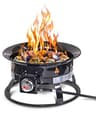
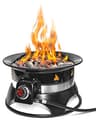
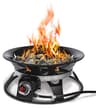
Most portable propane fire bowls are the same idea: a steel bowl, a burner ring, lava rock and a hose with a regulator. The differences that matter on the road are unglamorous:
- Is the cover and carry kit included? A lid that clamps the lava rock in place is what stops you unpacking a bag of rock and soot. Outland includes this; several rivals do not.
- Published BTU.58,000 is a warm fire. Where a listing does not publish a figure — the Camplux does not — our specs table says so rather than guessing, and you should treat it as unknown rather than assume parity.
- Ignition. Match-lit is fine and has nothing to fail. Auto-ignition is better in wind and in the dark, and the piezo unit is the most commonly replaced part on any gas appliance.
- Diameter against packed size. 19 inches fits a trunk with other gear; 21 inches gives a wider flame and starts to dominate the load. For an RV with a dedicated bay, take the bigger one.
- Hose length. Enough to put the tank outside the seating circle and out of the way of feet, which is both a trip and a heat consideration.
Fuel, run time and what to pack
These pits run on a 20 lb tank, which is not included with any of them. The arithmetic is simple and worth doing before a trip: run time scales directly with the amount of propane you carry and inversely with how high you run the burner. A tank that lasts a long weekend at a low setting will not last one at full output. Check the run-time figure the maker publishes for your model, and take a second tank for anything over a few nights.
Pack, in addition: a regulator hose long enough to site the tank clear of the circle, a tank gauge if you dislike surprises, and the cover. Do not pack the tank inside a closed vehicle cabin for long drives, and never store one in an RV living space — tanks belong in a vented exterior compartment or outside.
Camping, RVs and overlanding
Different trips point at different pits:
- Car camping: the Outland 893 at 19 inches. Best balance of flame, weight and the fact that the cover is included.
- RV with a storage bay: the Outland 21-inch, for the wider flame. Weight matters less when it is not being lifted over a tailgate. Our RV propane heater picks cover the inside-the-rig half of the same problem.
- Tailgating and picnic tables:a tabletop propane unit instead — see small fire pit tables and tabletop fire pits.
- Backpacking: none of these. A 20 lb tank rules the whole category out, and a tiny wood or pellet bowl is the only thing that travels on foot.
Safety and campground etiquette
Short list, all of it worth following:
- Check the fire order in force,at the campground office or the managing agency’s site. Gas exemptions are common and not guaranteed, and “someone told me it was fine” is not a defense.
- Site it on bare ground or gravel, clear of dry grass, pine needles and overhanging branches. A propane pit throws no embers but its base and surrounds still get hot.
- Keep the tank outside the seating circle, upright, shaded and where nobody will catch the hose with a boot.
- Never use one inside a tent, awning or RV. These are outdoor appliances; an enclosed space needs a heater built and certified for it. See is a propane heater safe indoors.
- Turn the tank valve off, not just the burner knob, when you are done for the night.
Our fire pit safety guidecovers clearances in general, and Smokey Bear’s campfire guidance in our sources is the authority to read before fire season rather than during it.