What a tabletop heater can and cannot do
Start here, because this is where disappointed reviews come from. A tabletop patio heater is a close-range device. The propane units on this page publish 10,000 to 11,000 BTU; a full-size standing patio heater publishes 46,000 to 50,000. That is not a small gap and no amount of marketing language closes it.
What saves the category is geometry. Radiant heat follows an inverse-square relationship: double your distance from the source and you feel roughly a quarter of the warmth. A tabletop heater is two or three feet from your hands and chest instead of eight or ten, so a tenth of the output still lands as a very noticeable amount of warmth on the people actually at the table. The Cuisinart listing is the only one here honest enough to put a number on it — 30 square feet — and that number is a fair description of all of them.
So the rule is simple. If everyone will be sitting at the table, a tabletop heater is the efficient answer and a seven-foot mushroom heater is overkill you also have to store. If people will be standing, circulating, or spread across a patio, no tabletop unit will do the job and you want a full-size propane heater instead. What size patio heater do you need sets this tier against the 9,000, 46,000 and 80,000 BTU bands if you are still deciding which one your space calls for.
How we ranked these five
In this order, and the order matters more than usual here because this is a category where most listings publish almost nothing:
- Published output. A BTU figure or a wattage on the listing. Three of these five publish one; one does not, and that cost it two places.
- Published safety hardware. Anti-tilt switch, flame failure cutoff, burner guard. We will not credit a heater with a safety feature its maker has not claimed, and on a device that sits at chest height among drinks and elbows this is the specification that matters most.
- Fuel and where it can legally and safely go. Propane outdoors; electric anywhere the air does not move freely.
- Price against output.Last, not first — but the spread here is wide enough that it decides the value pick.
Nothing on this page is ranked on a burn test, because we have not run one. Our method, and what we refuse to claim, is written out in full.
Propane or electric, on a table specifically
On a full patio this is a genuinely close call. On a table it tilts, and in a different direction than you might expect.
Propane wins on heat and on atmosphere.Eleven thousand BTU is roughly double what a 1,500 W electric element delivers — 1,500 W works out to about 5,100 BTU of equivalent output, since a watt is about 3.4 BTU per hour. It also needs no socket, which on most patios is the deciding practicality, and a glass flame tube gives you something to look at. For a table, that last point is not frivolous: people sitting around a flame behave differently than people sitting around a warm grille.
Electric wins on everything to do with enclosure.No combustion means no carbon monoxide, no oxygen consumption and no fuel smell. The US Consumer Product Safety Commission notes that more than 200 people in the United States die every year from accidental non-fire carbon monoxide poisoning linked to consumer products. An open patio is not where that happens — a part-enclosed one is closer to it. If your table sits on a screened porch, in a gazebo with the sides down, or in a garage with the door half open, buy the electric unit and stop reading this paragraph. The longer version is in carbon monoxide and outdoor heaters.
Electric also wins on running cost and hassle, if you have the socket. One-pound disposable propane cylinders are an expensive way to buy gas per hour, and running out of one mid-evening is the standard tabletop-heater experience. An adapter hose to a 20 lb tank fixes the cost and reintroduces the tank on the floor you were trying to avoid.
The five questions to ask before you buy any of them
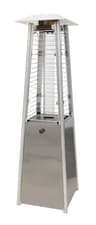
- Is my table stable enough? These are top-heavy objects with a live flame in them, and the pyramid units are 34 inches of hot glass sitting on a surface that people lean on. A solid table, every time. Not a folding bistro table, not a glass top with a wobble.
- Does the listing claim tip-over protection? If it does not, assume it does not have it. That is not a formality on a table, where a chair back or a sleeve is all it takes.
- What is overhead?The clearance figure people ignore is the one above the unit, and a tabletop heater puts the flame unusually close to an umbrella, a pergola slat or a canopy. Check the manual’s overhead figure before the sideways one.
- Where will the cylinder live?Propane cylinders are stored outdoors and upright — not in a cupboard, not in a hallway, not in a basement. If you have nowhere outside to keep one, that is an argument for electric before it is a preference.
- Will I leave it outside? Water in the burner or the ignition is the usual way small heaters die young. A cover costs a fraction of the heater; see patio heater covers.
What the listings do not tell you
Worth being blunt about, because it shapes the ranking above. Across these five listings, the following are simply not published: run time per cylinder on any of the propane units, weight on any of them, base diameter on three, and a BTU figure at all on the 34-inch pyramid. Two of the four propane heaters make no safety claim whatsoever.
We could fill those gaps with plausible-sounding numbers and nobody would check. We do not, on principle: every spec on this site traces to the listing it was read from on a dated visit, and a gap renders as “Not published”. The practical consequence for you is that the two heaters which publish the most — the Hiland and the Cuisinart — are the two at the top, and that is not a coincidence. A maker that states its safety hardware is a maker you can hold to it.
Three tables, three answers
- A bistro table on an open balcony, no socket.The Hiland pyramid on 1 lb cylinders. Buy a spare cylinder and a cover at the same time, and check your building’s rules on open flames and propane storage in writing before you order — a lot of apartment buildings prohibit both.
- A family dinner table on a deck. The Cuisinart. The anti-tilt switch and the burner screen guard are the reason, and the missing flame tube is the price. If the deck is timber or composite, the clearance rules in can you put a fire pit on a deck apply to a heater just as much as to a pit.
- A screened porch or a covered nook. The MOMOKOVA 1,500 W electric, and nothing that burns. Half the output, none of the ventilation question, and no cylinder to store. Electric porch heaters covers the mounted versions of the same idea.
When a tabletop heater is the wrong purchase
Three cases, stated plainly so you do not spend the money twice:
You want to warm a patio, not a table. Then you want a standing heater at 46,000 BTU and up. Our propane patio heater picks cover that range, and the tall units are better value per BTU by a wide margin.
You want atmosphere more than warmth. A tabletop fire pit does that job better and cheaper, runs on a handful of pellets and has no cylinder at all. See best tabletop fire pits — and be honest with yourself about which of the two you are shopping for, because the heaters and the little fire pits look similar in a photo and do completely different jobs.
Your problem is a small space rather than a table. If the constraint is a six-foot balcony rather than a dinner table specifically, best small patio heaters is the page you want: it ranges across tabletop, wall-mounted and portable units on the basis of what space you have, where this page is only about the ones that stand on the table itself.
The safety part, kept short
Four rules, all of which matter more at table height than at head height on a standing heater:
- Never use an outdoor propane heater in an enclosed space. These are outdoor appliances. A genuinely enclosed room needs an appliance certified for indoor use, ventilation and a carbon monoxide alarm — see is a propane heater safe indoors.
- Keep it on a solid, level surface, away from the table edge and out of the traffic path.
- Respect the overhead clearance in the manual, especially under an umbrella or a pergola.
- Turn it off and let it cool before covering it, and store cylinders outside and upright.
None of that is exotic, and all of it is the difference between a heater that lasts five seasons and an insurance claim.