Why the kettle, and not something bigger
A 22-inch kettle is a boring recommendation and it is the right one. The reason is airflow. Charcoal is controlled entirely by how much air reaches the fire, and you can only control air if it goes where you send it. A domed lid sitting in a rolled rim seals well enough that closing the vents actually slows the fire down. A flat lid resting on a flat barrel leaks everywhere, which is why cheap barrel grills eat fuel and cannot hold a low temperature.
For a beginner that difference is the whole experience. On a sealing kettle, “close the bottom vent halfway” produces a visible, predictable result, and cooking becomes learnable. On a leaky barrel it produces nothing, and the fire does whatever it wants. Add porcelain enamel that survives weather and spare parts you can still buy in a decade, and the kettle is the grill most likely to still be in use when the novelty has worn off.
Our full beginner grill comparison makes the case in detail, and the review of the kettle itself is honest about where it cuts corners.
The chimney starter is not optional
If you buy one thing from this page, and the budget does not stretch to a grill, buy the chimney starter. It is a cylinder you fill with charcoal and light from below; the draft pulls flame up through the load and the whole lot is glowing and ashed over in roughly fifteen minutes. No lighter fluid, no waiting, no chemical taste.
Lighter fluid is the single biggest reason people believe charcoal food tastes bad, and a chimney removes it entirely for the price of a pizza. It also removes the beginner’s worst habit, which is cooking over coals that are only half lit — a chimney makes “ready” obvious, because the coals at the top go grey. Our chimney comparison covers the sizes, and how to light charcoal walks a first-timer through it.
The thermometer is the confidence gift
New cooks cut into meat to check it, which lets the juice out and tells them very little. An instant-read thermometer ends that in one cook. It is also the item that makes grilling chicken — the thing beginners most often get wrong and most fear getting wrong — completely straightforward.
This is a safety point, not just a cooking one. USDA guidance is explicit that using a food thermometer is the only reliable way to know food has reached a safe internal temperature: 165°F for all poultry, 160°F for ground meats, 145°F for whole cuts of beef, pork and lamb with a three-minute rest. Color and cooking time are not reliable indicators. A cheap instant-read makes all of that a two-second check.
Gloves, because a dish towel is not a glove
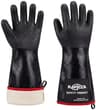
Charcoal cooking involves picking up a chimney full of burning coals and moving a grate that has been sitting over fire. Most beginners do this with a folded dish towel. Long-cuff heat-resistant gloves cost very little, protect the forearm rather than just the palm, and mean the person can reach into the grill to add coals mid-cook instead of avoiding it.
Charcoal itself: the add-on that completes the gift
A grill with no fuel is a gift the recipient cannot use until they have been to a shop. A bag of standard briquettes is a few dollars and turns the present into something they can cook on the same day.
For a beginner, briquettes are the right choice over lump — they are uniform in size, burn at a predictable rate and hold a steady temperature, which is exactly what someone still learning needs. Lump burns hotter and faster and is the better fuel for searing later on. Our lump vs briquettes guide explains the trade properly, and our briquette picks cover which bags are worth buying.
The complete beginner bundle, in order of importance
- The grill. 22-inch kettle if the budget and their space allow; 18-inch if not.
- A chimney starter. Non-negotiable. This is what makes the grill pleasant to use.
- A bag of briquettes. So they can cook on day one.
- An instant-read thermometer. Removes the fear of undercooked chicken.
- Long gloves.Cheap, and the reason they won’t burn a forearm in week two.
- A cover, later. Sized to the grill, so easiest to buy once you know which grill they have.
Items 2 through 5 together still cost a fraction of the grill. If you are splitting a gift between several people, this is the natural split: someone takes the grill, someone takes the kit.
What to skip for a beginner
Anything with a learning curve. Offset smokers, kamados and multi-probe wireless controllers are all great and all wrong here. A beginner needs a first cook that works, not equipment that rewards study.
Lighter fluid and self-lighting briquettes. If they are included in a bundle, quietly leave them out. The chimney replaces both.
The 20-piece tool set.One long pair of tongs is more useful than the whole case, and a fork — which most sets include — is the tool you specifically should not use on meat.
A big cheap grill. The most expensive mistake in this whole category is buying the biggest grill the money covers. It is why so many people think charcoal is fiddly. See what a small budget actually buys for the full argument.
Add a guide, not a cookbook
The genuinely useful non-physical part of this gift is knowing what to do on the first cook. Our how to use a charcoal grill walkthrough covers lighting, building a two-zone fire and controlling heat with the vents, and the temperature guide gives them target heats for steak, burgers and chicken. Both are free, and either one tucked into the card is worth more than a cookbook.