Coal & Char

Best Grill Brush for Charcoal (Bristle-Free)

Wire brushes shed. These don't. The bristle-free brushes worth owning for cast-iron and porcelain charcoal grates, ranked from cheapest-that-works upward.

By Stephen V.Last updated How we pick

A grill brush is a five-dollar decision with one genuinely serious failure mode. Traditional brushes clean by dragging stiff wire across hot metal, and wire fatigues. A strand works loose, sticks to the grate in the grease, and the next thing it touches is food. It is the one piece of grilling equipment where the cheap version can put metal on a plate.

Bristle-free brushes solve that by removing the loose part entirely. Instead of hundreds of individual wires they use a wound stainless coil, a woven pad, or a soft head that stiffens in cold water and steams the grate clean. Nothing can detach because nothing is attached in the first place.

The trade is real and worth stating plainly: bristle-free brushes are slower than a wire brush on baked-on carbon, and every one of them needs a hotgrate to work. On a cold grill they skate. Used properly — grate up to temperature, brush straight after cooking — they do the job as well as anything. Used lazily on a cold grate a week later, none of them will.

Four picks below, one per type, ranked by what we’d buy for a charcoal grill specifically. Prices are pulled live from Amazon and dated.

How this is funded:we earn a commission if you buy through our links, at no extra cost to you. It never changes which grill we recommend, and we’ll tell you when we’d skip one. Full disclosure.

Quick picks

Ranked on published specs, beginner-friendliness and value. Select a row to jump to the full write-up. We haven’t cooked on every one of these — here is exactly what we do instead.

#ProductBest forPrice
1
Scrub Daddy BBQ Daddy Bristle-Free Grill Brush

Scrub Daddy BBQ Daddy Bristle-Free Grill Brush

The brand-name version of the steam approach, and the most thought-through tool of the four. The head firms up in cold water and softens as grill steam hits it, so it stiffens where you need pressure and gives where the grate is shaped. The extras are the surprise: an integrated stainless scraper, a retractable hook for lifting a hot grate, and a squeeze trigger to rotate the head without turning your wrist over the fire.

Best overall
$29.98 · View on Amazon

Price as of September 8, 2026. #ad How we’re funded

2
TNTOR Bristle-Free Grill Brush with Scraper, 18" (sks02)

TNTOR Bristle-Free Grill Brush with Scraper, 18" (sks02)

The cheapest bristle-free brush we'd put near food. A three-layer stainless coil does the scrubbing, a sharpened scraper takes the baked-on carbon, and the detachable 18-inch handle keeps your knuckles a foot and a half from a live charcoal bed. Nothing here can shed a wire into a burger, which is the entire point of the category.

Best value
$16.99 · View on Amazon

Price as of September 8, 2026. #ad How we’re funded

3
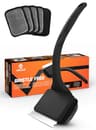
MEKER Bristle-Free Grill Brush with 5 Replacement Pads (GB5+1)

MEKER Bristle-Free Grill Brush with 5 Replacement Pads (GB5+1)

The pad type, and the one to choose if your grates are porcelain-enameled and you've watched a coil brush chip them. A woven steel-fiber pad wipes rather than gouges, a built-in scraper handles the stubborn ridges, and five spare pads come in the box — so the part that wears out costs about a dollar instead of thirty. The listing's method matters: heat the grate to at least 400°F, soak the pad in cold water, then wipe.

Best for porcelain grates
$21.56 · View on Amazon

$23.9510% off

Price as of September 8, 2026. #ad How we’re funded

4
Weetiee Grill Brush and Scraper, Bristle Free 18" (RFS017)

Weetiee Grill Brush and Scraper, Bristle Free 18" (RFS017)

A stiffer, wider take on the same idea: a triple-helix stainless coil that wraps around the bar instead of skating over it, plus a broad scraper for what the coil misses. The maker is unusually candid on the listing that no bristle-free brush cleans quite as fast as a wire one — that honesty matches our read of the whole category.

Best long-reach coil
$24.99 · View on Amazon

Price as of September 8, 2026. #ad How we’re funded

The picks in full

#1Best overall

Scrub Daddy BBQ Daddy Bristle-Free Grill Brush

The brand-name version of the steam approach, and the most thought-through tool of the four. The head firms up in cold water and softens as grill steam hits it, so it stiffens where you need pressure and gives where the grate is shaped. The extras are the surprise: an integrated stainless scraper, a retractable hook for lifting a hot grate, and a squeeze trigger to rotate the head without turning your wrist over the fire.

What’s good

  • Firms in cold water, softens with steam — adapts to the grate
  • ArmorTec mesh instead of loose bristles
  • Retractable hook lifts a hot grate so you can bank coals underneath
  • Integrated stainless scraper for charred build-up

Trade-offs

  • The dearest brush on this page by a clear margin
  • Needs a genuinely hot grill; on a cold grate it does very little
  • Replacement heads are an extra purchase
TypeBristle-free steam brush + scraper
HeadFlexTexture core with ArmorTec mesh
ExtrasRetractable grate hook, squeeze trigger, bottle opener
MethodWet the head in cold water, scrub a hot grate

Specs read from the product listing, on August 18, 2026. “Not published” means the maker doesn’t state that figure there.

#2Best value

TNTOR Bristle-Free Grill Brush with Scraper, 18" (sks02)

The cheapest bristle-free brush we'd put near food. A three-layer stainless coil does the scrubbing, a sharpened scraper takes the baked-on carbon, and the detachable 18-inch handle keeps your knuckles a foot and a half from a live charcoal bed. Nothing here can shed a wire into a burger, which is the entire point of the category.

What’s good

  • No wire bristles at all — nothing to shed into food
  • Detachable 18-inch handle, so it stores flat and hangs on a hook
  • Built-in scraper handles the carbon a coil alone won't shift
  • Listed as safe for porcelain, ceramic and cast-iron grates

Trade-offs

  • Coil brushes need a hot grate to work — on a cold one they skate
  • The handle is plastic; keep it out of direct flame
  • Budget build: expect a season or two, not a decade
TypeBristle-free coil brush + scraper
Length18 in (detachable handle)
HeadThree-layer stainless steel coil
Grate typesPorcelain, ceramic, cast iron, stainless, infrared

Specs read from the product listing, on August 18, 2026. “Not published” means the maker doesn’t state that figure there.

#3Best for porcelain grates

MEKER Bristle-Free Grill Brush with 5 Replacement Pads (GB5+1)

The pad type, and the one to choose if your grates are porcelain-enameled and you've watched a coil brush chip them. A woven steel-fiber pad wipes rather than gouges, a built-in scraper handles the stubborn ridges, and five spare pads come in the box — so the part that wears out costs about a dollar instead of thirty. The listing's method matters: heat the grate to at least 400°F, soak the pad in cold water, then wipe.

What’s good

  • Five replacement pads included — the wear part is the cheap part
  • Woven pad wipes rather than gouges, which suits porcelain enamel
  • Eight-screw pad mount, so the pad doesn't peel off mid-scrub
  • Built-in scraper and a dishwasher-safe handle

Trade-offs

  • Only works properly on a hot grate with a wet pad — it's a steam tool
  • Shorter than the coil brushes here at 13.8 inches
  • Pads darken fast; they still work, but they look finished before they are
TypeBristle-free woven-pad brush + scraper
Length13.78 in
In the boxHandle + 5 replacement pads
MethodHeat grate to 400°F, soak pad in cold water, wipe

Specs read from the product listing, on August 18, 2026. “Not published” means the maker doesn’t state that figure there.

#4Best long-reach coil

Weetiee Grill Brush and Scraper, Bristle Free 18" (RFS017)

A stiffer, wider take on the same idea: a triple-helix stainless coil that wraps around the bar instead of skating over it, plus a broad scraper for what the coil misses. The maker is unusually candid on the listing that no bristle-free brush cleans quite as fast as a wire one — that honesty matches our read of the whole category.

What’s good

  • Triple-helix coil wraps the bar and reaches the sides of the grate
  • Wide scraper edge for baked-on carbon at the back of the grill
  • 17.9 inches long — genuine distance from the coals
  • Nothing to shed: no wire, no nylon to melt

Trade-offs

  • Slower than a wire brush, as the maker states on the listing
  • Plastic handle — fine for heat off the grate, not for flame
  • At around 0.9 lb it feels light for the price
TypeBristle-free triple-helix brush + wide scraper
Length17.9 in
Weight0.9 lb
Grate typesPorcelain, gas, charcoal, smoker, infrared

Specs read from the product listing, on August 18, 2026. “Not published” means the maker doesn’t state that figure there.

The three types, and which suits your grate

“Bristle-free” covers three quite different tools. Pick by what your grates are made of, because that decides what can safely touch them.

Coil brushes wrap a spring of stainless steel around the grate bar and scrub it from several sides at once. They are the most aggressive of the three and the best match for bare cast iron — the grates on a Char-Griller Patio Pro or any of the barrel grills. They also cost the least.

Pad brushes use a woven steel-fiber pad that wipes across the bars rather than digging between them. They are the gentle option, which makes them the right choice for porcelain-enameled grates like the ones on a Weber kettle. Porcelain is a glass coating over steel: chip it and the steel underneath rusts, and a chipped grate is a replaced grate.

Steam brushes are the newest idea. The head is a foam-like material that firms up in cold water; when it hits a hot grate, the water flashes to steam and lifts the residue rather than scraping it. They are the most forgiving on any surface and the slowest on genuinely burnt-on carbon, which is why the good ones include a metal scraper for exactly that.

The method matters more than the brush

Almost every complaint about bristle-free brushes is really a complaint about timing. Do it in this order and a fourteen-dollar brush is enough.

Burn the grate first. After you take the food off, put the lid back on with the vents open and let the fire have the grate for ten minutes. Food residue is mostly sugar, protein and fat; at grilling temperatures it carbonizes into a dry, brittle crust. You are not scrubbing food off any more, you are knocking off carbon.

Brush hot, not cold.Every tool here works better on a hot grate, and the pad and steam types are essentially useless on a cold one. The best moment is while the coals are still going after dinner — ten seconds per bar and it’s done. If you clean before the next cook instead, get the grate hot first and brush it then.

Use the scraper on the ridges.The build-up that a coil or pad can’t shift lives on the top face of each bar and in the corners where the grate meets the bowl. That is what the scraper edge is for. Two passes with the scraper, then the brush, beats ten passes with the brush alone.

Wipe with oil before the food goes on. Fold a paper towel, hold it with long tongs, dip it in a high-smoke-point oil and run it along the bars. This is the step that stops food sticking, and it does more for a clean release than any brush does.

What to do if you own no brush at all

Two methods work, cost nothing, and are genuinely used by people who cook over charcoal every week.

The foil ball. Crush a sheet of aluminum foil into a tight ball roughly the size of a fist, grip it with long tongs, and scrub the hot grate with it. Foil is softer than the grate, so it will not chip porcelain, and it is aggressive enough on carbon. Throw it away afterwards. This is the closest thing to a free grill brush.

The half onion. Cut an onion in half, spear it on a fork or grip it with tongs, and rub the cut face over the hot bars. The water in the onion steams, the sugars lift residue, and it leaves the grate faintly seasoned. It is slower than foil and it smells fantastic.

Neither is a reason to skip buying a brush — the point is that a missing brush is never a reason to cook on a filthy grate.

How the money breaks down

This is a category where paying more buys convenience, not a cleaner grate. A fourteen-dollar coil brush used properly leaves a grate exactly as clean as a thirty-dollar steam brush used properly. What the extra buys is speed, a replaceable wear part, and in the case of the pad brush, five spares in the box so the thing you throw away costs a dollar rather than the whole tool.

The thing genuinely worth paying for is length. An 18-inch handle keeps your forearm well clear of a bed of coals that is still running at searing temperature. Twelve-inch brushes exist and they are a false economy of about four dollars. If you have ever reached across a live charcoal fire you know why we keep saying this — and it is the same argument we make about long gloves.

What to skip

Wire brushes, for the reason at the top of this page. If you own one and intend to keep using it, at least inspect the head before every cook and bin it the moment the wires splay or thin out. Then wipe the grate with a damp cloth after brushing, which catches anything that has come loose.

Brass-bristled brushes on porcelain.Brass is sold as the “gentle” wire, but it is still wire, and it still sheds.

Twenty-piece tool setsthat include a brush. The brush in the box is invariably the cheapest wire one available, and it lands you exactly where this page started. Buy the tools you need individually — our starter kit page lists the whole honest list.

Grill stones and pumice blocks. They work, and they crumble as they do it, leaving grit in the bottom of the bowl and dust wherever you are standing. Fine for a once-a-season deep clean; miserable as a weekly tool.

Frequently asked questions

Are wire grill brushes actually dangerous?

The failure mode is mechanical and easy to see for yourself: wire fatigues with heat and repeated scrubbing, a strand works loose into the grease on the grate, and the next thing that grate touches is food. We can't tell you how often that ends badly, and we won't invent a number — but a bristle-free brush removes the possibility entirely for the price of a bag of charcoal, which makes it an easy call.

Do bristle-free grill brushes actually clean as well?

On a hot grate, yes. On a cold one, no — and that is the whole difference between people who love them and people who return them. Bristle-free heads rely on heat and, in the pad and steam types, on water flashing to steam. Brush right after cooking while the coals are still live, or get the grate hot again first.

What kind of grill brush is safe for porcelain grates?

A woven pad or a steam head. Both wipe across the surface instead of digging into it. Avoid coil brushes and anything with wire on porcelain enamel: it is a glass coating over steel, and once it chips the steel underneath starts to rust, which ends with a replacement grate.

Should you clean the grate before or after cooking?

After, while it's still hot — that's when residue is carbonized and brittle. Then give it a quick pass before the next cook as the grate comes up to temperature, and wipe it with an oiled paper towel just before the food goes on. The oiling step does more to stop sticking than the brushing does.

How often should you replace a grill brush?

A coil brush lasts until the coil loses its spring or the scraper edge rounds off — typically a season or two of weekly use. Pad brushes are replaced by the pad, which is why a model that ships with spares is good value. With any brush, if the head is deforming or shedding anything at all, replace it that day.

Can you clean a charcoal grill grate without a brush?

Yes. Crush aluminum foil into a tight ball, grip it with long tongs and scrub the hot grate — it is softer than the grate, so it can't chip porcelain, and it is aggressive on carbon. Half an onion on a fork works too. Both are genuinely effective; neither is a reason to keep using a shedding wire brush.

Sources

  • USDA FSIS — Grilling Food SafelyUSDA on safe handling at the grill, using a food thermometer, and the difference between grilling and slower cooking (accessed July 21, 2026)

Keep reading