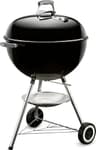
For twenty years, “buy a Weber kettle” was the only sensible advice at this price, because nothing else with the same shape was worth owning. That has changed. There are now full-size 22-inch kettles from other makers with the same cooking area, the same porcelain coating and the same two-damper airflow, sold for less — and the Char-Griller is the one we would actually consider.
So this is a genuinely open question rather than a formality, and it is the exact question a budget buyer should be asking: what does the badge cost, and what does it buy?
Where they're the same
Everything that determines how the grill cooks.
The bowl. Both are 22-inch porcelain-coated steel kettles. That shape is not a style choice: the dome gives hot air room to circulate over the food, and the rolled rim gives you a seal, which is what makes the vents actually control the fire. It is the reason kettles cook better than flat-lidded barrels at any price.
The cooking area. Char-Griller states 363 square inches. Weber does not publish a figure on the plain Original Kettle listing, but the Premium version of the same 22-inch bowl is stated at 363. Same footprint, whichever badge is on it.
The airflow. Adjustable dampers top and bottom on both. Intake at the bottom sets how hard the fire burns; exhaust at the top pulls the heat over the food. Two vents is all charcoal control is.
The finish.Porcelain over steel on both — glass fused to metal rather than paint. It does not blister off, and it is why either of these will outlast a painted barrel grill by years.
In other words, a steak cooked on one is a steak cooked on the other. If your decision is about dinner, it is a coin flip.
Where they differ
Warranty. Weber states a 10-year limited warranty on the Original Kettle. The Char-Griller listing we read published no warranty figure at all. That is not proof of a worse grill, but it is the difference between a documented commitment and an unknown, and on a purchase you intend to keep for a decade it belongs in the decision.
Parts, in five years. This is the quiet one. Kettle bowls essentially do not fail; grates, handles, dampers, wheels and ash catchers do. Weber spares for twenty-year-old kettles are still on shelves, which means a Weber is repairable indefinitely for pocket money. A newer model from any maker has no track record on that, and a kettle whose grate you cannot replace is a kettle with a finite life.
Ash handling — and the Char-Griller wins this one.The plain Weber uses the one-touch sweep with a fairly small catcher; you empty it often, and it can spill if you are careless. The Char-Griller’s EasyDump pan and bucket is a better piece of design, with more capacity and less mess. If you cook often, you will notice it every single time, which is more than can be said for most spec-sheet differences.
Weight. The Char-Griller is listed at 22 lb total. It is a lighter build, which makes it easier to move and marginally more affected by wind. Neither is a deal-breaker; both benefit from being positioned out of a prevailing draft.
Resale. Used Weber kettles hold value remarkably well and sell in an afternoon. That is worth real money if you ever upgrade, and it is effectively a discount on the original purchase that other brands do not offer.
The decision, in one paragraph
If the two prices are close, buy the Weber. You are getting the same cook plus a stated ten-year warranty, a parts supply that will outlive the grill, and resale value. If the Char-Griller is meaningfully cheaper on the day you look — enough to also buy a chimney starter, a cover and a couple of bags of good briquettes— then take it, because that combination will cook better food than a bare Weber will. Fuel and lighting method affect dinner more than the badge does.
The third option nobody mentions
A used Weber. Kettles are the most repairable grill ever made and they turn up constantly for a fraction of new money. The bowl is the only part that genuinely cannot be replaced cheaply, so inspect it for holes and flex, check the lid seats evenly all the way round the rim, and budget for a new grate and possibly dampers. Done well, this is the best value in charcoal grilling and it is how a lot of very good cooks got started — we go through the checks in our under-$100 guide.
And the Premium, while we're here
The Weber Original Kettle Premium is the same bowl again with a hinged cooking grate and a larger, sealed ash catcher. The hinged grate is the feature worth paying for if you cook weekly: you lift a corner and add charcoal without taking the food off, which is the difference between topping up mid-cook and deciding not to bother. The full three-way comparison is in Weber Kettle vs Master-Touch.
For someone buying their first kettle and grilling a few times a month, we would take the plain kettle and spend the difference on fuel and a starter kit. For someone who already knows they will be out there every weekend, the Premium is the better long-term object.
What this comparison isn't about
Neither of these grills is going to smoke a brisket. A 22-inch kettle will hold a low temperature for hours with the snake method, and that is genuinely enough for ribs and a pork shoulder — but if long cooks are the main event, the money belongs in a bullet smoker instead, and the kettle argument is a distraction.
Nor is either one a searing specialist. Both put the coals a fixed distance from the grate, which is fine but not adjustable; grills with a height-adjustable charcoal pan get closer to steakhouse heat, as our steak grill page explains. What a kettle does — better than anything else at this money — is everything else, forever.