This comparison is unusual, because for a large share of the people reading it the decision has already been made by someone else. Many leases and many local fire codes prohibit charcoal and open-flame cooking on the balconies of multi-family buildings. If that applies to you, an electric grill isn’t a compromise you settled for — it’s the only option, and it is a perfectly good one.
So this page does two things: it tells you honestly what electric gives up, and it tells you what to do about it. We run a charcoal site, and we are still going to say plainly that if your building bans charcoal, buy the electric grill and don’t feel short-changed.
The comparison in one table
| Charcoal | Electric |
|---|
| Flavor | Smoke and fat-vapor character; the reason people bother | Clean and neutral — the food tastes of the food |
|---|
| Searing | Excellent — radiant heat from coals | Adequate — good marks, shallower crust |
|---|
| Setup time | About 15 minutes, mostly hands-off | Under 10 minutes, fully hands-off |
|---|
| Running cost per cook | Roughly $2-4 of charcoal | Usually well under a dollar of electricity |
|---|
| Cleanup | Ash to empty and dispose of safely | Wipe the plate; often dishwasher-safe parts |
|---|
| Where you can use it | Outdoors only; often banned on balconies | Balconies, and indoor models exist |
|---|
| Lifespan | 10-15 years for enameled steel; nothing to break | Element and thermostat are wear items |
|---|
| Low-and-slow smoking | Yes, very capable | No, in any real sense |
|---|
What electric actually gives up
The flavor mechanism, entirely.This is the honest headline. Most of what people taste as “grilled” comes from fat rendering out of the food, dripping onto something extremely hot, vaporizing, and rising back onto the food. An electric grill’s element and drip tray are designed specifically to prevent that, because it is what causes smoke. The design goal is in direct opposition to the flavor.
Peak temperature.Charcoal delivers radiant heat from a dense bed of coals directly beneath the food. A domestic electric element is limited by what a household circuit can supply, so the surface temperature is a good deal lower. You get browning; you don’t get the thick, dark crust that a coal bed builds in ninety seconds.
Range.A charcoal kettle will sear at high heat and also hold 225-275°F for six hours to smoke a pork shoulder. An electric grill does one thing, at one kind of heat.
What electric doesn’t give up
More than charcoal enthusiasts usually admit.
Cooking well.A chicken breast cooked to 165°F on an electric grill is a properly cooked chicken breast. Vegetables char nicely. Burgers brown. The technique that matters most — getting the food to the right internal temperature and not past it — is fuel-agnostic, and USDA guidance is the same either way: use a food thermometer, not time or color.
Convenience, decisively.No chimney, no bag of fuel to store, no ash, no 48-hour wait before the coals are safe to bin. If your barrier to grilling is effort, electric will get used more often, and a grill that gets used beats a grill that doesn’t.
Consistency.A thermostat holds a set temperature. That is a real advantage for anything delicate — fish, thin cuts, vegetables that go from charred to burnt in thirty seconds.
Check the rules before you shop
This is the practical core of the page. Before buying a charcoal grill for a balcony, check two things:
- Your lease or HOA rules. Many explicitly prohibit charcoal and open flames on balconies, and some prohibit storing fuel on the property.
- Your local fire code. Restrictions on open-flame cooking within a stated distance of multi-family buildings are common, and they apply regardless of what your landlord says.
If both permit it, a small charcoal grill on a balcony is genuinely workable — provided you have a safe, non-combustible place to put hot ash afterwards, which is the part people forget. Used coals can reignite for a long time after they look dead; the disposal routine is in how to store charcoal.
And never use charcoal indoors, in a garage, or in any enclosed space, even with a door open. Burning charcoal produces carbon monoxide, which is colorless, odorless and lethal. This is not a caution about flavor or smoke — it is the one absolute rule in charcoal cooking.
If you can have charcoal, but only a little space
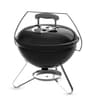
Small charcoal grills are better than their size suggests. A 14-inch kettle is a real kettle: it has a lid, working vents, and enough depth for indirect cooking, so you can roast a chicken on it rather than only searing burgers. It weighs under ten pounds, packs away in a cupboard, and costs less than most electric grills.
The limit is capacity — roughly six burgers, or dinner for two with one guest. If that matches your household, a small kettle gives you the entire charcoal experience in an electric grill’s footprint. Our small charcoal grills roundup ranks them, and portable grills covers the ones designed to travel.
Getting more flavor out of an electric grill
If electric is your only option, these help more than you’d expect:
- Preheat properly and for longer than feels necessary.Most of the disappointment with electric grills is food hitting a plate that isn’t fully up to temperature.
- Dry the surface of the food. A wet surface steams before it browns. This matters more on electric, where you have less heat in reserve.
- Use smoked seasonings.Smoked paprika, smoked salt or a small amount of liquid smoke in a marinade get closer to the taste you’re missing than any chip tray.
- Cook in batches. Crowding the plate drops its temperature and you end up steaming rather than searing.
- Finish, don’t overcook.Use a thermometer and pull at the right number. Electric’s consistency makes this easy, and it is the single biggest determinant of whether food tastes good on any grill.
The verdict
If your building allows charcoal and you have somewhere safe for ash, buy charcoal. The flavor and sear are the reason this whole hobby exists, and a small kettle costs less than a decent electric grill.
If it doesn’t, buy the electric grill and cook on it happily. A grill you are allowed to use beats a grill you aren’t, and the gap in results is smaller than charcoal partisans like to claim. When you eventually move somewhere with a garden, the budget charcoal picks will still be here.