Coal & Char

Best Small Charcoal Grills

Real charcoal cooking in an apartment-sized footprint. The compact grills genuinely worth owning when a 22-inch kettle simply will not fit — ranked with live prices.

By Stephen V.Last updated How we pick

Most “best charcoal grill” lists assume you have a garden. Plenty of people don’t. If your outdoor space is a balcony, a fire escape landing, a shared courtyard or four feet of patio behind a terraced house, the 22-inch kettle everyone recommends is simply the wrong object — it will dominate the space and you will resent it.

The good news is that small charcoal grills are not compromised charcoal grills. The physics of a charcoal fire doesn’t care about scale: a 14-inch kettle sears a steak exactly as well as a 22-inch one, because the heat comes from the coal bed directly under the food. What you give up is quantity, not quality — and if you’re cooking for one or two, you were never going to use the extra space anyway.

These are ranked by how much usable cooking you get per square foot of floor, with build quality weighted heavily — small grills live outdoors in tight spaces where they get rained on and knocked about. If portability rather than footprint is your priority, see our portable charcoal grill picks instead. Prices are live from Amazon and dated.

How this is funded:we earn a commission if you buy through our links, at no extra cost to you. It never changes which grill we recommend, and we’ll tell you when we’d skip one. Full disclosure.

Quick picks

Ranked on published specs, beginner-friendliness and value. Select a row to jump to the full write-up. We haven’t cooked on every one of these — here is exactly what we do instead.

#ProductBest forPrice
1
Weber Smokey Joe 14" (1501695)

Weber Smokey Joe 14" (1501695)

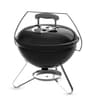
The cheapest object Weber sells that still cooks like a Weber. Eight and a half pounds, a lid that locks down over the top for carrying, and the same porcelain-enamel finish as the big kettles. Weber rates it at six burgers, which is honest — this is a balcony, campsite and picnic grill, not a party cooker, and at its price that is exactly the right trade.

Best small grill overall
$54.99 · View on Amazon

Price as of September 8, 2026. #ad How we’re funded

2
Weber Jumbo Joe 18"

Weber Jumbo Joe 18"

A full-flavor Weber kettle that fits in a trunk. The Jumbo Joe is a squat 18-inch kettle with a lid lock for transport — 240 sq in is enough for burgers and a couple of chickens, and it's the same porcelain-enameled steel as the big kettles. For camping, tailgating or a tiny balcony, it's the honest pick.

Best if you have a little more room
$89.99 · View on Amazon

Price as of September 8, 2026. #ad How we’re funded

3
Char-Griller Akorn Jr. Portable Kamado

Char-Griller Akorn Jr. Portable Kamado

The cheapest honest way into kamado cooking. Instead of heavy ceramic, the Akorn Jr uses triple-wall insulated steel, so it holds heat and sips charcoal like a kamado but costs a fraction of a ceramic egg and weighs little enough to carry. Small at 153 sq in, but for one or two people who want kamado efficiency without four-figure ceramics, it's the value pick.

Best for small-space smoking
$159.99 · View on Amazon

$199.9920% off

Price as of September 8, 2026. #ad How we’re funded

4
Cuisinart 14" Portable Charcoal Grill (CCG-190)

Cuisinart 14" Portable Charcoal Grill (CCG-190)

The cheapest way to find out whether you even like charcoal. A little 14-inch tabletop kettle with a chrome grate and a locking lid, for the price of a few bags of fuel. It won't last like a Weber and it won't feed a crowd — but as a first grill, a dorm grill or a backup you keep in the car, it earns its tiny cost.

Cheapest tabletop
$39.99 · View on Amazon

Price as of September 8, 2026. #ad How we’re funded

5
Char-Griller Patio Pro (E1515) Charcoal Grill

Char-Griller Patio Pro (E1515) Charcoal Grill

The cheapest grill on this list that we'd actually stand behind. A barrel body with heavy cast-iron grates, an adjustable charcoal pan and a side-hinged lid — genuinely more grill than the price suggests. The trade-off is thin steel that leaks heat, so you'll tend the fire more; for a first grill or a small patio, that's a fair deal.

Smallest full-size grill
$109.99 · View on Amazon

Price as of September 8, 2026. #ad How we’re funded

The picks in full

#1Best small grill overall

Weber Smokey Joe 14" (1501695)

The cheapest object Weber sells that still cooks like a Weber. Eight and a half pounds, a lid that locks down over the top for carrying, and the same porcelain-enamel finish as the big kettles. Weber rates it at six burgers, which is honest — this is a balcony, campsite and picnic grill, not a party cooker, and at its price that is exactly the right trade.

What’s good

  • Weighs 8.4 lb and packs down — genuinely a one-hand carry
  • Tuck-N-Carry lid lock doubles as a lid holder while you cook
  • Porcelain-enamel finish resists rust and scratches like the full-size kettles
  • Ash catcher underneath, so it won't scorch a table or a deck

Trade-offs

  • Weber rates it at 6 burgers — too small for a crowd
  • Sits low with no legs of its own; you want a table or the ground
  • Shallow bowl makes long low-and-slow cooks impractical
TypeCharcoal (portable kettle)
Cooking areaNot published
Primary materialPorcelain-enameled steel
Ease for beginnersEasy

Specs read from the product listing, on August 11, 2026. “Not published” means the maker doesn’t state that figure there.

#2Best if you have a little more room

Weber Jumbo Joe 18"

A full-flavor Weber kettle that fits in a trunk. The Jumbo Joe is a squat 18-inch kettle with a lid lock for transport — 240 sq in is enough for burgers and a couple of chickens, and it's the same porcelain-enameled steel as the big kettles. For camping, tailgating or a tiny balcony, it's the honest pick.

What’s good

  • Genuinely portable with a lid lock, but 240 sq in still feeds a few people
  • Weber's porcelain-enameled build — far sturdier than throwaway travel grills
  • Dead simple: one vent bottom, one vent top, done

Trade-offs

  • Sits low to the ground — you cook crouched or on a table
  • No ash catcher; you tip it out
TypeCharcoal (portable kettle)
Cooking area240 sq in
Primary materialPorcelain-enameled steel
Ease for beginnersEasy

Specs read from the product listing, on July 21, 2026. “Not published” means the maker doesn’t state that figure there.

#3Best for small-space smoking

Char-Griller Akorn Jr. Portable Kamado

The cheapest honest way into kamado cooking. Instead of heavy ceramic, the Akorn Jr uses triple-wall insulated steel, so it holds heat and sips charcoal like a kamado but costs a fraction of a ceramic egg and weighs little enough to carry. Small at 153 sq in, but for one or two people who want kamado efficiency without four-figure ceramics, it's the value pick.

What’s good

  • Insulated steel holds low-and-slow temps and sips charcoal
  • A fraction of the price and weight of a ceramic kamado
  • Portable enough to take camping, unlike a heavy egg

Trade-offs

  • 153 sq in is small — a one-or-two-person cooker
  • Steel won't retain heat quite like thick ceramic, and can dent
TypeCharcoal (insulated kamado)
Cooking area153 sq in
Primary materialTriple-wall insulated steel
Ease for beginnersEasy

Specs read from the product listing, on July 21, 2026. “Not published” means the maker doesn’t state that figure there.

#4Cheapest tabletop

Cuisinart 14" Portable Charcoal Grill (CCG-190)

The cheapest way to find out whether you even like charcoal. A little 14-inch tabletop kettle with a chrome grate and a locking lid, for the price of a few bags of fuel. It won't last like a Weber and it won't feed a crowd — but as a first grill, a dorm grill or a backup you keep in the car, it earns its tiny cost.

What’s good

  • About as cheap as a real charcoal grill gets
  • Locking lid and light body make it genuinely portable
  • Dual venting gives you a little airflow control for the price

Trade-offs

  • 150 sq in and thin build — a one-or-two-person grill at best
  • Won't hold heat or last the way a heavier kettle does
TypeCharcoal (tabletop)
Cooking area150 sq in
Primary materialEnameled steel
Ease for beginnersEasy

Specs read from the product listing, on July 21, 2026. “Not published” means the maker doesn’t state that figure there.

#5Smallest full-size grill

Char-Griller Patio Pro (E1515) Charcoal Grill

The cheapest grill on this list that we'd actually stand behind. A barrel body with heavy cast-iron grates, an adjustable charcoal pan and a side-hinged lid — genuinely more grill than the price suggests. The trade-off is thin steel that leaks heat, so you'll tend the fire more; for a first grill or a small patio, that's a fair deal.

What’s good

  • Cast-iron grates hold heat and lay down proper sear marks
  • Adjustable charcoal pan lets you raise the fire closer for searing
  • Compact 250 sq in footprint suits a patio or balcony
  • One of the cheapest charcoal grills worth owning

Trade-offs

  • Thin steel loses heat — needs more fuel and more fire tending
  • Basic assembly and finish; this is a starter, not an heirloom
TypeCharcoal (barrel)
Cooking area250 sq in
Primary materialSteel with cast-iron grates
Ease for beginnersModerate

Specs read from the product listing, on July 21, 2026. “Not published” means the maker doesn’t state that figure there.

Before you buy: check you’re allowed to

This matters more than any spec on this page. Many apartment buildings, and many local fire codes, prohibit charcoal grills on balconies— often with specific distance requirements from combustible walls, or an outright ban above ground level. Rules vary enormously by city and by building, and a lease clause can be stricter than the local code.

Check your lease and your local fire regulations before you spend anything. If charcoal is out where you live, that is a genuine constraint and we’d rather tell you now than sell you a grill you can’t light. And regardless of the rules: never use charcoal indoors, in a garage, or in any enclosed space. Charcoal produces carbon monoxide as it burns, and it does so silently.

How small is too small?

Cooking area is the number that matters, and the useful thresholds are roughly these. Around 150 square inches— a 14-inch kettle or tabletop — cooks for one or two people comfortably: four burgers, two steaks, a couple of chicken pieces with room to move them. Around 240 square inches, an 18-inch kettle, gets you to four people and starts to allow a proper two-zone fire with a genuinely cool side. Below about 120 square inches you are into single-serving territory and the grill stops being useful for anything but one person’s dinner.

The subtler point is depth. A shallow tabletop box with the grate three inches above the coals can only cook hot and fast — everything sears, nothing roasts, and a chicken thigh burns outside before it’s done inside. A small kettle, with its deep bowl and domed lid, can do indirect cooking properly. That is the single biggest reason we rank the Smokey Joe above cheaper tabletop grills with similar square inches.

Making a small grill work harder

Three habits make a compact grill feel much bigger than it is.

Use a two-zone fire even on a tiny grate.Bank all the coals to one half. You lose half your searing area but gain somewhere to park food that’s browning too fast, which is what lets you cook thicker cuts without burning them. Our guide to using a charcoal grill walks through the setup.

Cook in waves and rest.A small grate rewards sequencing — vegetables first, then the meat, resting under foil while the next thing cooks. Food rests better than you think, and a 15-minute rest under foil is a feature of good grilling rather than a compromise.

Buy a small chimney, not a big one. A full-size chimney holds far more charcoal than a 14-inch grill can use, so you either waste fuel or light it half-full, which it does badly. A compact chimney is the correct tool here and costs less.

Storage, and the thing nobody mentions

Small grills get put away, and that is where they die. A warm grill stuffed into a cupboard or a storage box holds condensation against bare steel and rusts from the inside within a season. Let it cool completely, tip the ash out, and either store it dry or leave it outdoors under a proper cover— outdoors-under-a-cover is genuinely kinder to a grill than a damp cupboard.

Ash disposal is the other small-space problem. Charcoal ash can hold live embers for 24 hours or more after a cook, which is how balcony fires start. Never tip ash into a plastic bin or a bin bag the same day. Tip it into a metal container with a lid, keep it away from the wall, and empty it the next day.
Frequently asked questions

What is the best small charcoal grill?

The Weber Smokey Joe 14-inch. It's a proper kettle — deep bowl, domed lid, porcelain-enameled steel — shrunk down, so it can do indirect cooking that flat tabletop grills can't, and it weighs 8.4 lb. Weber rates it at six burgers, which is honest for one or two people. If you have room for 18 inches, the Jumbo Joe is the better cooker.

Can you use a charcoal grill on a balcony?

Sometimes, and you must check first. Many apartment buildings and local fire codes ban charcoal grills on balconies, or require specific clearances from walls. Your lease may be stricter than the local rule. Check both before buying. Never use charcoal indoors or in a garage under any circumstances — it produces carbon monoxide.

How small a charcoal grill can I get away with?

About 150 square inches is the practical floor for two people — that's a 14-inch kettle. It'll take four burgers or two steaks with room to move them. Below roughly 120 square inches you're cooking one person's dinner at a time. Depth matters as much as area: a deep kettle can roast indirectly, a shallow tabletop box can only sear.

Is a small charcoal grill as good as a big one?

For flavor and searing, yes — identical. The heat comes from the coals directly under the food, and that doesn't change with grill size. What you lose is capacity and the ability to run a really generous two-zone fire. If you cook for one to four people, a small grill costs less, uses less charcoal and lights faster.

How do I get rid of charcoal ash in an apartment?

Let it cool for at least 24 hours — charcoal ash holds live embers far longer than people expect. Then tip it into a metal container with a lid, never a plastic bin or a bin bag, and keep that container away from walls and anything combustible. Empty it into your normal waste the following day once it is stone cold.

Sources

Keep reading