Reverse flow, explained without the diagram
A traditional offset is a horizontal chamber with a firebox on one end and a chimney on the other. Heat enters at one end, crosses the food, and leaves. The consequence is unavoidable: the food nearest the fire cooks faster than the food at the far end, and you rotate racks all day to compensate.
A reverse-flow offset puts a steel baffle plate under the cooking grates. Heat entering from the firebox is forced to travel underneath the food to the far end of the chamber first, then turns and comes back across the food to a chimney mounted at the firebox end. The baffle heats up and radiates evenly along its length, and the food sees heat that has already been evened out.
Two practical results. First, the temperature spread across the chamber drops dramatically — you can put four racks of ribs in and take four racks of ribs out without shuffling. Second, the baffle catches drippings, which both keeps the fire cleaner and adds a little moisture to the chamber. Oklahoma Joe’s builds both the Highland and Longhorn this way, and the Longhorn’s stack can be moved so you can run it as a traditional offset if you want to.
Steel thickness is the other half of the story
Everything an offset does well comes down to thermal mass. Thicker steel absorbs heat, holds it, and gives it back slowly — which means the pit shrugs off a gust of wind, a cold snap, or you opening the door to spritz. Thin steel does none of that, so the fire has to do all the work and every disturbance shows up immediately on the gauge.
You can read thickness indirectly from the shipping weight, which is why we list it. The Longhorn is 226 pounds of heavy-gauge steel; a $250 barrel offset is often under 90. That difference is the entire reason one holds 250°F overnight in October and the other doesn’t.
| Cooker | Type | Stated cooking area | What it’s really for |
|---|
| Oklahoma Joe’s Highland | Reverse-flow offset | See card — primary + secondary racks | The entry point to real stick-burning |
| Oklahoma Joe’s Longhorn | Reverse-flow offset | 1,060 sq in (751 primary + 309 secondary) | Competition-length cooks, large loads |
| Oklahoma Joe’s Laredo 900 | Barrel-style offset | 916 sq in (558 grilling, 358 warming) | Grilling first, smoking second |
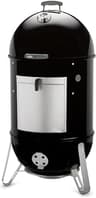
| Weber Smokey Mountain 22″ | Bullet / water smoker | Two full grates (area not published) | Set-and-hold overnight cooks |
The question to answer before you buy: do you want a hobby or dinner?
This is the most useful thing on the page, so we’ll be blunt. A reverse-flow offset is a stick burner. You will feed it a split of hardwood every 30 to 45 minutes for the entire cook. On a brisket that is twelve hours of being within earshot of your patio, adjusting a vent, managing a fire that is a live thing rather than a setting.
For a large number of people, that isthe appeal — it is a craft, the results are excellent, and there is nothing else quite like standing over a pit all day. For an equally large number of people it is a miserable discovery made after spending $700.
If the second description sounds more like you, buy a bullet smoker. A Weber Smokey Mountain will hold 250°F for eight to twelve hours on one charcoal load with a vent adjustment or two, produces barbecue that wins competitions, and costs less. That is why it is on this list at all — it is the honest alternative, not the consolation prize. Our vertical vs offset comparison works through the choice in full, and the WSM size guide covers which one to get.
Budget for the mods, because there will be mods
Every offset in this price band benefits from the same short list of changes, and none of them is expensive:
- High-temp gasket on the doors and lid (about $20). Cheap offsets leak at the seams; sealing them steadies the pit and cuts fuel use noticeably.
- A chimney extension down to grate level. Draws the smoke across the food rather than straight up out of the stack, which improves both evenness and flavor.
- Two real thermometers— one at grate level, one in the meat. The factory lid gauge on any offset reads the air at the top of the dome, which is routinely 25-50°F away from what the food sees. USDA guidance on smoking is explicit that a food thermometer is the only reliable measure. Our thermometer picks cover both.
- Long gloves. You are handling a live wood fire in a steel box every 40 minutes for twelve hours. See the glove picks.
Fuel: charcoal to start, wood to run
The standard method is a bed of lit charcoal to establish a clean, stable fire, then hardwood splits on top from there. Charcoal lights predictably and gives you a coal bed that keeps the wood burning cleanly rather than smoldering; wood does the flavor and the sustained heat.
Thin blue smoke is the target. Thick white smoke means the fire is starved of air and the food will end up bitter — the fix is almost always more airflow and a smaller, hotter fire, not less wood. We cover the fuel side in charcoal vs wood and best charcoal for smoking.
Where the $1,000 line sits
Above this band you are into welded, quarter-inch, made-to-order pits from small Texas builders. They are excellent and they are a different purchase — often several thousand dollars, frequently with a lead time. Below it, the reverse-flow Oklahoma Joe’s models are the value floor for a pit that genuinely cooks evenly.
If your budget is nearer $500 than $1,000, look at smokers under $500 instead — there are real options there, they just ask more of you.