Why briquettes usually win for low-and-slow
This is the opposite of our advice for kamados and searing, and the reason is worth understanding.
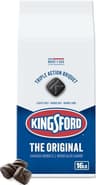
Briquettes are manufactured to a uniform size, shape and density. That uniformity is dull, and dullness is exactly the property you want at 2am on hour nine of a brisket. A bed of identical briquettes burns predictably, releases heat at a steady rate, and responds to a vent adjustment in a way you can learn and rely on. Lump, by contrast, is irregular hardwood: a bed containing a fist-sized chunk next to a handful of dust burns unevenly, can surge when a big piece catches, and is harder to hold at a precise low temperature.
The counter-argument is ash. Briquettes contain binders and mineral fillers and produce noticeably more ash than lump, and on a very long cook that ash accumulates under the fire and starts restricting airflow. In an open-bottom cooker like a bullet smoker that’s manageable. In a kamado, where all the air comes up through the coal bed, it’s a real problem — which is why kamados get lump.
So: briquettes for bullet smokers, offsets and kettles doing low-and-slow. Lump for kamados, or if you specifically want the cleaner burn and don’t mind managing a less predictable fire. If the cook you have in mind is forty minutes rather than twelve hours, the ranking flips and you want our best charcoal for grilling picks instead.
What to look for in a smoking charcoal
Three things separate a briquette that’s pleasant to smoke with from one that isn’t.
No additives, and definitely no instant-light. Never buy match-light or instant-light briquettes for smoking, or for anything else. They are impregnated with lighter fluid, and over a twelve-hour cook that chemical taste has plenty of time to get into your food. Natural or hardwood briquettes with no accelerants are what you want.
Low ash.Competition-grade briquettes generally produce less ash than standard supermarket ones, because they use less filler. You’re paying for a longer cook without an ash problem, which on a brisket is worth something real.
Consistent size.Look at the bag if you can. Broken, crumbly briquettes pack tighter and choke airflow; whole, uniform ones stack with gaps between them and burn how they should. This is why we rate the competition briquettes highly despite the price — the bag arrives intact.
Our full breakdown of the bags is in the best briquettes roundup, and the lump equivalent is best lump charcoal.
Chunks, not chips — and why it matters
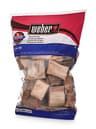
If you take one thing from this page: buy wood chunks, not wood chips.
Chips are thin, they catch fire rather than smoldering, and they are spent in ten to fifteen minutes. On a five-hour cook that means opening the lid six or seven times to add more — and every lid opening dumps your chamber temperature, disrupts the fire and adds half an hour to your cook. Chips exist for gas grills, where you have no charcoal bed to bury anything in.
Chunks are fist-sized. Buried in or laid on a charcoal bed they smolder slowly rather than flaming, and two or three of them will give you two to four hours of clean smoke without you touching the lid. That is the entire argument, and it is decisive.
You do notneed to soak them. Soaked wood doesn’t smolder longer; it just spends the first twenty minutes steaming off water, which cools your fire and produces a damp, dirty smoke. Put the wood on dry.
How much wood, and when
Less than you think, and earlier than you think.
Two to four chunks for a whole cook.Not per hour — for the cook. Meat absorbs smoke compounds most readily in the first two to three hours, while the surface is still cool and moist; after that the bark sets and further smoke largely sits on the outside. Piling wood on for twelve hours doesn’t make barbecue smokier, it makes it bitter.
Thin blue smoke, not thick white.This is the single most useful visual cue in barbecue. A clean fire with plenty of air produces smoke you can barely see, faintly blue against a dark background. A choked, smoldering fire produces thick white or gray smoke loaded with creosote, which deposits on the meat and tastes acrid. If your smoker is billowing white, open the intake and burn cleaner — you are actively making the food worse.
Which wood for which meat
The differences are real but smaller than the internet suggests. Broadly:
Hickoryis the all-rounder and the one to buy if you only buy one. Strong, classically “barbecue,” works on pork, beef and poultry. It is also the easiest to over-do — hickory turns harsh faster than the fruit woods, which is another argument for two chunks rather than five.
Oak (post oak especially) is the Texas brisket standard: medium strength, clean, forgiving. If hickory feels too assertive on beef, this is the answer.
Apple and cherry are mild and slightly sweet, and they are what you want on chicken and pork where hickory would dominate. Cherry also noticeably darkens the bark, which is why competition cooks like it.
Mesquite is very strong and burns fast. Excellent for a short, hot cook on beef; genuinely unpleasant if you run it for twelve hours. Treat it as a specialist.
Never use softwood — pine, fir, cedar boards excepted for plank cooking — or any treated, painted or reclaimed timber. Resinous and treated woods produce compounds you should not be eating.
Running the fire itself
Two techniques cover almost every charcoal smoker.
The minion method, for bullet smokers: fill the charcoal ring with unlit briquettes, hollow a small well in the middle, and tip in about a quarter chimney of lit coals. The fire spreads slowly outward from the center, giving ten hours or more of steady burn from a single load. Bury two or three wood chunks in the unlit charcoal at different depths so they catch progressively.
The snake (or fuse) method, for kettles: lay unlit briquettes in a two-wide, two-high crescent around the outer edge of the charcoal grate, place wood chunks along it, and light one end. The fire burns along the snake like a fuse. A 22-inch kettle set up this way holds 225-275°F for four to six hours — the band USDA guidance recommends for smoking meat and poultry.
In both cases, use two thermometers — one at grate level for the pit and one in the food — as USDA advises. And remember that safe and done are different numbers: 165°F for poultry and 145°F with a rest for whole cuts, but tough cuts like brisket and pork shoulder go to roughly 195-205°F for tenderness rather than safety.