Coal & Char

Charcoal vs Wood: Which Should You Burn?

Three fuels doing two different jobs. What charcoal is genuinely better at, what only wood can give you, and the combination that gets you both for very little money.

By Stephen V.Last updated How we pick

How this is funded:we earn a commission if you buy through our links, at no extra cost to you. It never changes which grill we recommend, and we’ll tell you when we’d skip one. Full disclosure.

“Charcoal vs wood” sounds like a choice between two fuels. It isn’t — it is a choice between three, and they are not really competing for the same job. Charcoal supplies heat. Wood chunks supply flavor. Hardwood splits supply both, at the cost of your whole afternoon.

Understanding why produces the recommendation almost every backyard cook should follow, which is to use two of them at once.

What charcoal actually is

Charcoal is wood that has already been through the messy part of burning. Heat it in a low-oxygen environment and the water, sap and volatile compounds are driven off, leaving nearly pure carbon.

That pre-processing is the whole advantage. When you light charcoal you skip straight to the coal stage — steady radiant heat, very little visible smoke, and a fuel that responds predictably to airflow. There is no flaming phase to wait out and no harsh smoke while it settles down.

The trade-off is that most of what people mean by “wood-fired flavor” was in the volatile compounds that got driven off during manufacture. Charcoal contributes some character — hardwood lump noticeably more than briquettes — but it is a fraction of what burning wood gives you.

What burning wood gives you that charcoal can’t

The smoke from smoldering hardwood carries aromatic compounds that deposit on the surface of food over hours. That is the flavor people are chasing, and there is no charcoal-only route to it.

Wood also gives you a variable you can steer, because different species taste genuinely different:

WoodStrengthBest with
HickoryStrong, classic barbecuePork, beef, poultry — the safe all-rounder
OakMedium, cleanBeef and brisket; the Texas default
Apple / cherryMild, slightly sweetPoultry, pork, fish; good for beginners
MesquiteVery strong, can turn harshShort, hot cooks — use sparingly
PecanMedium, nuttyPork and poultry; milder than hickory

Never burn softwoods — pine, fir, spruce — or any treated, painted or reclaimed timber. Resinous smoke tastes like turpentine and treated wood can put genuinely harmful compounds on your dinner.

Chips, chunks and splits

These three words get used interchangeably and shouldn’t be.

Chipsare thin shavings. They ignite fast and are gone in ten to fifteen minutes, so a long cook means opening the lid repeatedly to add more — which costs you heat every time. They exist mainly for gas grills, where there is no coal bed to lay a chunk on.

Chunks are fist-sized pieces. Buried in or laid beside a lit charcoal bed, they smolder for hours rather than flaring, which is exactly what a charcoal grill or bullet smoker wants. Two or three chunks will carry a whole cook. This is the format almost everyone reading this should buy.

Splitsare full logs, used as the primary fuel in an offset firebox. They are not an additive — they are what the pit runs on, and they need a firebox with enough volume to burn them cleanly. In a kettle, a split smolders badly and makes the food bitter.

The combination almost everyone should use

Charcoal for the heat, two or three wood chunks for the flavor. That is it. It costs a few dollars per cook, requires no new equipment, and gets you most of the way to what a dedicated wood-fired pit produces.

Practical notes that make a real difference:

  • Don’t soak the wood. Wet wood spends its first stretch boiling off water and producing steam rather than smoke. Dry chunks start smoldering properly much sooner. The soaking advice is folklore.
  • Place chunks on or beside lit coals, not under unlit ones— unless you are running a snake, in which case spacing chunks along the line gives you smoke released gradually across the whole cook. Our snake method guide has the layout.
  • Thin blue smoke, not thick white. Billowing white smoke means the wood is smoldering in too little air, and it deposits the bitter compounds rather than the pleasant ones. More airflow, smaller fire.
  • Less wood than you think.Smoke flavor is not linear. Past two or three chunks you are adding harshness, not depth — especially with hickory or mesquite.
  • Front-load the smoke. Most smoke absorption happens in the first few hours while the surface is still cool and damp. Adding wood to hour nine of a brisket achieves very little.

When burning wood alone makes sense

One case: you own an offset smoker with a proper firebox and you want to. A stick burner running on hardwood splits produces a specific character that the charcoal-plus-chunks approach approximates but does not quite match, and for a lot of people the fire management is the point of the hobby rather than a cost of it.

Even then, the standard method starts with charcoal. You build a bed of lit charcoal first, then feed splits on top of it. The coal bed is what keeps each new split burning cleanly instead of smoldering, and it is the difference between thin blue smoke and a bitter cook.

This is genuinely demanding: a split every 30 to 45 minutes for the whole cook, all day. If that sounds appealing, our offset ranking covers the equipment and vertical vs offset covers whether you want it at all.

A note on smoke and health

Worth saying plainly, because it comes up. The National Cancer Institute notes that PAHs form when fat drips onto a heat source and the resulting smoke coats the food, and that HCAs form in muscle meat cooked at high temperatures. That is true of any fuel — charcoal, wood, or a gas burner — and the practical mitigations are the same in each case: avoid flare-ups, trim excess fat, don’t char food black, and cook to a safe internal temperature rather than overcooking.

Adding a couple of wood chunks to a fire does not meaningfully change this picture. Standing over a pit inhaling thick smoke for twelve hours is worth ventilating against, which is one of several practical reasons the “thin blue smoke” target is worth hitting. We go through the research in is charcoal grilling bad for you.

The short version

Buy charcoal for heat. Buy a box of hickory or oak chunks for flavor. Use two or three chunks per cook, keep them dry, and aim for smoke you can barely see. Burning splits alone is a hobby with its own equipment, and a rewarding one — but it is not the upgrade path for most people, and it is not what makes the food good.
What to buy

The practical answer for almost everyone is a bag of charcoal for heat plus a small box of wood chunks for flavor. Both, with live prices:

Quick picks

Ranked on published specs, beginner-friendliness and value. Select a row to jump to the full write-up. We haven’t cooked on every one of these — here is exactly what we do instead.

#ProductBest forPrice
1
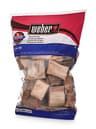
Weber Hickory Wood Chunks, 4 lb (17148)

Weber Hickory Wood Chunks, 4 lb (17148)

The small bag that turns a charcoal grill into a smoker. Two or three fist-sized hickory chunks buried in a lit charcoal bed give you hours of clean smoke — you do not need a smoker to smoke, and you do not need wood chips, which burn out in ten minutes. A 350-cubic-inch bag lasts most people a whole season of weekend cooks.

Best first bag of smoking wood
$10.99 · View on Amazon

$13.9921% off

Price as of September 8, 2026. #ad How we’re funded

2
Western Premium BBQ Products Hickory BBQ Cooking Chunks, 570 cu in (78055)

Western Premium BBQ Products Hickory BBQ Cooking Chunks, 570 cu in (78055)

The bigger box, for people who actually smoke rather than occasionally add a chunk. 570 cubic inches is well over half again the volume of the small bags, and the chunks run large enough to smolder properly rather than catching fire. If you own a bullet smoker or an offset, buy this size and stop reordering.

Best value in bulk
$21.55 · View on Amazon

$22.675% off

Price as of September 8, 2026. #ad How we’re funded

3
Jealous Devil Chunx XL Lump Charcoal (35 lb)

Jealous Devil Chunx XL Lump Charcoal (35 lb)

The lump serious cooks reach for. Big, dense South American hardwood chunks that burn hot, run long and throw very little ash or spark — which is exactly what you want in a kamado or for a hard sear. It costs more than grocery-store lump, but a 35-lb bag of big chunks goes a long way.

The charcoal to burn it on
$52.99 · View on Amazon

Price as of September 8, 2026. #ad How we’re funded

#1Best first bag of smoking wood

Weber Hickory Wood Chunks, 4 lb (17148)

The small bag that turns a charcoal grill into a smoker. Two or three fist-sized hickory chunks buried in a lit charcoal bed give you hours of clean smoke — you do not need a smoker to smoke, and you do not need wood chips, which burn out in ten minutes. A 350-cubic-inch bag lasts most people a whole season of weekend cooks.

What’s good

  • Chunks, not chips — they smolder for hours instead of flaring out
  • 350 cu in bag is enough for a season of weekend cooks
  • Hickory is the safest all-round choice for pork, beef and poultry
  • Cheapest possible upgrade to the flavor of a charcoal cook

Trade-offs

  • Hickory turns acrid if you overload it — two or three chunks is plenty
  • Small bag; heavy smokers will get through it faster than a bulk box
TypeSmoking wood chunks
WoodHickory
Bag size4 lb / 350 cu in
Best forPork, beef and poultry on a charcoal grill

Specs read from the product listing, on August 11, 2026. “Not published” means the maker doesn’t state that figure there.

#2Best value in bulk

Western Premium BBQ Products Hickory BBQ Cooking Chunks, 570 cu in (78055)

The bigger box, for people who actually smoke rather than occasionally add a chunk. 570 cubic inches is well over half again the volume of the small bags, and the chunks run large enough to smolder properly rather than catching fire. If you own a bullet smoker or an offset, buy this size and stop reordering.

What’s good

  • 570 cu in — considerably more wood per dollar than a small bag
  • Chunks are cut large enough to smolder rather than flare
  • Works in charcoal, gas and electric cookers alike
  • Hickory is the standard for pork and beef barbecue

Trade-offs

  • Too much wood if you only smoke two or three times a year
  • Box takes real shelf space and must be kept dry
TypeSmoking wood chunks
WoodHickory
Box size570 cu in / 6.5 lb
Best forBullet smokers and offsets on long cooks

Specs read from the product listing, on August 11, 2026. “Not published” means the maker doesn’t state that figure there.

#3The charcoal to burn it on

Jealous Devil Chunx XL Lump Charcoal (35 lb)

The lump serious cooks reach for. Big, dense South American hardwood chunks that burn hot, run long and throw very little ash or spark — which is exactly what you want in a kamado or for a hard sear. It costs more than grocery-store lump, but a 35-lb bag of big chunks goes a long way.

What’s good

  • Dense hardwood burns hotter and longer than cheap lump
  • Very low ash and almost no sparking or popping
  • Big XL chunks are easy to arrange for a long, controlled burn

Trade-offs

  • Priciest lump here — overkill for a quick weeknight burger
  • Big pieces can need breaking up for a small grill
TypeLump hardwood (XL chunks)
Bag weight35 lb
Best forSearing, kamados, long high-heat cooks
Ash / sparkingVery low (per listing)

Specs read from the product listing, on July 21, 2026. “Not published” means the maker doesn’t state that figure there.

Frequently asked questions

Is wood better than charcoal for grilling?

Not for grilling, no. Wood burns with flames and a shifting temperature until it breaks down to coals, which is the opposite of what searing a steak needs. Charcoal is already at the coal stage, so it gives you steady radiant heat straight away. Wood's advantage is flavor on long cooks, and you can get that by adding a couple of chunks to a charcoal fire.

Can you use wood instead of charcoal in a grill?

You can, but you need to burn it down to coals first, which takes 45 minutes or more and produces harsh smoke while it's flaming. Most kettle grills also lack the firebox volume to do this well. If you want the wood-fire character on a normal grill, burn charcoal and add wood chunks — you get most of the flavor with none of the hassle.

What's the difference between wood chips, chunks and splits?

Size, and it changes everything. Chips are thin shavings that burn out in ten to fifteen minutes, so they need constant replacing. Chunks are fist-sized and smolder for hours, which is what you want on a charcoal grill or bullet smoker. Splits are full logs used as the primary fuel in an offset firebox, not as an additive.

Do you need to soak wood chunks before smoking?

No. Soaked wood doesn't smoke sooner — it spends the first stretch of time boiling off the water you added, producing steam and delaying the smoke you wanted. Dry chunks placed on or beside the lit coals start smoldering properly much faster. This is one of the most persistent pieces of barbecue folklore and it doesn't hold up.

How much wood should you add to a charcoal fire?

Two or three fist-sized chunks for a normal cook, and less than you think. Smoke is not linear — past a certain point more wood makes food acrid rather than smokier, particularly with strong woods like hickory and mesquite. Aim for thin blue smoke you can barely see; thick white smoke means the wood is smoldering badly and the food will taste bitter.

Is charcoal or wood cheaper?

Charcoal, for a normal backyard cook. A bag lights predictably, burns for hours and needs no processing. Hardwood splits are cheap by weight if you have a source and somewhere dry to season them, but you burn a great deal more of them and an offset smoker gets through a barrow-load on a long cook. Wood chunks used as a flavor additive cost very little per cook.

Sources

Keep reading