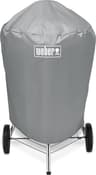
Measure before you buy — three numbers
Grill covers are sold by nominal grill size, and nominal sizes lie. Get a tape measure out and take three figures.
Widest diameter, measured across the bowl at its widest point — including the lid hook, the tool hooks and any handle that sticks out. This is the number people get wrong, because a “22-inch grill” measures nearer 26 to 28 inches across its widest hardware. Every cover on this page states its actual diameter for that reason.
Height from the ground to the top of the lid, with the lid on. A cover that’s tall enough to reach the wheel axles is what stops wind getting underneath.
Anything permanently attached. A side table, a work surface, an ash bucket bracket or a charcoal storage rack changes the shape entirely. Weber’s own covers explicitly note whether they fit models with a side table, and most generic 22-inch covers do not.
A cover an inch or two larger than your measurements is fine. One that is tight will not go on when the grill is cold, let alone with a warm lid, and it will tear at the seams within a season.
Waterproof vs breathable: the real trade-off
This is the one genuine technical decision, and both answers are defensible.
A fully waterproofcover — typically polyester with a PVC or vinyl coating — keeps every drop out. It also keeps moisture in. If you cover a grill that’s still slightly warm or still damp inside, that water has nowhere to go and you have built a small greenhouse around your steel. People who do this find surface rust on the grate and a musty grill after a wet fortnight.
A breathable water-resistantcover — heavy polyester without a full impermeable coating, which is what Weber uses — sheds rain but lets vapor escape. In sustained heavy rain a little damp can get through; in normal use it keeps the grill drier overall because it never traps anything.
Our read: breathable is the safer default, and waterproof is better if you live somewhere genuinely wet andyou’re disciplined about only covering a cold, dry grill. Either way, the habit matters more than the fabric.
Straps, and why cheap covers blow away
A grill cover is a large sail on a round object. Without fastening it will be in your neighbor’s garden by February.
One pair of straps under the bowl is the minimum and is what most covers ship with. Two pairsis meaningfully better in exposed positions — the Unicook cover on this page makes a point of it, and it’s a real advantage rather than a marketing line. A bottom hook-and-loop strap, as on the iCOVER, does a similar job cheaply.
Also look for fabric handles. Pulling a cover off by gripping the fabric itself stresses the seams and eventually tears them; sewn handles distribute that load and make the whole thing a two-second job rather than a wrestle.
How to actually use one
Four rules, and the first one is not negotiable.
Never cover a warm grill.Charcoal holds live embers for well over 24 hours, and a cover over a grill with heat still in it is a fire risk and a melted cover. Wait until the grill is cold to the touch — not warm, cold.
Empty the ash first. Ash is hygroscopic; it pulls moisture out of the air and holds it against the bottom of the bowl. A covered grill with a full ash catcher rusts faster than an uncovered empty one. Emptying the ash after every cook is the single best maintenance habit there is, and our cleaning guide covers the rest of the routine.
Let it dry before covering.After rain, or after you’ve hosed the grill down, give it time in the air. This matters much more with a fully waterproof cover than a breathable one.
Take it off occasionally. On a grill that sits unused for months, air it out every few weeks. Nothing under a cover for a whole winter comes out well.
Covers for smokers and barrel grills
Everything above applies, with two additions.
Bullet smokers need their own cover. A Weber Smokey Mountain is a tall cylinder, not a kettle shape, and every 22-inch kettle cover on this page explicitly does not fit one. Buy the shape, not the diameter.
Barrel and offset grills matter more.These are usually painted rather than porcelain-enameled steel, so they are far more vulnerable to weather — a cover extends the life of a painted barrel grill proportionally much more than it does a Weber kettle. Measure the full width including the firebox and any shelves, which on an offset can be five or six feet.
Is an expensive cover worth it?
Modestly. The step from no cover to any cover is enormous. The step from a ten-dollar cover to a forty-dollar one buys UV-stabilized fabric that doesn’t fade or go brittle in sunlight, better stitching, and a longer warranty — three years on Weber’s premium version versus two on the standard and none on most generics.
The honest calculation: if your grill lives in full sun, the UV-resistant fabric genuinely lasts several times longer and is worth the money. If it sits under an eave, in a shaded corner or against a north wall, a cheap cover replaced every couple of seasons costs less and protects just as well. Buy for your position, not for the spec sheet.