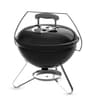
The lid lock is the whole product
Every genuinely portable charcoal grill solves the same problem in one of two ways. Weber’s Go-Anywhere folds its legs up and over the lid, clamping the whole thing shut into a flat box with a handle. The Joe series uses a “Tuck-N-Carry” catch that hooks the lid down over the bowl and doubles as a lid holder while you cook. Cheaper grills like the GasOne use a three-point catch around the rim.
All three work. What doesn’t work is a grill with no catch at all, because a loose lid means you either carry it separately — two hands, in a car park, with a hot grill — or you accept that the lid will slide off and dump ash in your boot. If a listing doesn’t mention a lid lock, assume there isn’t one.
How much grill do you actually need?
Be honest about the group. Two peopleare served fine by 140-160 square inches — a Go-Anywhere or a Smokey Joe. Four people want closer to 240, which is Jumbo Joe territory. Six or more and you are past what a carryable grill can do in one round; you either cook in two waves and rest the first batch, or you bring a full-size grill.
The rectangular grate on the Go-Anywhere deserves a specific mention. Round grates waste their edges — you can’t lay a hot dog across the last inch of a circle. A rectangle of the same nominal area fits noticeably more food in practice, which is why we rank it above round grills with similar figures on paper.
Charcoal, fuel and the trip itself
The single biggest mistake with a portable grill is bringing a full-size chimney and a 16 lb bag of briquettes. Neither fits the job. Bring a compact chimney— it matches the fuel load a small grill wants and packs inside most of these grills. Our chimney starter picks include the compact version specifically for this.
For fuel, briquettes are the more sensible travel choice than lump. They pack denser, they don’t shed as much dust in a bag, and their even sizing means a small grill’s shallow bed burns predictably. Lump burns hotter and is better on a big grill; on 150 square inches, hotter is rarely the problem. We compare the two properly in lump vs briquettes.
Two practical rules for the trip. First, light the chimney on something that can’t burn— a paving slab, a fire pit, bare earth, never dry grass or a wooden picnic table. Second, plan how you’ll get home with hot ash. The realistic answer is: don’t. Douse the coals thoroughly with water and leave them, or bring a metal tin with a lid. Charcoal holds live embers for well over 24 hours, and a bag of “cold” ash in a car boot is a genuine fire risk.
Food safety when you’re cooking away from a kitchen
Tailgating and camping remove the two things a home cook takes for granted: a fridge and a sink. USDA guidance for grilling away from home is worth following literally. Keep raw meat in a cooler at 40°F or below with ice packs, transport it in a separate cooler from drinks (which get opened constantly), pack a spare set of clean plates and utensils so cooked food never touches a surface raw meat sat on, and bring a thermometer— in bright outdoor light, judging doneness by eye is even harder than usual.
The temperatures don’t change because you’re in a field: 165°F for all poultry, 160°F for ground meat, 145°F with a three-minute rest for whole cuts of beef and pork. And cooked food shouldn’t sit out more than two hours — one hour if it’s above 90°F.