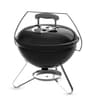
What a hundred dollars actually buys
Three things, in this order of importance.
A lid that seals.This is the specification that separates the picks here from everything else at the price. Charcoal is controlled by airflow, and airflow can only be controlled if the air is going where you send it. A domed lid sitting in a rolled rim — the kettle design — seals well enough that closing the vents genuinely slows the fire. A flat lid resting on a flat barrel leaks everywhere, which is why cheap barrels burn through fuel and cannot hold a low temperature.
Porcelain-enameled steel.Enamel is glass fused to steel. It does not need painting, it does not blister, and it does not rust where the finish has flaked — because it does not flake. Painted thin steel, the alternative at this price, starts rusting the first season at the hottest point of the bowl.
Parts you can still buy. Unglamorous and decisive. Grates, ash catchers, dampers and handles for the small Webers are stocked everywhere and cost a few dollars. When the grate on an unbranded barrel rusts, the grill is finished.
What it doesn't buy
Size. Nothing on this page will cook for eight people in one go. The largest here is an 18-inch bowl; a 22-inch kettle has roughly half as much area again. If you routinely feed a crowd, this is the wrong budget and the honest answer is to save for the under-$200 tier.
A hinged grate. On a small grill you lift the whole grate to add coals, usually with food on it. Long gloves solve this. A hinged grate arrives at around the $300 mark.
A lid thermometer.Not fitted at this price, and honestly not much of a loss — lid thermometers read the air at the top of the dome rather than the temperature at the grate. An instant-read thermometer costs very little and tells you what actually matters, which is the temperature of the food.
Serious low-and-slow. A small bowl holds a small fire, and a small fire cannot run for eight hours. Two to three hours of indirect cooking is realistic; ribs are possible with a mid-cook top-up; brisket is not. That is a smoker job.
How to cook well on a small grill
The technique that makes an 18-inch or 14-inch grill feel much larger is batching. Do not try to fit everything on at once. Cook the food that takes longest first, move it to a covered plate — meat rests better than it sits on a grate anyway — and use the free space to cook the rest. A small hot fire cooks faster than a big lukewarm one, so two rounds on a good small grill are often quicker than one crowded round on a big cheap one.
You can still build a two-zone fire in a small bowl. Bank the coals against one side, leave a third of the grate empty, and use the empty part exactly as you would on a larger grill: for anything that flares, for finishing thick pieces, and as somewhere to park food while something else sears. Our how to use a charcoal grill guide covers the layout, and it scales down fine.
Two accessories matter more at this price than at any other. A chimney starter— a compact one, since a full-size chimney lights more coal than these grills can use — and a cover, because the difference between a covered and uncovered budget grill is measured in years.
Should you buy used instead?
Often, yes, and this is the one budget where we would genuinely say so. A used full-size 22-inch kettle in usable condition regularly sells for less than a new grill at this price, and kettles are almost infinitely repairable: grates, handles, dampers and ash catchers are all inexpensive spares.
What to check. The bowl: surface rust and burnt-off enamel on the inside are cosmetic and normal; holes are not, and a bowl that flexes when squeezed is done. The rim: the lid should sit evenly all the way round, because that seal is the whole point. The vents: both dampers should move freely; seized ones can usually be freed. Everything else you can replace for pocket money.
Buying new is still the right call if you want a warranty, a known history, and no weekend spent scrubbing someone else’s ash out of a bowl. Both answers are defensible — what is not defensible is spending a hundred dollars on a new grill that will be scrap in two seasons.
What we'd avoid at this price
Large unbranded barrel grills. Thin painted steel, no seal, a thermometer that reads the wrong thing, and no spare parts. They photograph well next to the small kettles and they are the reason so many people conclude that charcoal is fiddly.
Anything with no name at all on the lid. Not snobbery. Grills that arrive under a rotating series of brand names are not supported by anyone the year after you buy them.
Grills with the vents in the wrong places. You need an intake at the bottom and an exhaust at the top; that is what makes the airflow controllable. Some very cheap grills have a single vent, or fixed holes, which means the fire runs at whatever temperature it feels like.
Bundles that include lighter fluid. A small point, but a telling one. Spend that part of the budget on a chimney and wax starters instead.
Where the next hundred dollars goes
If you can stretch, here is exactly what the money buys, in order. At around $150-200you reach a full-size 22-inch kettle — the single biggest jump in usefulness on the whole ladder, and enough grill for most households for life. At $300 you add a hinged grate, a lid thermometer and a proper ash system. At $500 you are choosing between insulated kamado-style cookers and real offset smokers.
What none of that buys is better food. A hot fire under a good lid cooks a steak beautifully whether the bowl is fourteen inches or twenty-six. This budget is about how many people you can feed at once and how long the grill lasts— not about how good dinner tastes.