Length is the whole thing
If you remember one number: 16 inches. That is the length at which your hand sits comfortably outside the radiant heat of a full bed of charcoal while you still have enough control to turn something delicately.
Shorter than about 14 inches and you are cooking with your knuckles in the heat, which is unpleasant on a kettle and genuinely uncomfortable on a barrel grill with a big fire. Longer than about 18 and leverage starts working against you — the tips flex, you lose the fine feel needed to pick up a sausage without crushing it, and the tongs become awkward on a small grill.
The exception is fire management. If you regularly rake coals, move a chimney or reposition a hot grate, a longer pair — 17 or 18 inches — earns its place as a second tool. Plenty of experienced charcoal cooks keep a cheap long pair for the fire and a shorter, more precise pair for the food, and that is a genuinely good setup.
The head shape nobody mentions
Look at the business end. There are broadly three designs and they behave very differently.
Scalloped or fan-shaped pincers— a broad, slightly cupped head with shallow serrations. This is the best all-round shape. It grips a chicken thigh or a burger securely across a wide area without puncturing it, and the cupping means round things like sausages don’t squirt out sideways.
Sharp-toothed pincerslook aggressive and are worse. Deep teeth pierce the surface of the meat, which releases juice onto the coals and causes flare-ups — and on anything delicate they tear.
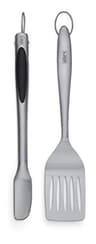
Flat paddle ends are for serving, not grilling. They have no grip on anything round or heavy.
Locking, springs and the drawer problem
A locking mechanism sounds trivial until you own tongs without one. Spring tongs sit permanently open, which means they take up an absurd amount of drawer space and tangle with everything. A pull-ring or slide lock collapses them flat for storage.
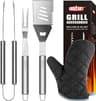
The counterpoint, and the reason some good tongs deliberately omit it, is that lock mechanisms are the part that fails — and a lock that engages by accident while you are holding a hot steak is worse than no lock at all. The GRILLART set on this page makes exactly that argument and it’s a reasonable one. Either approach is fine; a cheap, flimsy lock is not.
On the spring itself: you want firm rather than stiff. Tongs that need real hand strength to close are exhausting over a long cook, and tongs with no resistance give you no feedback about how hard you’re gripping.
Handles: what to avoid
Silicone and rubber gripsare comfortable and they are the first thing to fail. Left on a hot grill lid or too close to the fire, they soften, deform and eventually turn tacky — and once a rubber handle goes sticky it never comes back. If you buy soft-handled tongs, make a habit of never resting them on the grill.
All-stainless handles solve that permanently and are dishwasher-proof forever. The trade is that bare steel conducts, so if you leave them lying across a hot lid the handle gets hot. Given that you should not be leaving tongs on the grill anyway, we think all-stainless is the better long-term buy on a charcoal grill.
Wooden handleslook lovely, feel good, and cannot go in a dishwasher. Fine if you’ll hand-wash; a slow disaster if you won’t.
What else is worth owning — and what isn’t
Since the argument here is against buying sets, it’s fair to say what the short list actually is. Tongs. A wide spatula, if you cook burgers or fish. A stiff grate scraper. That’s it for tools.
The rest of your money is far better spent on things that change outcomes: a chimney starter, which eliminates lighter fluid entirely; a thermometer, which is the only way to know food is safely cooked; and long-cuff gloves, which let you handle a hot chimney or reposition a grate without ceremony.
One tool we’d specifically avoid: the meat fork that comes in every set. Piercing meat to turn it releases juice into the fire, which flares up and chars the outside. Use tongs.
And a genuine safety note on brushes: wire-bristle grill brushes can shed bristles that end up in food. If you use one, inspect the head regularly and wipe the grate with a folded paper towel afterwards, or use a bristle-free scraper instead. We cover the whole cleaning routine in our guide to cleaning a charcoal grill.
Buying tongs as a gift
Tongs are a good gift and sets are a tempting one, so a word on that. The set that works as a present is a smallone — two or three quality pieces in decent packaging — because the recipient will use all of it. The 19-piece aluminum briefcase looks generous and gets opened twice.
If you want to spend more, spend it on a better version of a tool they will actually use every cook, or pair a good pair of tongs with something they probably don’t own: a chimney starter or a two-probe thermometer are both far more transformative than another spatula.