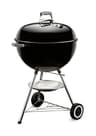
Under about $200, nearly every charcoal grill worth buying is one of two shapes. A kettle is a round bowl with a domed lid: the Weber design, copied by Char-Griller and others. A barrel is a horizontal drum cut in half with a hinged lid: the Char-Griller Patio Pro, the Royal Gourmet barrels, the big Pro Deluxe, and every grill-and-offset combo. They cost about the same money. They cook quite differently, and which is better depends almost entirely on how you cook.
This is that decision, reasoned from the specs on the listings and the way each shape handles fire. We have a clear preference; we have tried to be fair to the other shape, because for some cooks it is the right answer.
The short answer
Buy a kettle if you want the easiest fire to control, the least charcoal per cook, the option to smoke, and a grill that lasts a decade. Buy a barrel if you need more grate area for the money, you sear a lot and want an adjustable charcoal pan, you want a side firebox, or you want shelves and a work surface built in. If none of that describes you, the kettle is the default, and the plain Weber is the one we would buy.
Kettle vs barrel in one table
| | Kettle | Barrel |
|---|
| Lid seal | Domed lid drops into a round bowl — near airtight | Long flat seam on a hinge — leaks along its length |
| Fuel use | Lower; the vents are in charge | Higher; leaks feed the fire and thin steel sheds heat |
| Temperature control | Two vents, predictable response | Dampers help, but leaks make them less decisive |
| Searing | Bank coals on one side; grate height fixed | Adjustable charcoal pan on many models raises the coals |
| Grate per dollar | 363 sq in on a 22-inch kettle | Often 550+ sq in of main grate at similar money |
| Smoking | Yes, banked coals or the snake method | Yes, via a side firebox on offset models |
| Cleanup | One-touch sweep and ash catcher (Weber, Char-Griller) | Varies: ash pans on the better ones, tipping on the cheapest |
| Work surface | None on the classic kettle | Side and front shelves are standard |
| Warranty at this price | 10 years stated on the Weber | 1 year, or not published, on the budget barrels |
Fuel and control: why the lid decides it
The single biggest difference is not the shape of the grate. It is that a kettle lid seals and a barrel lid does not. A kettle’s domed lid sits inside the rim of the bowl, so the only air reaching the fire comes through the bottom vent and leaves through the top one. Close the bottom vent halfway and the fire actually slows. That is what makes the kettle the easiest charcoal grill to learn on, and why our beginner grill pick is always a kettle.
A barrel’s lid is a long hinged flap, and the seam where it meets the body leaks air along its entire length. The Royal Gourmet and Char-Griller listings both say so in their own way: seal the gaps, expect to tend the fire, expect heat loss in wind. The dampers still work, but they are fighting a leak they cannot close. High-temperature gasket tape along the rim is the fix, and it is the first thing in our cheap grill upgrades list for a reason.
Searing and space: where the barrel wins
The barrel’s answer is a feature the kettle does not have at any price: an adjustable charcoal pan. The Patio Pro and the CC1624W both let you crank or lift the fire grate so the coals sit a few inches under the meat, which is where a steakhouse-style crust comes from. A kettle fixes its coals well below the grate; it sears fine with all the coals banked to one side, but it cannot raise them. If searing is your priority, our steak grill roundup is led by a barrel for exactly this reason.
The second win is floor. A 22-inch kettle is 363 square inches and that is the end of it. Barrel grills at similar money routinely offer 550 square inches or more of main grate plus a warming rack, and the combos add a firebox. If you cook for eight or more every weekend, the barrel gives you the space; if that describes two weekends a year, a kettle in two batches is the better everyday grill. Our large grills page goes through the big barrels and is honest about how much of each headline number is warming rack.
Smoking on each
Both shapes smoke. A kettle does it with coals banked to one side or laid in a snake around the edge, two or three wood chunks, and the lid on with the top vent over the food; it holds the USDA’s 225-300°F smoking band for hours on a single load and our smoking on a charcoal grill guide is written around it. A barrel with a side firebox smokes with the fire in a separate chamber, which gives more room for the food and a more traditional offset flow, at the cost of more fire-tending and more fuel. If smoking is the main reason you are buying, the honest comparison is not kettle versus barrel but kettle versus dedicated smoker.
Cleanup and lifespan
Ash is the daily chore and the shape matters. A Weber kettle sweeps ash through the bottom into a catcher with one motion; the Char-Griller kettle has a dump pan and bucket that the listing is fair to call better still. Cheap barrels vary from a pull-out pan on the better ones to tipping the whole grill on the worst, and a grill that is a pain to empty is a grill you stop using.
Lifespan follows the steel. The plain Weber states a 10-year warranty on the listing; the budget barrels state a year or nothing, and their thinner steel rusts sooner if it sits uncovered. A cover and the two-minute routine in how to clean a charcoal grill close most of that gap, and a barrel that is looked after will give you years. But at the same money, the kettle is the safer long-term buy.
Which one for how you cook
- Weeknight burgers, chicken, the odd weekend smoke, four to six people: a kettle. The plain Weber if you can, the Char-Griller kettle if the badge does not matter to you — our Char-Griller vs Weber comparison is that decision.
- Steak most weekends, and you care about the crust: a barrel with an adjustable pan and cast-iron grates. The Patio Pro is the cheap one.
- Big groups every weekend: a barrel, for the floor. Budget for the extra charcoal and the gasket tape.
- Grilling and smoking on one cooker, tight budget: a barrel with an offset firebox. The CC1624W is the cheapest we would stand behind; the combo roundup has the rest.
- First grill, learning from scratch: a kettle, without hesitation.
On either shape, buy a chimney starter and an instant-read thermometer with the grill. They matter more than the shape does, and they are the difference between a cheap grill that cooks well and a cheap grill that gets blamed for the cook.