Coal & Char

Best Wood Burning Stoves

Freestanding stoves, inserts and tent stoves — heating area, blowers, EPA certification and the install costs nobody quotes you.

By Stephen V.Last updated How we pick

For most houses the right buy is the US Stove US1100E-BL — 1,200 square feet rated, with a blower. The blower is the reason. A wood stove without a fan heats by radiation, which means the room it stands in gets hot and the next room stays cold. A fan pushes that heat out into the house and makes a 1,200 square foot rating behave much more like 1,200 square feet. If you are heating a genuinely large house, step up to the Ashley Hearth AW2020-P at 2,000 square feet.

Before any of that, the unwelcome part: the stove is the cheap bit. A freestanding wood stove needs a code-compliant flue, a hearth pad, correct clearances from combustibles and, in most jurisdictions, a professional installation and an inspection. That package routinely costs more than the appliance. An insert — a stove that drops into an existing masonry fireplace — additionally needs a correctly sized liner up the existing chimney and a sweep’s inspection first. Nobody quotes you that on a product page, so we are saying it here.

The other thing worth knowing before you shop is what EPA-certifiedmeans, because it is on every box. Under the 2020 New Source Performance Standard a new residential wood heater must meet 2.0 grams per hour tested with crib wood, or 2.5 grams per hour tested with cord wood; stoves certified under the earlier 2015 standard met 4.5 grams per hour. The EPA notes that cord wood — ordinary firewood — is the better measure of how a heater will actually perform in a home. Full explanation in EPA-certified wood stoves explained.

This hub also covers tent stoves— packable stainless and steel stoves for hot tents and ice shelters, which are a completely different product that happens to share a name. If that is what you are here for, go straight to the tent stove picks, and read the carbon monoxide section when you get there, because in a sealed shelter that is the part that can kill you.

How this is funded:we earn a commission if you buy through our links, at no extra cost to you. It never changes which pit or heater we recommend, and we’ll tell you when we’d skip one. Full disclosure.

Quick picks

Ranked on published specs, beginner-friendliness and value. Select a row to jump to the full write-up. We haven’t cooked on every one of these — here is exactly what we do instead.

#ProductBest forPrice
1
US Stove US1100E-BL 1,200 sq ft Wood Stove with Blower

US Stove US1100E-BL 1,200 sq ft Wood Stove with Blower

The blower is the reason to pick this one. A wood stove without a fan heats by radiation, which means the room it is in gets hot and the next room stays cold; a blower pushes that heat out into the house and makes a 1,200 square foot rating behave much more like 1,200 square feet. US Stove is a mainstream brand and this sits at a sensible price for a mid-size stove. It still needs a proper flue, a hearth pad and a code-compliant install.

Best overall
$1,029.27 · View on Amazon

Price as of October 7, 2026. #ad How we’re funded

2
Ashley Hearth AW2020-P 2,000 sq ft Wood Stove

Ashley Hearth AW2020-P 2,000 sq ft Wood Stove

A 2,000 square foot rating is whole-house territory, and that is what separates this from the small stoves people buy to warm one room. It ships with both legs and a pedestal so you can set it up either way, and Ashley Hearth is one of the long-standing mainstream US stove brands rather than a marketplace label. Treat the square-footage rating as a maximum under ideal conditions, not a promise — and budget for the flue, the hearth pad and a professional install, which will cost more than the stove.

Best for a whole house
$1,249.99 · View on Amazon

Price as of October 7, 2026. #ad How we’re funded

3
Cleveland Iron Works Single Burn Rate Wood Stove

Cleveland Iron Works Single Burn Rate Wood Stove

A single-burn-rate stove is a deliberately simple design: one air setting, no damper fiddling, built to run at the rate it was certified at. For a cabin, a workshop or a garage that is often exactly what you want — fewer controls to get wrong and fewer ways to smoulder a stove into a creosote problem. It is the cheapest stove from a recognised brand here, and the simplicity is the reason.

Best simple cabin stove
$399.99 · View on Amazon

Price as of October 7, 2026. #ad How we’re funded

4
US Stove US1800E 1,200 sq ft Wood Fireplace Insert

US Stove US1800E 1,200 sq ft Wood Fireplace Insert

An insert, not a freestanding stove — it goes into an existing masonry fireplace and turns it from a hole that loses heat into something that actually warms the room. That is the single best upgrade available to a house with an open fireplace, and the reason it is here. It is also the hardest install on this page: an insert needs a correctly sized liner up the existing chimney and a sweep's inspection first. Get a professional involved before you order.

Best fireplace insert
$1,499.99 · View on Amazon

Price as of October 7, 2026. #ad How we’re funded

5
Guide Gear Outdoor Wood Burning Stove with Chimney Pipe

Guide Gear Outdoor Wood Burning Stove with Chimney Pipe

The long-running default camp stove, and the one most hot-tent users have either owned or borrowed. It is heavier and plainer than the stainless imports, which is the point — thicker steel takes a season of being thrown in a truck better than thin stainless does. The chimney pipe is included. Like every tent stove it demands a stove jack, real clearances and a carbon monoxide alarm in the shelter.

Best tent stove
$159.99 · View on Amazon

Price as of October 7, 2026. #ad How we’re funded

6
US Stove BSK1000 Barrel Camp Stove Kit

US Stove BSK1000 Barrel Camp Stove Kit

Not a stove — a kit of cast iron door, legs and flue collar that you bolt to a steel drum you supply. That is why it costs seventy dollars instead of seven hundred. For a workshop, a barn or a sugar shack where a certified appliance is not required and you have a suitable drum, it is the cheapest heat per dollar in existence. It is also unsuitable for a living space, and local code almost certainly will not permit it in one.

Cheapest workshop heat
$72.28 · View on Amazon

Price as of October 7, 2026. #ad How we’re funded

The picks in full

#1Best overall

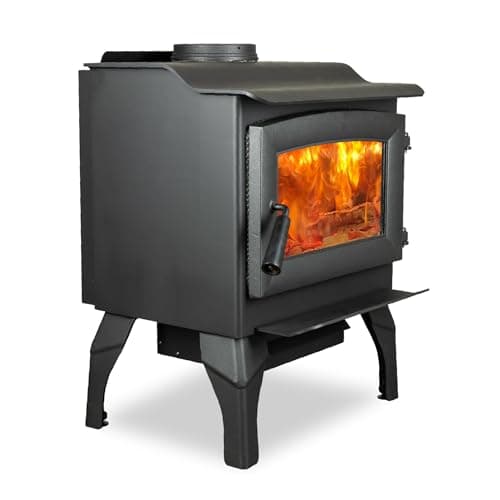
US Stove US1100E-BL 1,200 sq ft Wood Stove with Blower

The blower is the reason to pick this one. A wood stove without a fan heats by radiation, which means the room it is in gets hot and the next room stays cold; a blower pushes that heat out into the house and makes a 1,200 square foot rating behave much more like 1,200 square feet. US Stove is a mainstream brand and this sits at a sensible price for a mid-size stove. It still needs a proper flue, a hearth pad and a code-compliant install.

What’s good

  • Blower included — heat actually reaches adjoining rooms
  • 1,200 sq ft rating suits most single-storey homes or large open plans
  • Mainstream US brand with available spares
  • Priced below the 2,000 sq ft stoves by a clear margin

Trade-offs

  • Blower needs mains power — it does nothing in an outage
  • Flue and install costs are on top, as with any stove
  • Fan noise is audible in a quiet room
  • Emissions rating is not published on this listing
TypeFreestanding wood-burning stove with blower
Heating area1,200 sq ft (per the listing)
BlowerIncluded, per the listing
ModelUS1100E-BL
Emissions ratingNot published on this listing

Specs read from the product listing, on October 7, 2026. “Not published” means the maker doesn’t state that figure there.
#2Best for a whole house

Ashley Hearth AW2020-P 2,000 sq ft Wood Stove

A 2,000 square foot rating is whole-house territory, and that is what separates this from the small stoves people buy to warm one room. It ships with both legs and a pedestal so you can set it up either way, and Ashley Hearth is one of the long-standing mainstream US stove brands rather than a marketplace label. Treat the square-footage rating as a maximum under ideal conditions, not a promise — and budget for the flue, the hearth pad and a professional install, which will cost more than the stove.

What’s good

  • 2,000 sq ft heating rating — the largest here
  • Ships with both legs and pedestal, so the install can go either way
  • Established US hearth brand with dealer parts support
  • Large firebox means longer burns between reloads

Trade-offs

  • Flue, hearth pad and professional installation cost more than the stove
  • Far too much stove for a single room — it will cook you out
  • Heavy: this is a delivery-and-two-people item
  • Check your local code and insurer before buying any wood stove
TypeFreestanding wood-burning stove
Heating area2,000 sq ft (per the listing)
MountingLegs and pedestal both included, per the listing
ModelAW2020-P
Emissions ratingNot published on this listing

Specs read from the product listing, on October 7, 2026. “Not published” means the maker doesn’t state that figure there.

#3Best simple cabin stove

Cleveland Iron Works Single Burn Rate Wood Stove

A single-burn-rate stove is a deliberately simple design: one air setting, no damper fiddling, built to run at the rate it was certified at. For a cabin, a workshop or a garage that is often exactly what you want — fewer controls to get wrong and fewer ways to smoulder a stove into a creosote problem. It is the cheapest stove from a recognised brand here, and the simplicity is the reason.

What’s good

  • One air setting — very little to get wrong
  • Cheapest branded freestanding stove in this group
  • Simple designs have fewer parts to fail
  • Suits intermittent cabin or workshop use

Trade-offs

  • No low-and-slow setting — you get the burn rate it was built for
  • Heating area is not published on this listing
  • Still needs a code-compliant flue and hearth pad
  • Less refined finish than the mainstream hearth brands
TypeFreestanding single-burn-rate wood stove
Burn controlSingle burn rate, per the listing
Heating areaNot published
Emissions ratingNot published on this listing

Specs read from the product listing, on October 7, 2026. “Not published” means the maker doesn’t state that figure there.

#4Best fireplace insert

US Stove US1800E 1,200 sq ft Wood Fireplace Insert

An insert, not a freestanding stove — it goes into an existing masonry fireplace and turns it from a hole that loses heat into something that actually warms the room. That is the single best upgrade available to a house with an open fireplace, and the reason it is here. It is also the hardest install on this page: an insert needs a correctly sized liner up the existing chimney and a sweep's inspection first. Get a professional involved before you order.

What’s good

  • Turns a heat-losing open fireplace into a real heat source
  • 1,200 sq ft rating from a space you already have
  • No floor space lost — it sits in the existing opening
  • Mainstream brand with available spares

Trade-offs

  • Needs a correctly sized chimney liner — a significant extra cost
  • Requires a sweep's inspection of the existing chimney first
  • Hardest installation of any product on this site
  • Useless unless you already have a suitable masonry fireplace
TypeWood-burning fireplace insert
Heating area1,200 sq ft (per the listing)
ModelUS1800E
InstallationRequires an existing masonry fireplace and a liner

Specs read from the product listing, on October 7, 2026. “Not published” means the maker doesn’t state that figure there.

#5Best tent stove

Guide Gear Outdoor Wood Burning Stove with Chimney Pipe

The long-running default camp stove, and the one most hot-tent users have either owned or borrowed. It is heavier and plainer than the stainless imports, which is the point — thicker steel takes a season of being thrown in a truck better than thin stainless does. The chimney pipe is included. Like every tent stove it demands a stove jack, real clearances and a carbon monoxide alarm in the shelter.

What’s good

  • Heavier steel survives rough handling better than thin stainless
  • Chimney pipe included per the listing
  • Long-established model with a wide accessory range
  • Flat top is usable as a warming surface

Trade-offs

  • Heavy to pack compared with stainless camping stoves
  • Painted steel will discolour in the first burn, as expected
  • Needs a stove jack and proper clearances
  • Carbon monoxide alarm required in any enclosed shelter
TypePortable outdoor / tent wood stove
MaterialSteel
IncludedChimney pipe, per the listing
Firebox volumeNot published on this listing

Specs read from the product listing, on October 7, 2026. “Not published” means the maker doesn’t state that figure there.

#6Cheapest workshop heat

US Stove BSK1000 Barrel Camp Stove Kit

Not a stove — a kit of cast iron door, legs and flue collar that you bolt to a steel drum you supply. That is why it costs seventy dollars instead of seven hundred. For a workshop, a barn or a sugar shack where a certified appliance is not required and you have a suitable drum, it is the cheapest heat per dollar in existence. It is also unsuitable for a living space, and local code almost certainly will not permit it in one.

What’s good

  • By far the cheapest way to build a usable wood heater
  • Cast iron door and parts, not stamped steel
  • You choose the drum size, so you choose the firebox
  • Long-established kit with decades of use behind it

Trade-offs

  • You must supply a suitable steel drum — it is not a complete stove
  • Not a certified appliance; not for a dwelling, and check local code
  • No emissions rating, no efficiency rating, no warranty on the result
  • Requires real competence to install safely
TypeBarrel stove conversion kit (drum not included)
SizeMedium (per the listing)
MaterialCast iron kit components
CertificationNot a certified appliance

Specs read from the product listing, on October 7, 2026. “Not published” means the maker doesn’t state that figure there.

Go deeper in Wood Stoves

Narrower picks, model reviews and guides for exactly what you’re shopping for.

How to choose a wood stove

Size to the space you want warm, not to the house.The square-footage number on the box is a best case under ideal conditions: an open plan, decent insulation, hardwood at the right moisture, and a stove run hard. An oversized stove is actively worse than an undersized one, because you end up damping it down to avoid cooking everyone out of the room — and a damped-down stove burns dirty, wastes fuel and lays creosote in the flue. We work the sizing through properly in what size wood stove do I need.

Decide whether you want a blower. It is the single biggest practical difference between two stoves of the same rating. A blower moves heat out of the stove room and into the rest of the house, which is what most people actually want. The trade-offs are that it needs mains power, so it does nothing in an outage, and it is audible in a quiet room. For a single-room cabin or a workshop, skip it.

Freestanding, insert or kit.A freestanding stove is the default and the most flexible — it sits on a hearth pad and vents up a new flue. An insert is the right answer only if you already have a masonry fireplace, and it is the hardest install here, but it turns a hole that loses heat into something that actually warms a room. A barrel stove kit — cast iron door, legs and flue collar bolted to a steel drum you supply — is the cheapest heat per dollar in existence and is not a certified appliance; it belongs in a workshop or a barn, not a dwelling, and your local code almost certainly says so.

Feed it properly or none of this works.The EPA is explicit that wood burns best below 20 percent moisture content and that you should season wood for at least six months, stored outdoors, off the ground, with only the top covered — covering the sides traps moisture in the stack. Burning wet wood in a certified stove throws away the certification in practice: you get less heat, more smoke and a flue that needs sweeping far more often. A seasoning routine and a thirty-dollar moisture meter matter more to real-world performance than the difference between any two stoves on this page.

Then check the local rules before you order.Some jurisdictions restrict new solid-fuel appliances, some insurers require a certificate of installation, and some areas have burn-ban days. None of that shows up on a product listing. If you are heating a workshop or a tent rather than a house, the rules are different again — and a carbon monoxide alarm is not optional in any enclosed space with a fire in it.

Frequently asked questions

What is the best wood burning stove?

For most homes, the US Stove US1100E-BL: 1,200 square feet rated and supplied with a blower, which is what actually gets heat out of the stove room and into the rest of the house. For a larger property, the Ashley Hearth AW2020-P at 2,000 square feet. For a cabin or workshop where simple beats adjustable, the Cleveland Iron Works single-burn-rate stove.

What does EPA-certified mean on a wood stove?

It means the heater was independently tested to meet the federal particulate emission limit. Under the 2020 standard that is 2.0 grams per hour tested with crib wood, or 2.5 grams per hour tested with cord wood. Stoves certified under the earlier 2015 standard met 4.5 grams per hour. The EPA notes that cord wood — ordinary firewood — is the better measure of how a stove performs in a real home.

How much does it cost to install a wood stove?

More than the stove, in most cases. A freestanding stove needs a code-compliant flue, a hearth pad, correct clearances and usually a professional install and inspection. An insert additionally needs a correctly sized chimney liner and a sweep's inspection of the existing masonry first. Get a quote for the install before you choose the appliance, not after.

Is a bigger wood stove better?

No — oversizing is the common mistake. A stove too large for the space forces you to damp it down to stay comfortable, and a damped-down stove burns dirty, wastes fuel and lays creosote in the flue faster. Size to the area you genuinely want warm, treat the box's square-footage figure as a best case, and put the saved money toward a blower or a better install.

Can I use a tent stove in a regular tent?

Only in a tent with a proper stove jack, with the clearances the stove's manual specifies, and with a carbon monoxide alarm inside the shelter. A tent stove is a completely different product from a house stove — small firebox, packable chimney, constant feeding — and it is the single most CO-sensitive item on this site. Treat the alarm as part of the stove, not as an accessory.

Sources

  • EPA — EPA-Certified Wood Stoves — The 2020 New Source Performance Standard limit for new residential wood heaters: “2.0 grams per hour if tested with crib wood, or 2.5 grams per hour if tested with cord wood.” The EPA defines crib wood as “cut 2"x4" or 4"x4" lumber that is stapled together” and cord wood as “typical firewood which is a better measure of how a heater will perform in homes.” Stoves certified under the earlier 2015 standards met “a particulate emissions limit of no more than 4.5 grams per hour” (accessed October 7, 2026)
  • EPA Burn Wise — Best Wood Burning Practices — EPA on firewood: “Wood burns best at a moisture content of less than 20 percent,” and “Season wood for at least six months. Be sure to store wood outdoors, off the ground, with only the top covered -- covering the sides traps in moisture.” The same page lists what must never be burned, including household trash, “coated, painted, and pressure-treated wood,” plywood and particle board, driftwood, and “wet, rotted, diseased, or moldy wood” (accessed October 7, 2026)
  • CPSC — Carbon Monoxide Information Center — The US Consumer Product Safety Commission on carbon monoxide: “More than 200 people in the United States die every year from accidental non-fire related CO poisoning associated with consumer products,” and its standing recommendation to “Install battery-operated CO alarms or CO alarms with battery backup on every level of the home and outside sleeping areas” (accessed October 7, 2026)

Elsewhere on Coal & Char